What Are the Prospects for Black Guinea Pig Farming? A Comprehensive Analysis of Economic Value
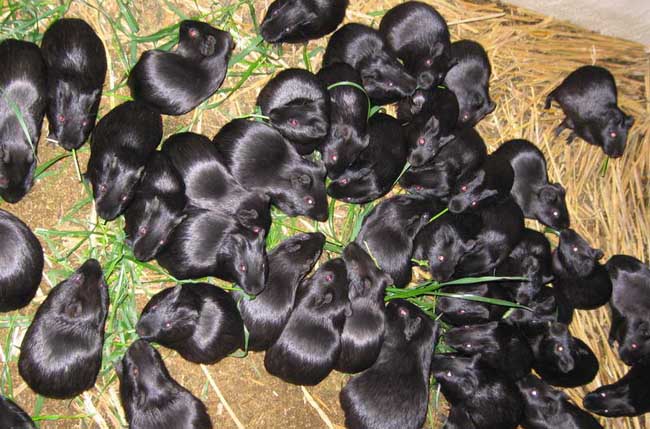
The guinea pig is also known as the cavy, the Dutch pig, and the sea pig. It originated in Peru in South America. It belongs to the class Mammalia and the family Caviidae. The normal lifespan of a guinea pig is 6-7 years. The estrous cycle averages 16 days. The gestation period averages 68 days. When males and females are kept together for life, they can produce about five litters per year, with an average of more than 4 young per litter. Within one hour of birth they can walk, and at around 1 day of age they begin eating pelleted feed while nursing, and they can be weaned at around 15 days of age.
Because guinea pig meat is delicious and the animals are easy to raise, guinea pigs have also become part of the meat farming industry in many countries such as Peru, India, and Thailand (just like households in China raising a few chickens and ducks), and Peru alone produces more than 20 million meat guinea pigs per year.
A few years ago, some breed sellers hyped black guinea pigs heavily, making black guinea pig farming seem like a fraudulent project in the eyes of many people. In addition, a few scholars did not understand the economic value of black guinea pigs, and their evaluations differed from the facts: they said black guinea pigs have no food value. These scholars certainly have never eaten them; if they had, they would not say such things. If they had no food value, then how could guinea pigs be a staple meat in many countries?
The Economic Value of Black Guinea Pigs
1. Black guinea pigs are a high-protein, low-fat, low-cholesterol food. The melanin they contain can scavenge free radicals in the human body and prevent lipid peroxidation, thereby helping to delay aging; their iron content is 3 times that of soft-shelled turtle, and they are also rich in the anti-cancer elements zinc and selenium, while their cholesterol and saturated fatty acid content is very low. They are an ideal nutritional and tonic health food, in line with the new 21st-century consumer trend for natural health-oriented black foods. Because black guinea pig meat is almost entirely muscle, its fibers are more tender than rabbit meat, and it has no gamy or muttony odor, so it has the characteristics of being easy to cook through, easy to soften, and suitable for quick cooking. Black guinea pig meat is sweet in flavor and neutral in nature, and has the effects of replenishing qi and blood and detoxifying, and is used to treat conditions such as physical weakness, kidney deficiency in the elderly, and postpartum anemia. The testicles of black guinea pigs can be used to produce drugs for treating epilepsy, and guinea pig blood can be used to extract the pharmaceutical raw material serotonin.
2. The fur of black guinea pigs is a very good processing material for fur clothing and handicrafts. Its processing performance and decorative performance can compare with mink fur, and it can be used to make fur clothing, shawls, gloves, and a series of guinea pig leather toys. Black guinea pigs can also serve as an ornamental animal, providing pets favored by pet breeders, especially children.
3. Black guinea pigs are small animals with a gentle temperament and are easy to restrain. Their blood is highly useful and convenient to collect, so they can be widely used in experiments in physiology, medicine, immunology, reproduction, and bioengineering. According to reports, Japan, South Korea, China, and other countries all use black guinea pigs as experimental animals, with annual demand of more than several hundred thousand, and domestic demand in the future will far exceed several hundred thousand. Therefore, black guinea pigs are an ideal experimental animal with wide applications.
4. Black guinea pig manure and urine are high-quality organic fertilizer. One adult black guinea pig accumulates 90-120 kg of fertilizer per year. The content of the three major elements nitrogen, phosphorus, and potassium in black guinea pig manure is far higher than in the manure of other livestock and poultry. According to estimates, 100 kg of black guinea pig manure is equivalent in fertilizer effect to 10.92 kg of ammonium sulfate and 1.97 kg of potassium sulfate, and black guinea pig fertilizer can improve soil structure, increase organic matter, and raise soil fertility. Tests in the yellow mud (acidic) soil of Phoenix Mountain in Chengdu, Sichuan Province, showed that yellow mud soil treated with black guinea pig manure increased organic matter by 42.3% and nitrogen content by 43.86%, significantly improving the soil quality and soil structure.
In summary, according to China's national conditions and the advantages of the black guinea pig industry, vigorously developing grain-saving black guinea pig farming has very good prospects. Of course, the key is correct guidance. Hyping breeding stock is not real ability; developing a commodity economy is the future.
Advantages of Black Guinea Pig Farming
1. Black guinea pigs are a wild economic animal whose farming is permitted by the state and whose market is open, so they can circulate smoothly in the market.
2. Black guinea pig meat is delicious, comparable to masked palm civet, and black guinea pigs in particular are herbivores and therefore a green food, with market demand continuously rising.
3. Black guinea pigs have low feeding costs and are not technically difficult to raise. The feeding cost is only one-sixth that of masked palm civet, and the technical difficulty is one-tenth that of masked palm civet. Raising one commercial black guinea pig weighing 500-800 grams has a comprehensive cost of only about 4 yuan.
4. Black guinea pig farming is technically easy, with few diseases and no plagues. Even with extremely simple farming, the survival rate is above 90%. Unlike raising rabbits, chickens, ducks, and other economic animals, where an outbreak of plague causes heavy losses.
5. Raising black guinea pigs brings quick results and good benefits. Raising 10 pairs of black guinea pigs can produce more than 300 offspring per year, with a net profit of more than 3,000 yuan. One person's management capacity can handle 400 pairs of breeding guinea pigs. The daily feed cost for 200 pairs is only the daily food intake of one sow, and the rest is all forage and feed.
Some Explanations of Issues in Guinea Pig Farming
1. Do not believe in guaranteed buyback for guinea pigs; the guinea pigs you raise yourself need to be sold by yourself. Why is there no guaranteed buyback? There are several reasons: the selling price of guinea pigs is not high. For example, if you are 1,000 kilometers away from the breeding stock supplier, the transport, packaging, and quarantine costs for one kilogram of guinea pigs would already equal half of your farming cost. After transporting them to the breeding stock supplier, how much profit would you have left? Therefore, long-distance small-scale sales of any animal have relatively high costs. Those who advertise selling breeding stock and buying back the offspring never mention the transport problem at buyback. Farmers, seeing buyback, think they have taken a reassurance pill. These people exploit exactly this psychology. After farmers raise the animals and transport them to the buyback seller: farming cost + transport cost + failing to meet their required low price……, and in the end all the losses fall on the farmers.
2. Regarding preparation and investment before guinea pig farming: first, make sure there is enough green feed, and build guinea pig farming pens. Guinea pig farming pens are very simple: a square pen 20 cm high, with an area of one square meter. The facility investment is very low among animal farming operations. Building a 100-square-meter pen area costs less than 2,000 yuan (not including the building). The farming building only needs to keep out wind and rain in winter and keep out rain while providing ventilation in summer. No heating is needed in winter, and installing some fans in summer is enough. Plant some forage grass in advance. If the local area has abundant vegetable scraps and other green feed, you can raise them directly. We have promoted guinea pig farming extensively in China, and farming has basically been successful. Some farmers have used guinea pig specialty dishes to bring very good business to their restaurants.
3. Raising guinea pigs requires enough green feed, which can be scraps from various vegetables, corn leaves, sugarcane leaves, abundant various tree leaves (more than 95% of tree leaves are food for guinea pigs), carrots, sweet potatoes, and so on. However, it is recommended to plant some forage grass as a supporting measure. Generally speaking, raising 200 breeding guinea pigs together with their offspring requires planting at least 3 mu of forage grass.
4. The best time to introduce guinea pigs is in the three seasons of spring, autumn, and winter. Introducing them during high-temperature seasons is not recommended.
5. Guinea pig farming entering the market is basically at zero across the country, and all markets must be developed by yourself. Guinea pig meat is indeed a very good green food from a herbivorous animal, with low farming costs, few diseases, extremely low facility investment, and simple management. Before farming, it is recommended that you come in person to inspect and taste, and only start farming after you think it is feasible. There are many breeds of guinea pigs. The breed we raise is one of them in China, a type that reproduces and grows relatively quickly and is easy to raise. Guinea pigs take about three months from birth to about 650 grams. The previous cost calculation was made in 2004. Calculated according to current prices (currently the highest stage in historical feed prices), each guinea pig requires a total cost of about 5.5 yuan.