Key points of Chinese black guinea pig breeding technology and feeding management methods
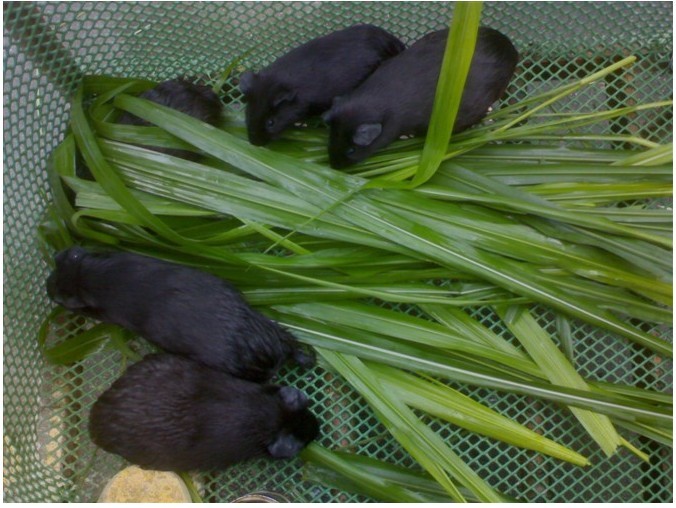
The Chinese black guinea pig is a black guinea pig - a precious herbivorous animal that combines game meat, fur, ornamental value and nourishing properties. The guinea pig belongs to the class Mammalia, order Rodentia, guinea pig. It has black ears, black eyes, black toes and glossy black fur, so it is called the black guinea pig. The guinea pig has a large head, short neck, round ears, no tail and short limbs; the forelimbs have four toes and the hindlimbs have three toes, and the claws on the toes are short and sharp. It does not scratch people, is not good at climbing or jumping, is docile in temperament, timid and easily startled, and sometimes makes squeaking cries. It has the characteristics of fast growth (it can be sold after 2 months of rearing), high reproductive rate (it reaches sexual maturity one and a half months after birth and can then be mated), strong disease resistance, high survival rate and strong adaptability.
Overview of black guinea pig breeding
The Chinese black guinea pig is a precious herbivorous animal that combines game meat, nourishing properties, medicinal value, fur and ornamental value. Its successful breeding has added a glorious page to the development of black foods in China and even the world.
1. Game meat and nourishing properties: The Chinese black guinea pig, developed through the introduction of wild guinea pigs and continuous optimization and selective breeding, has white and tender meat (muscle fibers are extremely fine) and a fresh taste superior to chicken, duck and fish; the guinea pig skin is rich in collagen, with a fatty and glutinous mouthfeel superior to soft-shelled turtle skirt. Modern scientific research has proved that black foods are not only rich in nutrients, but also have the special functions of eliminating free radicals in the human body, resisting oxidation, lowering blood lipids, resisting tumors, supporting yang function and resisting aging. Traditional Chinese medicine in China holds that black foods tonify the kidney, that the kidney is the foundation of innate constitution, and that the source of life is consolidated in the kidney. It points out that black products can consolidate the foundation and support healthy qi, nourish the skin and beautify the complexion, strengthen the body and prolong life. The black guinea pig is a high-protein, low-fat and low-cholesterol food. The melanin it contains can eliminate free radicals in the human body and prevent excess lipids, thereby delaying aging; its iron content is 3 times that of soft-shelled turtle.
2. Medicinal use: Black guinea pig meat is sweet in taste and neutral in nature, and has the effects of benefiting qi, nourishing blood and removing toxins. It is used to treat conditions such as physical weakness, kidney deficiency in the elderly and postpartum anemia. The meat of the black guinea pig can be used to produce drugs for treating epilepsy, and guinea pig blood can be used to extract the drug raw material serotonin. Patients with stomach diseases and cardiovascular diseases who eat 3-4 black guinea pigs within a short period (about 10 days) can stabilize and alleviate their condition, reduce symptoms and maintain this for a relatively long time.
3. Fur: The black guinea pig is also a precious fur animal. Its fur is black and glossy, and its gloss can compare with that of mink. The fur is 2 cm-3 cm long, shorter than fox fur, and conforms to the new trend of modern clothing disinfection. The skin board is thin and soft and rich in collagen. Testing by relevant leather scientific research institutions has proved that the fur of the black guinea pig can be used to produce high-grade fur coats and craft ornaments, and has very high economic value and utilization value.
4. Ornamental value: The black guinea pig has a mild temperament, is easy to raise and manage, and is lively and cute. It is loved by people, especially children, and can be kept as a pet.
Black guinea pig breeding technology
The black guinea pig is a herbivorous animal. Various wild grasses, vegetables, tree leaves, melon rinds, plant stems and leaves, rice straw and other straw materials are all good feed for it. Feed it once each in the morning and evening every day, with a daily food intake of about 150 grams per animal, appropriately supplemented with a small amount of grain, wheat, corn and other concentrate feed. It is a typical small domestic animal that saves grain. Rural areas have many grassy hills and slopes and very rich feed resources. Black guinea pigs can effectively use local grass feed, enabling each breeding household to obtain huge economic benefits and high-grade natural black nutritional tonics with game flavor in a very short time.
1. Preparation of the rearing site: First is the rearing facilities. There are many ways to raise black guinea pigs, adapting to local conditions. The commonly used methods are generally: cage rearing, flat pool-style pen rearing, and three-dimensional large-scale factory farming.
① Cage rearing: This rearing method can be used for small-scale rearing. Its advantages are that it can control reproduction and feeding and maintain cleanliness and hygiene. The cage can be made of wooden strips, bamboo pieces or iron wire, with a specification of preferably 60 cm × 50 cm × 40 cm.
② Flat pool-style pen rearing: Suitable for use when there is a single-story house and the shed is wide. Inside the room, bricks, wooden boards, etc. are used to partition pools with an area of 0.5-1 sq m. It is best to spread some sawdust or dry material in the pool, which helps keep warm and absorb moisture. At present, this method is mostly used for rearing.
③ Three-dimensional factory farming: It has a relatively large scale and is relatively concentrated, making management and operation convenient, and many animals can be raised. Bricks or wood and iron bars are used to make 3-5 layers, with the bottom slightly sloped so that feces flow out, making management convenient. There are small doors in the pools and cages. Generally, the number to be stocked is determined according to the size of the cage or shed. For a small density, 8-10 animals per sq m; for a large density, 10-20 animals per sq m. Generally, one 100 cm × 50 cm unit can hold 1 male and 4 females; one 80 cm × 50 cm unit can hold 1 male and 3 females; one 60 cm × 50 cm unit can hold 1 male and 2 females; one 45 cm × 35 cm unit can hold 1 male and 1 female. For pool rearing and box rearing, the stocking density should be appropriately reduced. Before stocking black guinea pigs, the housing should be sprayed and disinfected with a 0.02% potassium permanganate solution.
2. Feeding: The Chinese black guinea pig has a very broad diet and is a herbivorous animal mainly feeding on green feed. Wild grasses, tree leaves, straw and vegetables are all sources of food for it. Generally, feed it once each in the morning and evening every day, about 150 grams per animal per meal. To promote the growth of black guinea pigs, some complete mixed feed should also be supplied, and its composition is similar to rabbit feed. If making mixed feed (concentrate feed) yourself, the raw material proportions are: cornmeal 40%, grain meal 10%, bran 30%, peanut shell meal 15%, fish meal 2%, bone meal 2%, salt 1%. Make the feed into pellets or mix it with water into wet feed for feeding. The black guinea pig has a very omnivorous diet, and normal growth, development and reproduction all require sufficient nutrition. Because the black guinea pig is a herbivorous animal and has a relatively high digestion rate for crude fiber, if green feed or dry grass and other plants are not supplied for a long time, skin peeling will occur, so feed supply should combine concentrate feed and green feed. Green feed: fresh tender grass, such as elephant grass, corn leaves, sugarcane leaves, tree leaves, green vegetables, fruit peels, carrots, sweet potatoes, etc.
3. Sanitation management: Black guinea pigs love cleanliness. Whether raised in pens or cages, the environmental sanitation of the rearing room must be well maintained. Feeding troughs should be cleaned regularly to prevent food from becoming moldy, ensure the freshness of feed and drinking water, and prevent wild rats, cockroaches and the like from contaminating feed and drinking water.
4. Reproduction: Black guinea pigs reach sexual maturity early. Generally, female guinea pigs show sexual characteristics at 35-45 days of age and male guinea pigs at 70 days of age. However, female guinea pigs are best mated for reproduction after 70 days of age.
① Sex identification: A simple method is to press the perineal area with the hand; by checking whether a penis appears and the shape of the external genitalia, the sex can be confirmed. When catching and examining, press the back of the black guinea pig with the right hand, grasp its left shoulder with the thumb, and grasp the right shoulder and chest with the other four fingers. After gently picking it up in this way, support its body with the left hand. The estrous cycle of the female guinea pig is 16 days, and the duration of estrus is 1-18 hours, with an average of 9 hours. The gestation period of the female guinea pig is 56-68 days, and the litter size is 3-5 young, sometimes up to 6-9.
② Selection of breeding stock: Breeding guinea pigs should be selected for a plump body condition, sturdy bones, correct limb shape, bright eyes, good nutritional status and development, glossy coat color, soft and elastic skin, symmetrical and equally sized testes in males, and normal external genital development in females.
③ Mating: The duration of estrus in black guinea pigs is 1-18 hours, with an average of 9 hours. Estrus mostly occurs between 5 p.m. and 5 a.m. the next day. After the female guinea pig mates during estrus, there is a gelatinous mixture at the vaginal opening. Based on the presence or absence of this plug, it can be judged whether the black guinea pig has mated successfully. Under normal circumstances, black guinea pigs kept for original breeding are all mated using the one-male-one-female method, that is, only 1 pair of breeding guinea pigs is placed in each breeding pool. Female guinea pigs should be allowed to live and reproduce together only after the young guinea pigs are weaned; within half a day after the female guinea pig gives birth, the male can be placed in for postpartum mating; both the mating rate and the reproductive rate are high. In large-group rearing, 3-4 female guinea pigs are mostly placed with 1 male black guinea pig for mating. Never place 2 male guinea pigs together, to prevent fighting from affecting mating.
④ Birth and rearing: The gestation period of the female guinea pig is about 68 days, and the litter size is generally 3 to 7 young. The young guinea pigs are weaned after 15 days and raised separately after weaning. Under normal circumstances, 60-80 days of rearing can meet commercial requirements. During gestation, in addition to increasing the quantity and quality of feed, the site should be kept quiet and clean, and idle personnel should not enter or leave at will. The daily ration must be kept fresh, with small and frequent meals. In the late gestation period, dry grass should be placed in the cage so that the female guinea pig can build a nest and prepare for giving birth. The lactation period of young black guinea pigs is 15 days in summer and 20 days in winter. During lactation, the feed nutrition of the female guinea pig should be increased. Black guinea pigs have a high reproductive rate and strong immunity. The service life of breeding guinea pigs is 3 years. During the rearing process, no immunization or drug prevention and treatment are needed.
5. Feeding management: Feeding management is the key to black guinea pig breeding, with emphasis on preventing feed from becoming moldy and deteriorating. Mixed feed is best fed as soon as it is mixed. When pelleted feed is fed directly, clean water should be provided for drinking, or the feed should be mixed and fed. Feed small and frequent meals, with a daily ration cost of about 40 grams per animal, fed twice a day, and keep the feeding trough clean and hygienic. After feeding concentrate feed, put in fresh green feed at the same time. Green feed is best cut and fed on the same day. The daily amount of green feed collected per adult animal is about 250 grams. Prevent feeding green feed contaminated by pesticides and the like. The rearing room should be kept quiet, feces should be cleaned every day, and utensils should often be scrubbed clean. The room temperature should preferably be maintained at 18°C-25°C, with a relative humidity of 45%-55%. Do good work in keeping warm in winter. Prevent rats and snakes from entering the rearing room, and create a comfortable living environment for black guinea pigs. Keepers should be conscientious and responsible, pay attention to observation, and deal with problems promptly when found.
① Spring management: The temperature in spring is suitable. More green feed should be fed, reproduction should be carried out promptly, and a certain density and indoor environmental sanitation should be maintained.
② Summer management: The temperature in summer is relatively high. Do a careful job in preventing heatstroke and lowering temperature, strengthen indoor ventilation, keep the room clean and dry, remove feces promptly, reduce density, strictly disinfect, strengthen nutrition, and keep the physical condition of black guinea pigs stable.
③ Autumn management: In autumn the sky is high and the air is crisp, and the temperature is pleasant. Keep the indoor floor, cages and feeding utensils clean, draw up a good breeding plan, prepare more green feed, and prevent feeding deteriorated feed.
④ Winter management: The weather in winter is cold, so good work must be done in keeping warm and preventing wind from entering. The rearing density of black guinea pigs can be appropriately increased. Because the supply of green feed is insufficient in winter, an appropriate increase can be made in feeding grain, bran and other concentrate feed. Black guinea pigs eat grass, have a docile temperament, reproduce quickly, have relatively few diseases, and have a simple rearing method with low input and quick results. They are very suitable for raising by laid-off workers and surplus rural labor, and are suitable for all ages. Therefore, promoting black guinea pig breeding has very good social significance. It can achieve good social benefits and economic benefits.
Disease prevention and treatment
If the rearing methods for artificially raised black guinea pigs are mastered and management is strict, diseases rarely occur, and even if there are deaths from disease, they are only very isolated cases. If feed deteriorates, feeding is irregular, green feed is unclean, nutrition is incomplete, and management is extensive, diseases will be caused. The following introduces two common diseases.
1. Bloat
[Causes]Most cases are due to eating moldy and deteriorated feed or drinking contaminated water, or eating green vegetables on which dew has not dried and green vegetables with excessive water content, leading to indigestion. It mostly manifests as abdominal distension, listlessness, reduced or stopped feeding, pale lips, and feces that are excessive and thin or watery, greenish, and foul-smelling.
[Prevention and treatment methods]When a diseased animal is found, isolate it immediately and feed it drugs such as chloramphenicol or oxytetracycline. Herbal medicine can also be used: boil Andrographis paniculata in water and feed it, continuously for 2-3 days, 1-2 times a day. Centella asiatica can also be washed clean, dried and fed fresh.
2. Emaciation disease
[Causes]Due to a long-term single daily ration, malnutrition, or feeding dry grain without adding drinking water, digestion is hindered and eating stops, or guinea pig stomach diseases occur and cannot be discovered and treated in time, resulting in progressive emaciation day by day.
[Prevention and treatment methods]Cod liver oil or egg yolk can be used as a supplement, and cooked soybeans can be mixed into the feed for feeding. After 10 days, return to the regular feed. At the same time, add poultry multivitamins. If body temperature rises, 20,000-30,000 units of penicillin can be injected intramuscularly, twice a day, for 3-5 consecutive days.