Market Prospect Analysis of Chinese Guinea Pig Farming
The guinea pig is a mammal of the genus Cavia, family Caviidae, with a stout body and short, thick limbs, reaching a body length of 30--50 cm. Its head is blunt and round, its snout is relatively large, its eyes are small and its ears short and hidden within the fur, and it has relatively long claws. The Chinese guinea pig has the following distinctive "four black" external features: black fur, black eyes, black toes and black ears. It is a typical new variety of black food. A mature Chinese guinea pig can weigh 1-1.5 kg, feeds mainly on grasses, and after 3--4 months of rearing can grow to 0.75 kg, at which point it can be sold or bought back.
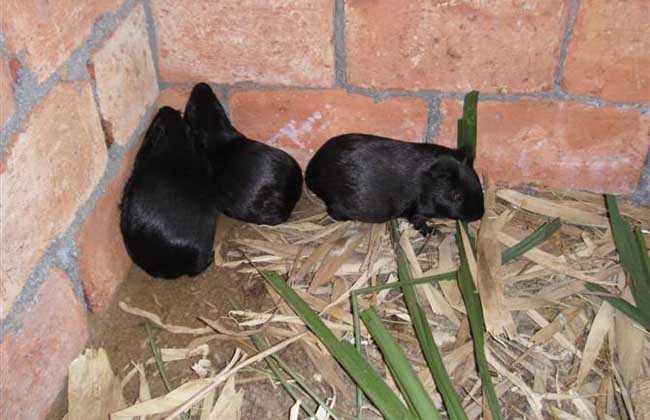
Economic Value of the Chinese Guinea Pig
The Chinese guinea pig is a precious herbivorous animal that combines game meat, tonic value, medicinal use, fur and ornamental value in one. Its successful breeding has added a glorious page to the development of black foods in China and indeed the world.
1. Game meat and tonic value: As early as several thousand years ago, the working people of ancient China had the habit of eating guinea pig meat, and it was included as a high-grade game dish in the Chinese Famous Dishes cookbook (for details, see the "Yunnan Flavors" volume of Chinese Famous Dishes published by China Financial and Economic Publishing House). The Southern Song poet and gourmet Su Dongpo regretted all his life that he never got to taste the delicacy of guinea pig. Once a villager gave him a guinea pig, but as there was no time to cook it, he missed eating it and wrote a poem saying: "Caught in haste, ashamed I cannot feast upon it." The delicacy of guinea pig meat is well proven by the saying, "Above, the turtledove of the sky; below, the guinea pig of the earth." The Chinese guinea pig, developed through the introduction of wild guinea pigs and continuous optimization and selective breeding, has white, tender meat (with extremely fine muscle fibers) and a fresh flavor surpassing that of chicken, duck and fish; the guinea pig skin is rich in gelatin and has a fatty, glutinous texture superior to the skirt edge of soft-shelled turtle. Modern scientific research has shown that black foods are not only nutritious but also have special functions such as scavenging free radicals in the human body, providing antioxidant effects, lowering blood lipids, fighting tumors, supporting yang energy and resisting aging. Traditional Chinese medicine holds that "black foods nourish the kidney," that "the kidney is the foundation of innate constitution," and that "the source of life is rooted in the kidney," pointing out that black foods can strengthen the constitution and support vital energy, nourish the skin and beautify the complexion, strengthen the body and prolong life. The Chinese guinea pig is a high-protein, low-fat and low-cholesterol food; the melanin it contains can scavenge free radicals in the human body and prevent excess lipids, thereby helping to delay aging; its iron content is 3 times that of soft-shelled turtle.
2. Medicinal use: Guinea pig meat is sweet in flavor and neutral in nature, with the effects of tonifying qi and nourishing blood and of removing toxins, and is used to treat conditions such as physical weakness, kidney deficiency in the elderly and postpartum anemia. Guinea pig meat can be used to produce drugs for treating epilepsy, and guinea pig blood can be used to extract the pharmaceutical raw material serotonin. Patients with stomach ailments and cardiovascular diseases who eat 3-4 guinea pigs within a short period (about 10 days) can stabilize and alleviate their condition, reduce symptoms and maintain the improvement for a relatively long time.
3. Fur: The guinea pig is also a valuable fur animal. Its fur is jet black and glossy, with a luster comparable to that of mink; the fur is 2 cm--3 cm long, shorter than fox fur, in line with the new trend of modern clothing disinfection, and the skin plate is thin and soft and rich in gelatin. Testing by relevant leather research institutions has proven that guinea pig fur can be used to produce high-grade fur coats and craft ornaments, and has very high economic value and utilization value.
4. Ornamental value: The guinea pig has a gentle temperament, is easy to raise and manage, and is lively and cute, loved by people, especially children, and can be kept as a pet.
How to Raise Guinea Pigs
The guinea pig is a herbivorous animal; wild grasses, wild vegetables, tree leaves and the like can all be fed to it, three meals a day, 2 liang--3 liang per meal. To meet its nutritional needs for frequent reproduction, supplement with a small amount of corn and feed, four qian per day; urban and rural residents raising 5-10 pairs in their spare time will not affect their production or work. The rearing pen only needs to be 30 cm-50 cm high, and wooden boxes, bamboo cages, brick pools and the like can be used for raising them. Each sow produces 4-5 litters per year, with 3--6 young per litter. Young guinea pigs can mate and reproduce from birth to 60 days, and can reproduce 40-60 animals cyclically per year, with a survival rate as high as 98%. Guinea pigs pose no threat of any plague disease; as long as they are given a clean, dry environment, they can be raised well and safely and reliably. Among livestock, and especially rare animals, it is one of the precious animals that is relatively easy to raise.
Guinea pig meat is rich in protein, abundant in the 17 amino acids needed by the human body and in various trace elements such as iron, calcium and phosphorus, and also contains the anticancer elements zinc and selenium. It is an ideal nutritional tonic and health food, with obvious dietary therapeutic effects on stomach ailments, high blood pressure and coronary heart disease. Because of its high tonic content, even soup simmered in the hot summer can congeal like soft-shelled turtle soup. Nutrition experts call guinea pig meat the beauty meat for women, the bodybuilding meat for young people, the nourishing meat for children and the anti-aging meat for the elderly. As a new type of meat product, the guinea pig has already been accepted by more and more consumers and by the international market. The farming and comprehensive development of the Chinese guinea pig has now been assessed by the Expert Committee of the National Agricultural New Technology Product Dissemination Network as a key recommended project for China's new agricultural technology products, and has been submitted for inclusion in provincial-level Spark Program projects. All of this has laid a good social foundation for the large-scale farming and development of guinea pigs.
Disease Prevention and Treatment of Guinea Pigs
A relatively common disease in guinea pigs is called bloat, caused by eating moldy, spoiled feed or drinking water contaminated by pathogens, which leads to indigestion and abdominal distension of the liver and abdomen. For prevention and treatment, feed drugs such as oxytetracycline and Shidefu for 2-3 consecutive days, 1-2 times a day; however, as long as breeders pay attention to daily cleanliness and hygiene and do not give moldy, spoiled feed or pathogen-contaminated water, this disease can be completely avoided. (For more detailed techniques on preventing and treating guinea pig diseases, please read other articles in Guinea Pig Farming.)