Key Technical Points and Daily Feeding Management Methods for Guinea Pig Farming
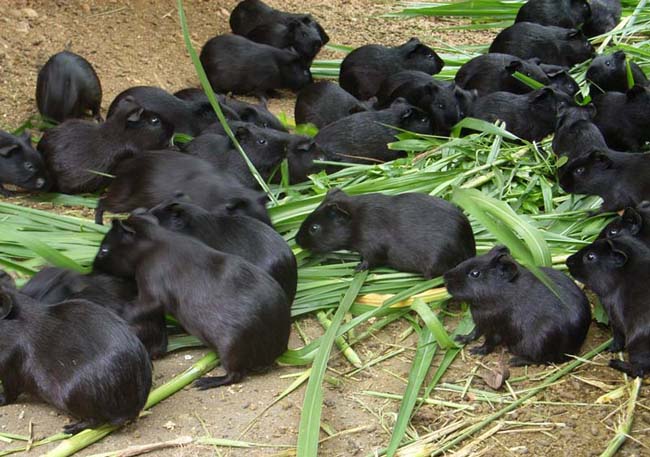
Guinea pigs are herbivorous animals; all kinds of wild grasses, vegetables, tree leaves, melon rinds, plant stems and leaves, rice straw and other crop stalks are good feed for them. Feed them once each in the morning and evening, with a daily intake of about 150 grams per animal, supplemented appropriately with a small amount of grains, wheat, corn and other concentrated feed; they are a typical grain-saving small livestock. Rural areas have many grassy hills and slopes and very abundant feed resources; guinea pigs can effectively utilize local grass feed and, in a very short time, enable every farming household to obtain substantial economic benefits and a high-grade wild-flavor natural black nutritional tonic.
Preparation of the Guinea Pig Farming Site
The first consideration is the rearing facilities. There are many ways to raise guinea pigs; adapting to local conditions, the commonly used methods are: cage rearing, flat pen rearing, and three-dimensional large-scale factory farming.
1. Cage rearing. This rearing method can be used for small-scale raising. Its advantages are that it allows control of breeding and feeding and maintains cleanliness and hygiene. Cages can be made of wooden strips, bamboo slips or iron wire, with dimensions of 60 cm × 50 cm × 40 cm being suitable.
2. Flat pen rearing. Suitable for use in single-story houses with a wide floor area. Inside the house, use bricks, wooden boards, etc. to partition off pens of 0.5-1 sq m in area; it is best to spread some wood shavings or dry straw inside the pen to help keep it warm and absorb moisture. At present this method is mostly used for rearing.
3. Three-dimensional factory farming. Its scale is relatively large and relatively concentrated, making it easy to manage and operate, and allowing many animals to be raised. Use bricks, wood or iron bars to build 3-5 tiers, with the bottom slightly sloped so that manure flows out, making management convenient. The pens and cages have small doors. Generally, the number of animals stocked is decided according to the size of the cage or pen: for small density, 8-10 animals per sq m; for large density, 10-20 animals. Generally, a pen of 100 cm × 50 cm can hold 1 male and 4 females; 80 cm × 50 cm can hold 1 male and 3 females; 60 cm × 50 cm can hold 1 male and 2 females; 45 cm × 35 cm can hold 1 male and 1 female. For pen rearing and box rearing, the stocking density should be appropriately lower. Before stocking guinea pigs, the housing should be sprayed and disinfected with a 0.02% potassium permanganate solution.
Guinea Pig Feeding Techniques
The Chinese guinea pig has a very broad diet; it is a herbivorous animal that mainly eats green feed. Wild grasses, tree leaves, crop stalks and vegetables are all sources of food for it. Generally, feed once each in the morning and evening, about 150 grams per animal per meal. To promote the growth of guinea pigs, some complete mixed feed should also be given; its composition is similar to rabbit feed. For example, for self-made mixed feed (concentrated feed), the raw material proportions are: cornmeal 40%, grain meal 10%, bran 30%, peanut shell meal 15%, fish meal 2%, bone meal 2%, salt 1%. Make the feed into pellets or mix it with water into a wet feed for feeding. Guinea pigs have a very omnivorous diet, and normal growth, development and reproduction all require sufficient nutrition. Because guinea pigs are herbivorous animals with a relatively high digestion rate for crude fiber, if they are not supplied with green feed or dried grass and other plants for a long time, they will develop peeling skin, so feed supply should combine concentrated feed and green feed. Green feed: fresh tender grass, such as elephant grass, corn leaves, sugarcane leaves, tree leaves, green vegetables, fruit peels, carrots, sweet potatoes, etc.
Sanitation Management of the Farming Site
Guinea pigs love cleanliness; whether raised in pens or cages, the environmental sanitation of the rearing room must be well managed, the feeding troughs must be cleaned regularly to prevent food from becoming moldy, and the freshness of feed and drinking water must be ensured, eliminating contamination of feed and drinking water by wild rats, cockroaches and the like.
Guinea Pig Breeding Techniques
Guinea pigs reach sexual maturity early. Generally, female guinea pigs show sexual characteristics at 35-45 days of age, and males at 70 days of age. However, females are best mated for breeding after 70 days of age. Sex identification: the simple method is to press the perineal area with the hand; by checking whether a penis appears and the shape of the external genitalia, male or female can be confirmed. When catching and examining them, press your right hand on the guinea pig's back, grip its left shoulder with your thumb, and grip the right shoulder and chest with the other four fingers; after lifting it gently in this way, support its body with your left hand. The estrous cycle of the female guinea pig is 16 days, and estrus lasts 1-18 hours, averaging 9 hours. The gestation period of the female guinea pig is 56-68 days, and the litter size is 3-5 young, with some reaching 6-9.
1. Seed selection. Breeding guinea pigs should be selected for a full body condition, sturdy bones, straight limb shape, bright eyes, good nutritional status and development, glossy coat color, soft and elastic skin, symmetrical testes of the same size in males, and normal external genital development in females.
2. Mating. The duration of estrus in guinea pigs is 1-18 hours, averaging 9 hours, and estrus mostly occurs between 5 p.m. and 5 a.m. the next morning. After a female guinea pig mates during estrus, there is a gelatinous mixture at the vaginal opening; based on the presence or absence of this plug, one can judge whether the guinea pig has mated successfully. Under normal circumstances, guinea pigs kept as foundation breeding stock are all mated one male to one female, that is, only 1 pair of breeding guinea pigs is placed in each breeding pen; after the young guinea pigs are weaned, the female should be allowed to live and breed with the male again; the male can be placed in for postpartum mating within half a day after the female gives birth; both the mating rate and the reproduction rate are high. In large-group rearing, 3 to 4 females are mostly placed with 1 male guinea pig for mating; never place 2 males together, to prevent fighting from affecting mating.
3. Reproduction. The gestation period of the female guinea pig is about 68 days, and the litter size is generally 3 to 7 young; the young are weaned after 15 days and raised separately after weaning. Usually, 60-80 days of rearing is enough to meet market requirements. During gestation, in addition to increasing the quantity and quality of feed, the site must be kept quiet and clean, and idle outsiders must not enter freely. The daily ration must be kept fresh, with small, frequent meals. In the later stage of gestation, dried grass should be placed in the cage to let the female build a nest in preparation for giving birth.
The suckling period of young guinea pigs is 15 days in summer and 20 days in winter. During the suckling period, the feed nutrition of the female guinea pig should be increased. Guinea pigs have a high reproduction rate and strong immunity; breeding guinea pigs have a useful life of 3 years, and no immunization or drug prevention and treatment is needed during the rearing process.
Guinea Pig Feeding and Management Methods
Feeding and management are the key to guinea pig farming, with emphasis on preventing feed from becoming moldy and deteriorating. Mixed feed is best prepared and fed as needed; when pelleted feed is fed directly, clean water should be provided for drinking, or the feed should be mixed with water and fed, with small, frequent meals, about 40 grams of daily ration per animal, fed twice a day, keeping the feeding trough clean and hygienic. After feeding concentrated feed, fresh green feed should also be placed in at the same time; green feed is best cut and fed on the same day, with a daily green feed intake of about 250 grams per adult animal, preventing the feeding of green feed contaminated by pesticides and the like.
The rearing room must be kept quiet, manure cleaned up every day, and utensils often scrubbed clean. The room temperature is best kept at 18°C-25°C, with a relative humidity of 45%-55%, and good warmth preservation work done in winter. Prevent rats and snakes from entering the rearing room, creating a comfortable living environment for the guinea pigs. Keepers must be conscientious and responsible, pay attention to observation, and handle problems promptly when found. Four-season management, spring management:
1. In spring the temperature is suitable, so more green feed should be fed, breeding should be carried out promptly, and a certain density and indoor environmental hygiene should be maintained.
2. Summer management: summer temperatures are relatively high, so heat prevention and cooling work must be done conscientiously, indoor ventilation strengthened, the interior kept clean and dry, manure removed promptly, density reduced, disinfection strictly carried out, and nutrition strengthened to keep the guinea pigs' physical condition stable.
3. Autumn management: in autumn the sky is high and the air is crisp, and the temperature is pleasant; keep the indoor floor, cages and feeding utensils clean, draw up a good breeding plan, prepare more green feed, and prevent feeding spoiled feed.
4. Winter management: winter weather is cold, so warmth preservation work must be done well and wind prevented from entering; the rearing density of guinea pigs can be appropriately increased. Because the supply of green feed is insufficient in winter, concentrated feed such as grains and bran can be appropriately increased.
Guinea pigs eat grass, are gentle in temperament, reproduce quickly, have relatively few diseases, are simple to raise, require little investment and yield quick results; they are very suitable for laid-off workers and surplus rural labor to raise, and are suitable for all ages. Therefore, promoting guinea pig farming has good social significance. It can achieve good social and economic benefits.