Bamboo rat farming video tutorial, with a detailed explanation of the entire farming process
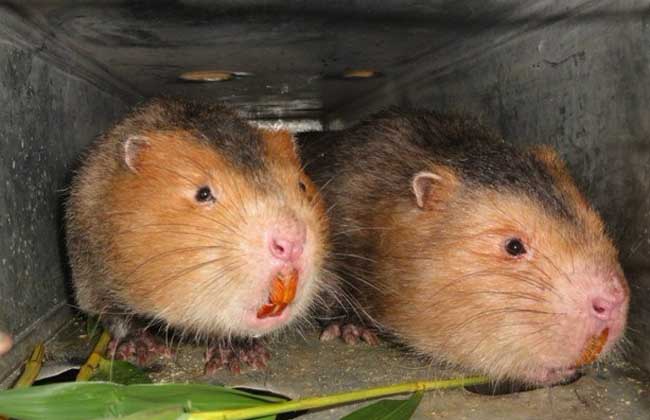
Under artificial rearing conditions, bamboo rats reach sexual maturity at 4-5 months of age and a body weight of 1 kg or more, and they breed after 6 months of age, generally producing more than 10 young per year. Young rats raised for 3 months reach a body weight of 0.5 kg, by 5 months they can reach more than 1 kg, and the largest reach 2-3 kg.
Enclosure
An empty room, cellar, or air-raid shelter can all be used for farming, or an enclosure of 1.2 x 1.0 x 0.8 m can be built with bricks, divided by bricks into two compartments, with an opening left in the partition wall, one compartment used as an inner chamber and the other as the rearing area. For group rearing, 5 pairs per square meter, or they can be kept in cages.
Young rats
This refers to bamboo rats within 3 months of age after weaning. They need to be fed fresh, easily digestible feed rich in nutrients. Such as carrots, sweet potatoes, bamboo shoots, melon rind and other succulent feed, as well as corn, wheat bran, dried steamed buns and other concentrated feed. At the same time, add fish meal, bone meal, salt, vitamins, and growth hormones to the daily ration to improve feed digestibility and promote the growth and development of young rats. The types of food must remain relatively stable; if there are changes, there should be a transition period. Young rats consume 14-17 g per day, fed twice a day, with less in the morning and more in the afternoon. They should be raised in separate pens according to body weight and physical strength, with 4-5 per cage. The weak ones should be raised separately to promote recovery of the young rats' physical condition.
Adult rats
1. Adult rats have strong disease resistance and grow quickly, with a body weight of 1.2-1.5 kg. They should be fed at fixed times and in fixed amounts, once each in the morning and evening, with 150-200 g of straw per rat per day and 15-20 g of concentrated feed. The basic daily ration does not need to be changed year-round; if it is changed, there should be a transition period. Adult rats' teeth grow quickly, so a bamboo pole or hard wood strip needs to be placed in the cage for them to gnaw on. Check every day whether the bamboo rat's feces are smooth on the surface and granular, rather like medicinal capsules. Pay attention to whether its coat color is glossy and whether it is lively in activity; if there are any abnormalities, deal with them promptly.
2. Breeding male rats. Breeding male rats are required to be well developed, with a body weight of more than 1.3 kg. The back is straight, the body is robust, the testes are prominent, sexual desire is strong, they are tolerant of coarse feed, and they do not fight. Mating movements are quick, and semen quality is excellent.
3. The quantity and quality of breeding male rats' semen are related to nutrition, but they must not be fed too fat. Green and coarse feed includes bamboo leaves, bamboo stems, bamboo shoots, corn stalks, reed stalks, sugarcane, carrots, etc. The mixed daily ration is: corn meal 55%, bran 20%, peanut meal 15%, bone meal 3%, fish meal 7%.
4. Breeding rats mate 1-2 times per day. In spring and autumn, when temperatures are suitable, male rats have strong sexual desire and good semen quality. Each estrus lasts 1-3 days, and mating takes place at night. The male-to-female breeding ratio is 1:2-3, with 1:1 being better.
5. Breeding female rats. Breeding female rats are required to have a high litter rate, strong maternal behavior, strong feed intake, and a body weight of more than 1.2 kg. Because young rats are growing and developing, and adult female rats also need to raise their young, the daily ration formulas for young rats and adult female rats are as follows: (1) Corn 55%, bran 20%, peanut meal 15%, bone meal 3%, fish meal 7%. In addition, add 0.5% of the total amount as salt and growth hormones. (2) Bamboo powder 20%, flour 35%, corn meal 10%, soybean cake meal 13%, wheat bran 17%, fish meal 2%, bone meal 2%, salt 0.2%, sugar 0.8%. In addition, for every kilogram of feed, supplement folic acid 1 mg, nicotinic acid 20 mg, zinc oxide 75 mg, D-L methionine 400 mg, potassium iodide 0.5 mg, manganese sulfate 60 mg, VA 1500 IU, VD3 1500 IU, VB12 20 mg, VB2 6 mg, VE 30 mg. Mix the above feed, add water and knead it into steamed-bun shapes or granules, then sun-dry or oven-dry it, and feed it to the bamboo rats.
6. The female rat's pregnancy period is 60 days. During this period, the feed fed must be clean, fresh, diverse, and kept relatively stable. After the female rat becomes pregnant, she should be raised separately, and the enclosure should be kept clean at all times, with dry, fine, soft bedding. The delivery takes 2-4 hours, and at the fastest it still takes 1-2 hours to finish giving birth. 6-7 days before giving birth, the female rat's nipples become exposed, activity decreases, and movement becomes slow. Before giving birth, she makes a "gu--gu--" sound from time to time. During delivery, the young rats are delivered together with the fetal membranes and placenta. While giving birth, the female rat eats the fetal membranes and placenta, and at the end bites off the umbilical cord and cleans the amniotic fluid off the young rats' bodies. At this time, the "ji--ji--" cries of the young rats can be heard. 12 hours after giving birth, the female rat begins to nurse the young rats.