Key Technical Points for Environmental Control in Bamboo Rat Breeding Houses
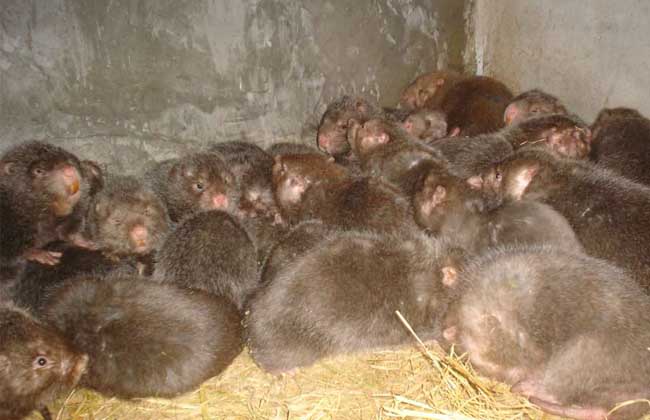
The goal of raising bamboo rats is fast growth, high feed efficiency, good slaughter quality, a short breeding cycle and a low mortality rate. In terms of the bamboo rat house, consideration should be given to providing a suitable environment for the bamboo rats and reducing feed waste, with attention paid to the following points.
Environmental Temperature and Humidity for Bamboo Rats
Before reaching a body weight of 1 kg, the suitable temperature is 16°C-22°C; at a body weight of 1-1.5 kg, the suitable temperature is 14°C-20°C, and must not fall below 12°C; at a body weight above 1.5 kg, the suitable temperature is 12°C-16°C, and must not fall below 10°C. If in a high-temperature environment, cooling measures should be taken, and the relative humidity should be 40%-70%.
Each Bamboo Rat Needs Sufficient Floor Area
If the area occupied by each bamboo rat is too small, it will cause stress in the bamboo rats and thereby affect their growth; moreover, the heat given off by each bamboo rat makes the already hot summer environment of the south even hotter, so each bamboo rat should be provided with an appropriate floor area. The stocking density should not be too high, and generally no more than 25 head per pen is advisable. It is recommended that each meat bamboo rat occupy a floor area of 1.0 sq m, and on slatted flooring, 10.9 sq m.
Bamboo Rat Houses Are Easy to Clean
In the management of meat bamboo rat houses, cleaning the bamboo rat house takes the most time, so in the design, consideration should be given to how to reduce the washing time. For example, the slope of solid flooring should be sufficient so that drainage is smooth, while the grooves of slatted flooring allow bamboo rat manure to fall off easily, and at the same time injury to the bamboo rats' feet should be avoided.
Increase the Feed Intake of Bamboo Rats and Reduce Feed Waste
The correct design of the feed trough, the position where the trough is placed in the bamboo rat house, and the ratio of the number of bamboo rats raised to the number of trough openings all affect the feed intake of the bamboo rats and the amount of feed wasted. The main nutritional destinations of meat bamboo rats:
1. After maintenance requirements, only the surplus is used for production, that is, fattening and meat growth. For example, taking energy as an example, the energy intake of a meat bamboo rat = maintenance requirement + fattening and meat growth.
2. Regardless of whether weight is gained or not, one day's maintenance consumption must be used up, and as body weight increases, the maintenance consumption also increases correspondingly. Therefore, if the fattening period of meat bamboo rats is extended for no reason, a great deal of feed must be used to sustain life, which is a great waste; in other words, shortening the fattening period can save a large amount of feed.
Control Harmful Gases in the Bamboo Rat House
Clear away bamboo rat manure and urine in a timely manner, ventilate the bamboo rat house, and create an environment with fresh air. Only with suitable temperature and humidity and dry, warm, comfortable bamboo rat breeding environment conditions can meat bamboo rats rest fully, maintain a vigorous appetite, reduce the incidence of disease in bamboo rats, obtain a higher weight gain rate and feed conversion rate, and create higher economic benefits.