Detailed Explanation of Key Points of Artificial Bamboo Rat Breeding Technology
The bamboo rat, also known as the bamboo root pig or mang pig, belongs to the class Mammalia, order Rodentia, family Rhizomyidae. The wild species in China include: the bamboo rat, the Chinese bamboo rat, and the hoary bamboo rat. They are mainly distributed in Southeast Asia and East Africa. It is also a special wild animal of the mountainous areas of southern Hunan.
The meat of the bamboo rat is fine and lean, with high nutritional value. It is a low-fat, low-cholesterol meat food, and is rich in phosphorus, calcium, vitamin E, and amino acids. As early as the Ming Dynasty, Li Shizhen recorded in the "Compendium of Materia Medica": “Eating its meat nourishes yin and strengthens yang, consolidates the foundation and promotes body fluids.” Bamboo rat meat can also treat scalds, burns, and unnamed swellings and pains; its fur is fine and soft, bright and smooth, with thick underfur, and is a superior raw material for making fur garments. It is a high-grade commodity for earning foreign exchange through export.
Morphological Characteristics
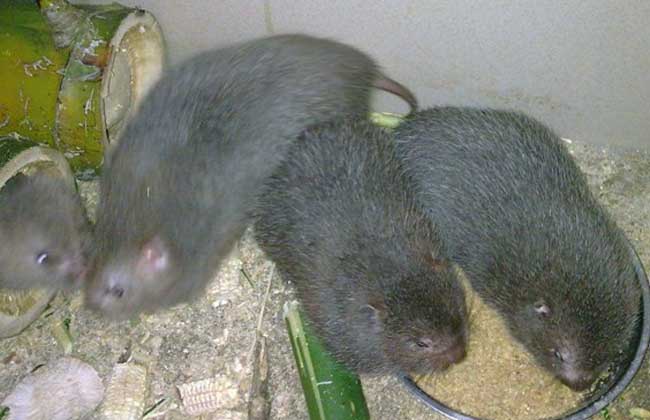
The bamboo rat has a stout body, cylindrical in shape. The adult body length is about 38cm. The body weight is 1—3kg. The head is blunt and round, the snout is relatively large, the eyes are small, and the ear shells are hidden in the fur. The limbs are short and stout, and the tail is short and small. The back fur color of the adult is grayish brown and grows white-tipped needle hairs. The fur color on both sides is slightly lighter. The fur on the ventral surface of the body is relatively sparse, and pink skin can be seen through the fur. Spots may appear on the chest of individual animals. The color of the back of the feet and the tail hair is grayish brown. The fur color of the young is darker than that of the adult, and the whole body is dark gray.
Biological Characteristics
1. Living habits: Bamboo rats like to live in a quiet, clean, dry, appropriately lit, and fresh-air environment. In the wild, they are mainly found on mountain slopes among grasses and in bamboo forests. They live underground in burrows. They are nocturnal animals. They are gentle in temperament. Males and females are inseparable. The living temperature is 8—40°C. The suitable temperature is 11.7—28.5°C.
2. Feeding habits: The bamboo root rat is a herbivorous animal. It mostly feeds on bamboo roots and underground stems (bamboo rhizomes), grass roots, and plant seeds and fruits.
3. Growth pattern: Bamboo rats grow relatively quickly. From birth to weaning, the young pig is about 40d, and its body weight can reach 0.25kg. With artificial breeding for 2 months, the body weight can reach 1kg, and it can be sold as a commercial pig.
4. Reproductive habits: Young bamboo rats reach sexual maturity at 4—5 months of age and can then reproduce. They produce 4—5 litters per year. Each litter has 4—8 young, and some can reach more than 10. The gestation period is about 2 months. After the female gives birth, 12—36h later she mates with the male. The conception rate is 50%—60%; non-pregnant sows again show estrus around 45d during lactation and reproduce on their own. When giving birth, the sow must not be startled, and the young pigs must not be held by hand. Otherwise, the sow will not feed her own young and let them starve to death. After 25d from birth, the young pigs have opened their eyes and can crawl. In addition to suckling, they can eat tender roots, stems, and other plant parts. Under artificial breeding, feed can be given.
Artificial Breeding Technology
1. Building cages and pens
For small-scale feeding, a large water vat can be used. Soil can be placed at the bottom of the vat. For batch feeding, idle pig houses, cellars, air-raid shelters, and ordinary single-story houses can be used. In a house 6m×4m×2.8m in length, width, and height, iron cages are placed in two rows and three tiers. 50 pairs of pigs can be raised. The cage specification is 90Cm×60cm×30cm, divided into three compartments. Opening the door on top or at the front is both acceptable. If raised in pools, build them with bricks to a specification of 60cm×40cm×25Cm, with one compartment holding one pair. The inner surface of the pool should be smoothed with cement. The bottom surface should also be smoothed with cement to prevent escape.
2. Introduction of breeding stock
For first-time feeding, it is advisable to raise well-domesticated bamboo rats as breeding stock, or wild bamboo rat stock can also be purchased, but it should be noted that it is advisable to purchase whole litters and pairs, and bamboo rats unfamiliar with each other must not be mixed together. All breeding stock should be strong, disease-free, and without external injuries. Purchasing wild breeding pigs that are injured by traps, beatings, or snares must be strictly avoided. Because injured wild breeding stock need a period of domestication at first, and when they first arrive at the breeding cage (pool), they are not adapted to the domestic environment, are very afraid of their surroundings, do not think about food, and coupled with injuries, are very likely to die.
3. Feeding
During artificial breeding, grasses, sugarcane, bamboo stems (roots), grass roots, taro, mountain ginger seeds, corn steamed buns, and melon and fruit peels (shells) can be fed. Now, according to feeding standards, a compound feed has been developed. Its formula is: cornmeal 55%, wheat bran 20%, soybean cake 15%, bone meal 3%, fish meal 7%. Add 0.5% salt and growth promoter based on total weight. Make the feed into steamed corn bread and feed it. In addition, feed a small amount of minerals and multivitamins. Because bamboo rats are nocturnal animals and are mostly active at night, the feeding method of feeding less in the morning and more in the afternoon should be adopted. A young bamboo rat consumes 20—25g of feed per month. It should also be supplementally fed 250g of grass or bamboo leaves and bamboo branches.
4. Feeding management measures
① Temperature: The house temperature should be relatively stable. In winter it is 7-10°C. The room temperature for giving birth is 17—20°C. In summer the room temperature should be below 27°C. If it exceeds 32°C, cooling measures should be taken.
② Humidity: Maintain the indoor relative humidity at 50%-60%. The ground should be dry, with no standing water.
③ Feed should be fed in batches. Feed less and add frequently. Feed that is not finished should be cleaned up promptly on the 2nd day, so as to avoid the animals eating spoiled feed and becoming ill.
④ Feces should be removed frequently to keep the cage (pool) clean: when adding grass (bamboo) during normal times, there is no need to add drinking water, and the moisture content of the feed should not be too high; care should be taken to close the doors of the cages and houses well to prevent escape. Dogs must not be kept in the breeding farm, so as to avoid startling them, etc. 4. Breeding: Sows are about 120d, and boars at 140d have reached sexual maturity, that is, they have mating ability. The sow's sexual cycle is 30—50d, with an average of 41d, and the estrus period can last 2—3d. During estrus, activity increases, and sometimes they can be seen rolling in the cage, constantly playing and chasing with the boar, or mounting the boar, or the vulva swells. Boars have no obvious periodic sexual cycle changes. They can mate year-round.
⑤ Artificial mating: Use one male and one female in a cage (pool) mixed together and let them mate on their own. After the sow is mated and conceives, there is a plug-like blockage at the vaginal opening. This plug is a mixture secreted by the boar's seminal vesicle glands and prostate. Based on the presence or absence of the plug, it can be judged whether the sow has already been mated. The plug at the vaginal opening can prevent sperm from slipping out and thereby achieve fertilization. Bamboo rats have the habit of postpartum mating, that is, 12—36h after giving birth, they mate with the boar. Using this mating habit greatly increases the conception rate. Bamboo rat mating can only occur when the male and female can be raised together after domestication, and close-relative or distant-relative mating cannot be done casually. Once they do not get along in the same cage, they cannot be bred and raised together, so as to avoid biting each other to death.
5. Disease prevention and control
Bamboo rats have strong disease resistance and rarely get sick. However, due to reasons such as feed and feeding management, the following diseases may be seen:
① Constipation: In the early stage of the disease, there is mild reduction in food intake and reduced defecation. The dung balls are dry, hard, and small, often accompanied by high fever. When the disease course is longer, appetite drops sharply, food is refused, spirit is low, and the animal gradually becomes emaciated. 5—10ml of vegetable oil (rapeseed oil, peanut oil, rapeseed oil, etc.) can be administered orally.
② Diarrhea: The symptom is loose stools. The area around the anus and the hind limbs are contaminated by loose feces. At first the head droops, the eyes are dull, the tail drags on the floor, and behavior is sluggish. Sulfonamide drugs can be taken orally, or oxytetracycline can be taken orally. In addition, feed some 2—3-year-old bamboo.
③ Bloat: The symptom is swelling of the stomach, low spirit, and crouching in the cage. This disease is commonly seen in weaned young pigs. For treatment, sulfonamide drugs can be taken orally, and in addition the sick pig should be prompted to run around, and it can often recover on its own.
④ Fur-eating disorder: The symptom is biting its own fur or biting each other. For treatment, compound vitamins can be injected intramuscularly, and anti-inflammatory ointment can be applied to external injuries to prevent inflammation.
⑤ For more knowledge on bamboo rat diseases, please read the article "Prevention and Control of Ten Common Diseases in Bamboo Rat Breeding."