Feeding and management methods for bamboo rats to give birth to more cubs
Build breeding pools scientifically
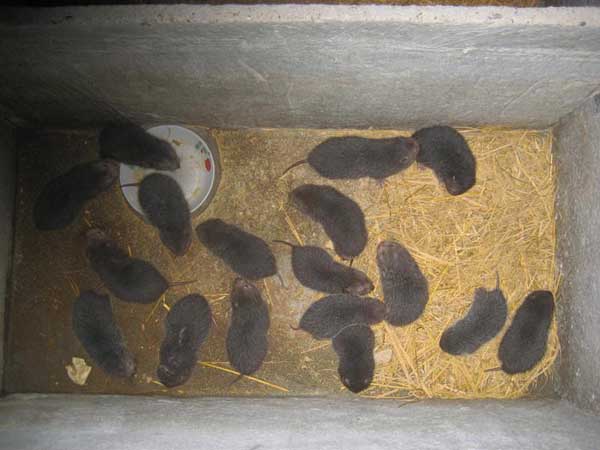
The bamboo rat is also called the bamboo civet. There are two types of breeding pools for bamboo rats, and only when both are used together are the breeding results good. One is the birthing nest pool, divided into an inner pool and an outer pool. The inner pool is 30, 25 and 70 cm in length, width and height respectively, with a cover on top, thus forming the bamboo rat's nest. The outer pool is 70, 50 and 70 cm in length, width and height respectively, forming the place where the female rat feeds and moves around. At the bottom of the cement board separating the inner and outer pools there is a round hole 12 cm in diameter connecting them, so that after the female rat becomes pregnant she can be moved into the birthing nest pool for rearing. The other is the large mating pool. It is 1.5 m, 2 m and 0.7 m in length, width and height respectively (the area is required to be more than 2 sq m). On one side inside the pool a 30 cm wide insulated trough is built, and under the partition board of the trough two holes 12 cm in diameter are opened, connecting with the large pool. In addition, a cover board is placed on the insulated trough for the bamboo rats to rest inside. Each pool can house 3 males and 12 females. Practice has proved that when 1 male and 1 female (or 2 females) were originally kept in a small breeding pool, although mating and breeding were also possible, the number of cubs per litter was not as many as with group rearing and group mating.
Secondary selection of breeding stock and repeated mating
First, when purchasing breeding stock, choose superior individuals as much as possible. Then, through self-breeding and self-rearing, select and keep the offspring that produce 4 litters or more per year with 4 or more cubs per litter, and keep superior individuals weaned at 30 to 35 days of age and weighing more than 250 grams as breeding stock. Through secondary selection, both the reproduction rate of female rats and the number of cubs can be increased by more than 80%. There is one best mating time for the female rat after giving birth and one after the cubs are weaned. The first is called "blood mating". After wild bamboo rats are successfully domesticated, they need to breed to the third generation; only when they are fully adapted to domestic rearing is blood mating easy to succeed. For wild breeding stock that is not yet fully mastered technically or has just been domesticated for 1 to 2 generations, the mating opportunity after the cubs are weaned must be firmly grasped. Immediately after weaning, the female rat is put back into the large pool for group rearing, and 3 male rats are allowed to mate with her in turn to achieve the purpose of repeated mating, which can increase the number of cubs by more than 50%.
The male-to-female ratio must be appropriate
Theoretically, 1 male to 2 or 3 females is most suitable. But practice has proved that under current technical conditions this speculation is wrong. Because most breeders do not carry out pairing and combination at the young rat stage, males and females are often only temporarily combined when they reach adulthood. Since bamboo rats have a strong memory, those that are not originally mates kept in the same group often need to live together for 2 to 3 months before adapting to each other and mating. After giving birth the male and female are separated again, and after weaning, when the male and female are paired again, it takes another period of time to adapt. Therefore, with one male to multiple females the adaptation time is long, which is not conducive to breeding. For beginners, 1 male to 1 female can guarantee 4 to 5 litters a year; with 1 male to 2 or 3 females, most can only get 2 to 3 litters a year, whereas if multiple males are kept with multiple females in a group, they adapt quickly, and the reproduction rate and number of cubs can be greatly increased.
Carefully protect the pregnancy and wean at the right time
After a bamboo rat becomes pregnant, miscarriage, or eating the cubs after 20 days of nursing, is often caused by insufficient water in the feed. After the bamboo rat has been pregnant for 1 month, it is necessary to supplement with succulent, tender green feed, and from 10 days before giving birth until the cubs are weaned (bamboo rats are generally weaned 30 to 35 days after giving birth), feed 20 to 30 grams of jicama, sweet potato or water chestnut every day. At the same time, add bone meal and multivitamins to the concentrated feed.
Mix the feed carefully to ensure nutrition
Every day supply 200 to 250 grams of concentrated feed and 2 to 3 kinds of roughage. Concentrated feed (generally complete chicken feed for meat-type chickens) 20 to 40 grams. Mix the concentrated feed with congee and add a little salt and mineral feed additives. The roughage is required to be 80% fresh. Feeding dry roughage or moldy, spoiled roughage will stop the growth, development and reproduction of bamboo rats.
Sufficient roughage, with tender green feed without interruption
Bamboo rats like to eat plant-based food. During the day they hide in the burrow to gnaw. If too little roughage is provided, the bamboo rats often feel hungry, and even if the concentrated feed is sufficient this will affect reproduction. So generally the green and roughage is fed before getting off work in the afternoon, and when the burrow chamber is cleaned the next morning, only if a small amount of leftover fresh green roughage is still seen is the feed supply considered reasonable; if only some old bamboo poles that cannot be gnawed up are seen in the pool (those are for the bamboo rats to wear down their teeth and have very low nutritional value), it shows that the green and roughage is insufficient. If the supply of tender green feed is insufficient, the bamboo rats cannot eat their fill, and reproduction will also stop.
Cleanliness and hygiene
Some specialized households raise bamboo rats without paying attention to cleanliness and hygiene, and the bamboo rat's nest pool is damp and cold, so the bamboo rats can hardly find a dry place to sleep. If this continues, no matter how good the feed is, they will not mate and breed.
Quiet environment and suitable temperature
Moving, noise, strong light and noise stimulation, and human disturbance will all make bamboo rats stop mating for a period of time, and even if they can mate, the conception rate is very low. The suitable temperature for bamboo rat reproduction is 8 to 28°C. In high-temperature weather, appropriate cooling measures can be taken so that they reproduce normally. When the temperature is higher than 35°C, comprehensive cooling and protection measures must be taken, otherwise the female rat will become thirsty, eat the cubs or die of heatstroke. When the temperature is lower than 5°C, the straw bedding in the birthing room and the insulated trough must be added to a thickness of 10 to 15 cm, so that the cubs born in winter can be ensured to survive.