Sun Huan, Father of Soybean Hybridization, on Foreign Beans for Oil and Domestic Beans for Food
Original title: Imported soybeans are no monster; domestic soybeans need to take "food-oriented" development as their way out
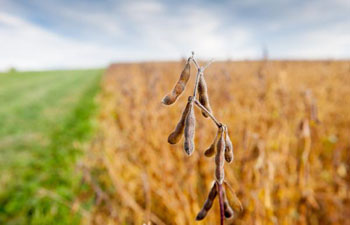
Sun Huan, a renowned soybean genetics and breeding scientist and researcher at the Jilin Academy of Agricultural Sciences, said that a surge in imported soybeans was bound to happen sooner or later. (Network illustration: Oriental IC file photo)
San Nong Zhi Tong Che comprehensive report: Against the backdrop of rising foreign dependence for domestic soybeans, the national on-site demonstration meeting on green soybean yield-increasing and efficiency-enhancing technology models, which closed on September 14 in Heihe City, Heilongjiang Province, reached a consensus: imported soybeans are no monster; domestic soybeans should be positioned toward high protein and food use, and only "two increases and one reduction" (increasing yield, improving quality and reducing costs) can provide a way out.
Pan Wenbo, deputy director of the Planting Industry Management Department of the Ministry of Agriculture, introduced that last year China's soybean consumption was 93 million tons, while domestic output was only just over 10 million tons, meaning that more than 80% needed to be imported; last year imported soybeans totaled 8.169 million tons, and soybean oil 8.8179 million tons, accounting for 80% of international soybean and soybean oil trade volume. "These two 80%s are worth deep reflection by decision-makers, production managers and researchers alike."
Sun Huan, a renowned soybean genetics and breeding scientist and researcher at the Jilin Academy of Agricultural Sciences, said that a surge in imported soybeans was bound to happen sooner or later. First, this is related to China's national conditions of many people and little land: producing one ton of soybeans uses three times as much land as producing one ton of corn. In Brazil, the world's main soybean producing area, the country has 230 million hectares of wasteland; 100 million hectares are used for raising cattle, and the remaining 1.95 billion mu is equivalent to all of China's cultivated land. Second, this is related to people becoming wealthier: from eating enough to eating well. The main standard for eating well is high-quality protein plus vegetable oil. China's per capita soybean consumption has reached 66.9 kg, a level of developed countries; per capita vegetable oil consumption is 88.7 kg, also very high. "With such large consumption, imports are necessary." Third, this is related to industrialization: among China's main agricultural products, only rice is basically self-sufficient; for others such as corn and soybeans, the landed import price is lower than the domestic price, and large imports are an objective law.
But Sun Huan stressed that there is no need to panic. The solution lies in "positioning imported soybeans for oil extraction, basically genetically modified; positioning domestic soybeans for food use, non-genetically modified." First, domestic soybean breeding research should change its previous main goals of increasing oil yield and replacing imports, and turn toward "food use, special use and specialized use" that increases protein content. Domestic soybeans should adopt a defensive rather than offensive strategy. Defend against what? Strictly prevent genetically modified soybeans from entering the food market, and defend against foreign non-genetically modified soybeans entering. Second, China's current per capita meat consumption is 64 kg, far exceeding the 29 kg standard in the national "Guidelines for Food and Nutrition Development (2014-2020)," leading to persistently high rates of obesity, diabetes and cardiovascular disease. The Guidelines clearly state "vigorously develop soybean products," with an annual per capita amount of 13 kg, or 35.6 grams per day. Therefore, developing food-use soybeans is not only a way out for domestic soybeans, but also a way to take responsibility for the health of the Chinese nation. (Reporter Qu Jian)