The added value of growing black wheat will be 20 times that of ordinary wheat
Original title: Beiyuanzi Village: Black wheat sows new hope
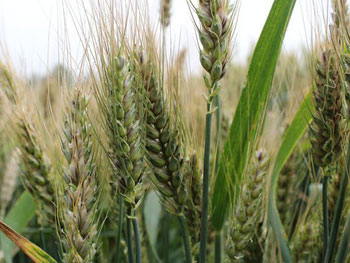
Black wheat (image from the internet)
San Nong Express comprehensive report: "Old Wen has really harvested a 'fortune' recently!" As soon as the reporter walked into Beiyuanzi Village, Tabusai Township, Tumed Left Banner, several villagers could be heard eagerly discussing it, with a tone of envy. After asking carefully, the reporter learned that Wen Wenbing, a villager in the village, had trial-planted two mu of black wheat, harvesting on average nearly 1,000 jin of wheat per mu.
Why does black wheat differ from ordinary wheat and have such high economic value and yield? The reporter went to Wen Wenbing's trial field with this question. Looking from afar at the wheat field, the reporter found that black wheat and ordinary wheat showed no difference in appearance. Observing up close, one finds that this wheat has tall stalks, unusually long ears and many grains; unlike the golden yellow of ordinary wheat, it is greenish-yellow mixed with flecks of purplish-red. Pinching off an ear and rubbing it lightly between the palms, then blowing away the husk, the grains are black, and when chewed they have a sweet fragrance and plenty of chewiness.
Speaking of the introduction and cultivation of black wheat, Liu Pengfei, the first secretary stationed in the village and the person who introduced black wheat, excitedly told the reporter, "During an inspection trip, I unexpectedly found that in a big city a black steamed bun sold for 2 yuan, a bowl of black noodles for 10 yuan, and deeply processed black wheat sold for as much as 68 yuan per jin, with the market often unable to meet demand." After seeing the business opportunity, Liu Pengfei conducted careful market research and found that black wheat cultivation techniques differ little from those for ordinary wheat.
Almost all land that can grow ordinary wheat can also cultivate black wheat, and black wheat has strong resistance to wind and waterlogging. It has the same growth cycle, but its price is close to three times that of ordinary wheat. Sold as good seed, growing one mu of black wheat brings 6,000-9,000 yuan more income than growing one mu of ordinary wheat; if deeply processed, the added value of black wheat will be 20 times that of ordinary wheat.
At present, Tumed Left Banner places industrial development at its core, adhering to the integration of industry and village and enriching the people through industry. With the implementation of the "Ten Full Coverages" project, Liu Pengfei decided to bring black wheat, which the villagers had never heard of, into the village to increase local farmers' incomes.
Next, Liu Pengfei plans to take black wheat to the relevant departments for precise testing of its nutritional components. If it meets the standards, he plans to promote large-scale cultivation in the village. While expanding black wheat cultivation, he will rely on the village's agricultural cooperative to carry out deep processing of black wheat, forming a one-stop "full entrustment service" from seed selection to seed supply, field management, harvesting and sales. A trademark for specialty organic agricultural products is currently being actively registered, a black wheat brand is being launched, brand influence is being built, a green wheat base is being formed, and black wheat is being made into a specialty product to bring to market. Liu Pengfei said the village will carry out industrial restructuring, develop specialty industries, and, with the help of e-commerce platforms such as "Tokyo Easy Buy", bring to market together specialty, efficient, ecological and pollution-free farm products such as hu oil, raw pork and beef cattle, increasing farmers' incomes. (Grassroots reporting team reporters Zhang Yanjie, Yun Jing, correspondent Chen Mufei)