Is the eleven-spotted ladybug a pest or a beneficial insect? This article helps you tell them apart
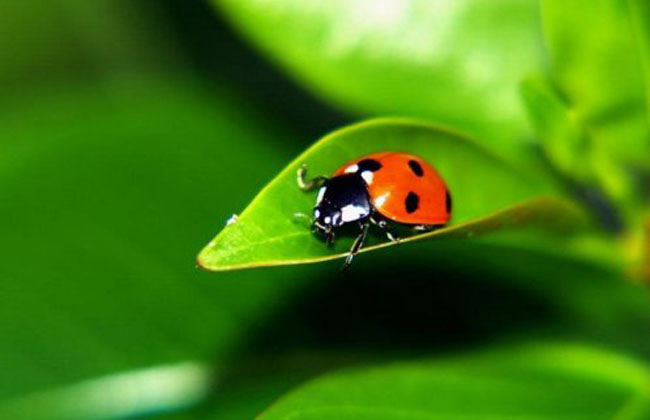
The eleven-spotted ladybug is a type of ladybug, an insect of the genus Coccinella in the family Coccinellidae of the order Coleoptera. Its body length is 3.5 to 5.5 mm, and its body width is 2.7 to 4.1 mm. The body is oval around the margin, and the pronotum is black. It is distributed in Hebei, Shandong, Shanxi, Shaanxi, Ningxia, Gansu, ** and other places in China. Let us take a look below at whether the eleven-spotted ladybug is a pest!
Is the eleven-spotted ladybug a pest?
The eleven-spotted ladybug, like the twenty-eight-spotted ladybug, is a pest. The eleven-spotted ladybug is a phytophagous ladybug that mainly harms plants of the Solanaceae family. Adults and larvae scrape and feed on the leaf mesophyll on the underside of leaves, leaving only the epidermis and forming many irregular, semi-transparent fine grooves that look like the bottom of a basket. They can also eat the leaves into holes or leave only the veins. In severe cases, the affected leaves dry up and turn brown, and the whole plant dies. Areas of eggplant fruits and melon strips that are gnawed often split, and the tissue becomes stiff, rough, and bitter, making it unfit to eat.
Which ladybugs are pests?
1. Twenty-eight-spotted ladybug: The host plants of the twenty-eight-spotted ladybug are Solanaceae vegetables such as potato, eggplant, tomato, and green pepper, as well as Cucurbitaceae vegetables such as cucumber, winter melon, and loofah. It also harms legumes, black nightshade, groundcherry, datura, tobacco, and others. Adults and larvae feed on leaf mesophyll, leaving the upper epidermis in a net-like pattern. In severe cases, they eat all of the leaf. In addition, they also feed on the surface of melons and fruits, and the damaged areas become hard and carry a bitter taste, affecting yield and quality.
2. Ten-spotted ladybug: Both adults and larvae of the ten-spotted ladybug feed on leaves, causing the leaves to become perforated or notched, or eating the leaves completely and leaving only the veins. After the larvae mature, they bore into the soil to make a chamber and pupate. After the adults emerge, they move to the host to cause damage, mainly feeding on grapes, wild grapes, and plants such as five-leaved cayratia.
3. Potato ladybug: Adults and larvae of the potato ladybug scrape and feed on the leaf mesophyll on the underside of leaves, leaving only the epidermis and forming many irregular, semi-transparent fine grooves that look like the bottom of a basket. They can also eat the leaves into holes or even leave only the veins. In severe cases, the affected leaves dry up and turn brown, and the whole plant dies. Areas of the fruit that are gnawed often split, and the tissue becomes stiff, rough, and bitter, making it inedible.
Which ladybugs are beneficial insects?
1. Seven-spotted ladybug: The seven-spotted ladybug is a beneficial insect. Adults can prey on pests such as wheat aphids, cotton aphids, locust aphids, peach aphids, scale insects, and mites, and can greatly reduce the damage to trees, melons and fruits, and various crops caused by pests. It is called a “living pesticide” by people and is widely distributed throughout China.
2. Harlequin ladybug: In addition to preying on cotton aphids, the adults and larvae of the harlequin ladybug can also prey on the eggs and young larvae of the cotton bollworm. An adult can prey on an average maximum of about 70 cotton bollworm eggs per day, while larvae have not been observed preying on cotton bollworm eggs. For newly hatched cotton bollworm larvae, adults consume 70, and fourth-instar larvae consume 69.
3. Six-striped ladybug: The six-striped ladybug is also called the six-spotted ladybug. The larvae are black in body color, with white longitudinal spots in the center of the back, and feed on many kinds of aphids. Adults have more than 20 variations in spot pattern, but the markings on the pronotum are relatively stable. It is commonly distributed from flat land to low-altitude mountain areas, often active on plants with aphids, and can be seen year-round.
4. Propylaea japonica: Propylaea japonica is a beneficial insect that preys on aphids, leafhoppers, planthoppers, and others. In cotton fields in July and August, it preys on summer aphids, cotton bollworms, and the eggs and young nymphs of other pests. At the same time, July to September is also an important natural enemy in orchards, feeding on pests such as aphids, leafhoppers, and planthoppers in apple orchards.
5. Large shoulder ladybug: The adult large shoulder ladybug has a body length of 0.8 to 17 mm, an oval or long oval margin, a hemispherical dorsal side, and a flat ventral side. It is scarce in number and preys on scale insects. Both adults and larvae prey on sugarcane woolly aphids. It is distributed in Guangxi, Fujian, Taiwan, China, Guangdong, Guizhou, Yunnan, and other places.
6. Australian ladybug: The Australian ladybug is an agricultural beneficial insect native to Australia. It prefers shaded environments and has a habit of playing dead. When newly hatched, it often concentrates on feeding on female adult cottony cushion scales, and later gradually disperses. At present, more than 50 countries have introduced the Australian ladybug to control cottony cushion scale. China began introducing it in 1955 for research and utilization, effectively controlling the occurrence of cottony cushion scale. It is known to be distributed in the citrus-producing areas of southern China.