What do thirteen-spotted ladybugs eat? An introduction to their main diet
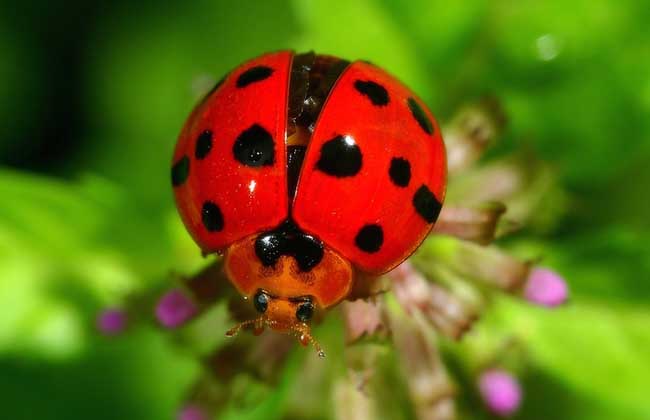
The thirteen-spotted ladybug is an insect of the order Coleoptera, family Coccinellidae, with a body length of 6.0-6.2 mm and a body width of 3.4-3.6 mm. The head is black but with a yellow front margin, the compound eyes are black, and the scutellum is black or brownish-yellow. In China it is distributed in Beijing, Jilin, Hebei, Shandong, Henan, **, Zhejiang and other places. Let us take a look below at what the thirteen-spotted ladybug eats!
What do thirteen-spotted ladybugs eat?
The thirteen-spotted ladybug is a carnivorous insect. Both the larvae and adults of the thirteen-spotted ladybug are beneficial insects, mainly preying on pests such as the cotton aphid, the pagoda tree aphid, the English grain aphid, the bean aphid, the oat bird-cherry aphid, the millet aphid, and the lotus aphid. In the Guanzhong region, adults occur in cotton fields in June and July, and in northern Shaanxi they occur in wheat fields in May.
Are ladybugs beneficial insects or pests?
Ladybugs include both pests and beneficial insects. There are a great many species of ladybugs, and by feeding habit they can be divided into carnivorous ladybugs and herbivorous ladybugs. Adult carnivorous ladybugs prey on any soft-bodied insect, and their favorite food is aphids, such as the seven-spotted ladybug. Most species of herbivorous ladybugs feed on plants of the Solanaceae, Cucurbitaceae and Asteraceae, such as the potato ladybug and the 28-spotted ladybug, which collectively eat the leaves of eggplant and potato and are therefore regarded as pests.
The living habits of the thirteen-spotted ladybug
1. First instar: body length 2-3 mm, the whole body black, from the mesothorax to the eighth abdominal segment, each segment bearing 6 tubercles with bristles.
2. Second instar: body length 4 mm, head and legs entirely black, body grayish-black, the left and right posterior lateral corners of the pronotum yellow, each abdominal segment bearing 6 spiny tubercles on the dorsal and lateral surfaces. On the first abdominal segment, the 2 dorsal spiny tubercles on the left and right are yellow, with black spines. On the fourth abdominal segment, the yellow patches of the dorsal spiny tubercles are not obvious, and the remaining spiny tubercles are black.
3. Third instar: body length 7 mm, body grayish-black, head, legs, thoracic tergites and the anal plate at the end of the abdomen black, the anterior and posterior lateral corners of the pronotum with yellow patches, the lateral spiny tubercles and lower lateral spiny tubercles on the left and right of the first abdominal segment orange-yellow, with black spines. The 2 dorsal-lateral spiny tubercles on the fourth segment are slightly yellowish, and the remaining spiny tubercles are black.
4. Fourth instar: body length about 11 mm, body grayish-black, the anterior and posterior lateral corners of the pronotum with orange-yellow patches. On the first and fourth abdominal segments, the lateral spiny tubercles and lower lateral spiny tubercles on the left and right all have orange-yellow patches, and the remaining spiny tubercles are black.
5. Pupal stage: body length 7 mm, width 5 mm, body yellow, the front margin of the pronotum with 4 black spots, the central 2 arranged in a triangle, the rear margin of the pronotum with 2 black spots in the center, and the two lateral corners with 2 black patches. The mesothoracic tergite has 2 black patches. The dorsal surface of abdominal segments 2-6 has 4 black patches on the left and right. The end of the abdomen carries the black cast skin of the final-instar larva.