Are ladybugs beneficial insects or pests? You'll understand after reading this
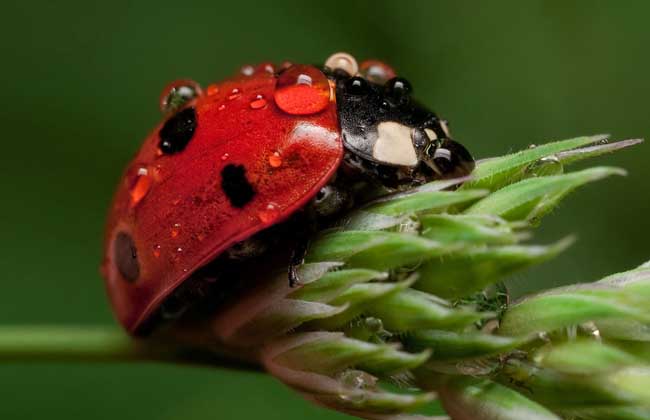
Ladybugs are the general term for round, protruding beetles of the family Coccinellidae in the order Coleoptera. Their body colors are bright, often with red, black or yellow spots. They are also known as pangxiao, hongniang, huadajie, jingui, and even commonly called chouguizi because some species' secretions have a foul odor. In their lifetime they go through complete metamorphosis in four stages: egg, larva, pupa and adult. Now let's take a look together at whether ladybugs are beneficial insects or pests!
Are ladybugs beneficial insects or pests?
Among ladybugs there are both pests and beneficial insects. There are a great many species of ladybugs, and based on feeding habits they can be divided into carnivorous ladybugs and phytophagous ladybugs. Adult carnivorous ladybugs prey on any soft-bodied, tender insects, and their favorite food is aphids, such as the seven-spotted ladybug. Most species of phytophagous ladybugs feed on plants of the Solanaceae, Cucurbitaceae and Asteraceae families, such as the potato ladybug and the 28-spotted ladybug, which collectively eat the leaves of eggplants and potatoes and are therefore regarded as pests.
Which ladybugs are pests?
1. 28-spotted ladybug: The host plants of the 28-spotted ladybug are Solanaceae vegetables such as potato, eggplant, tomato and green pepper, as well as Cucurbitaceae vegetables such as cucumber, winter melon and loofah. In addition, it also harms beans, black nightshade, Chinese lantern, datura, tobacco and others. Adults and larvae feed on the leaf mesophyll, leaving the upper epidermis in a net-like pattern; in severe cases the entire leaf is eaten clean. In addition, they also feed on the surface of melons and fruits, and the damaged parts become hard and carry a bitter taste, affecting yield and quality.
2. Ten-spotted ladybug: Both adults and larvae of the ten-spotted ladybug feed on leaves, making the leaves appear holey or notched, or eating the leaves completely leaving only the veins. After the larvae mature, they burrow into the soil to build chambers and pupate. After the adults emerge, they move to the host plants to cause damage, mainly feeding on plants such as grapes, wild grapes and five-leaved ivy.
3. Potato ladybug: Adults and larvae of the potato ladybug scrape and feed on the mesophyll on the underside of leaves, leaving only the epidermis and forming many irregular translucent fine grooves, resembling the bottom of a basket. They can also eat the leaves into holes, or even leave only the veins. In severe cases the damaged leaves dry up and turn brown, and the whole plant dies. The places where the fruit has been gnawed often split, and the tissue becomes stiff, rough and bitter, making it inedible.
Which ladybugs are beneficial insects?
1. Seven-spotted ladybug: The seven-spotted ladybug is a beneficial insect. Adults can prey on pests such as wheat aphids, cotton aphids, pagoda tree aphids, peach aphids, scale insects and mites, and can greatly reduce the damage suffered by trees, melons, fruits and various crops from pests. It is called a “living pesticide” by people and is widely distributed across China.
2. Harmonia axyridis: In addition to preying on cotton aphids, the adults and larvae of Harmonia axyridis can also prey on the eggs and young larvae of cotton bollworm. The maximum daily average predation by adults is about 70 cotton bollworm eggs; larvae have not been observed preying on cotton bollworm eggs. For newly hatched cotton bollworm larvae, adults consume 70 and fourth-instar larvae consume 69.
3. Six-striped ladybug: The six-striped ladybug is also called the six-spotted ladybird. The larvae are black in body color, with a white longitudinal stripe in the center of the back, and feed on many kinds of aphids. Adult spot patterns vary in more than 20 forms, but the markings on the pronotum are relatively stable. It is commonly distributed from flat ground to low-altitude mountainous areas, often active on plants with aphids, and can be seen year-round.
4. Propylaea japonica: Propylaea japonica is a beneficial insect and preys on aphids, leafhoppers, planthoppers and others. In cotton fields in July and August it preys on summer aphids, cotton bollworms and the eggs and young nymphs of other pests. At the same time, July to September is also an important natural enemy period in orchards, where it feeds on pests such as aphids, leafhoppers and planthoppers in apple orchards.
5. Synonycha grandis: The adult of Synonycha grandis has a body length of 0.8 to 17 mm, with an oval or long oval outline, a hemispherical dorsal surface and a flat ventral surface. It is scarce in number and preys on scale insects. Both adults and larvae prey on sugarcane woolly aphids. It is distributed in places such as Guangxi, Fujian, Taiwan, China, Guangdong, Guizhou and Yunnan.
6. Rodolia cardinalis: Rodolia cardinalis is a beneficial agricultural insect native to Australia. It prefers shaded environments and has a habit of feigning death. Newly hatched individuals often gather to feed on female adult cottony cushion scale, then gradually disperse. At present, more than 50 countries have introduced Rodolia cardinalis to control cottony cushion scale. China began introducing it in 1955 for research and utilization, effectively controlling the occurrence of cottony cushion scale. It is known to be distributed in the citrus-producing areas of southern China.