What is the difference between Cirsium japonicum and Cirsium setosum? A quick guide to tell them apart
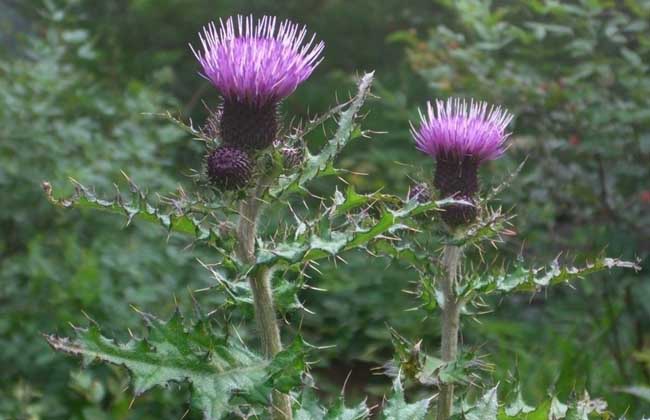
Cirsium japonicum is also known as ci ji, shan luo bo and so on, while Cirsium setosum is also known as ci er cai, ci jiao ya, ci jiao and so on. The varieties of Cirsium japonicum and Cirsium setosum on the market are not only complex but also rather chaotic, with many varieties sharing different names for the same thing. In some regions Cirsium japonicum and Cirsium setosum are called by each other's names, while in other regions the two are not distinguished at all and the same plant is used for both. Let us take a look below at the differences between Cirsium japonicum and Cirsium setosum!
The difference between the stems of Cirsium japonicum and Cirsium setosum
1. Cirsium japonicum: Cirsium japonicum is a perennial herbaceous plant, with tuberous roots spindle-shaped or radish-shaped, up to 7 mm in diameter. The stem is erect, 30-80 cm tall, branched or unbranched, all stems and branches have ridges and are covered with dense or sparse multicellular long articulate hairs; the lower part below the capitulum is grayish white, covered with dense tomentum and multicellular articulate hairs.
2. Cirsium setosum: Cirsium setosum is a perennial herbaceous plant, the underground part is often larger than the aboveground part, with long rhizomes. The stem is erect, the young stem is covered with white cobweb-like hairs, has ridges, 30-80 cm tall, the base is 3-5 mm in diameter, sometimes up to 1 cm, the upper part is branched, the inflorescence branches are hairless or have thin tomentum.
The difference between the leaves of Cirsium japonicum and Cirsium setosum
1. Cirsium japonicum: The basal leaves of Cirsium japonicum are relatively large, the overall shape is ovate, long obovate, elliptic or long elliptic, 8-20 cm long, 2.5-8 cm wide, pinnately deeply lobed or almost fully lobed, the base gradually narrows into a short or long winged petiole, the edge of the petiole wing has spines and spiny teeth. All stem leaves are the same color on both sides, green, with sparse multicellular long or short articulate hairs along the veins on both sides or almost hairless.
2. Cirsium setosum: The basal leaves and middle stem leaves of Cirsium setosum are elliptic, long elliptic or elliptic-oblanceolate, the apex is obtuse or rounded, the base is cuneate, sometimes with a very short petiole, usually without a petiole, all stem leaves are the same color on both sides, green or lighter below, hairless on both sides, very rarely different in color on the two sides.
The difference between the flowers of Cirsium japonicum and Cirsium setosum
1. Cirsium japonicum: The capitulum of Cirsium japonicum is erect, the involucre is bell-shaped, the involucral bracts are about 6 layers, arranged imbricately, gradually longer toward the inner layers, the outer and middle layers are ovate-triangular to long triangular, the apex is long acuminate, with spines 1-2 mm long, the inner layer is lanceolate or linear-lanceolate, 1.5-2 cm long, 2-3 mm wide, the apex is acuminate and soft spiny, all bracts have slightly rough hairs on the outside and sticky glands along the midrib. The florets are red or purple.
2. Cirsium setosum: The capitulum of Cirsium setosum is solitary at the tip of the stem, or the plant has a few or many capitula arranged in a corymb at the tips of the stems and branches, the involucre is ovate, long ovate or ovate-round, 1.5-2 cm in diameter. The involucral bracts are about 6 layers, arranged imbricately, gradually longer toward the inner layers, the outer and middle layers are 1.5-2 mm wide, the inner and innermost layers are long elliptic to linear, the apex of the outer and middle layers has short spines less than 0.5 mm long, the inner and innermost layers are acuminate, membranous, with short spines. The florets are purplish red or white.
The difference between the fruits of Cirsium japonicum and Cirsium setosum
1. Cirsium japonicum: The achene is flattened, obliquely cuneate-oblanceolate, 4 mm long, 2.5 mm wide, the apex is obliquely truncate. The pappus is light brown, in multiple layers, united at the base into a ring, falling off as a whole, the pappus bristles are long feather-like, up to 2 cm long, the inner layer is spindle-shaped enlarged or gradually tapering toward the apex. The flowering and fruiting period is April to November.
2. Cirsium setosum: The achene of Cirsium setosum is pale yellow, elliptic or obliquely elliptic, flattened, 3 mm long, 1.5 mm wide, the apex is obliquely truncate. The pappus is dirty white, in multiple layers, falling off as a whole, the pappus bristles are long feather-like, 3.5 cm long, gradually tapering toward the apex. The flowering and fruiting period is May to September.
Summary: As for the difference in medicinal effects between Cirsium japonicum and Cirsium setosum, clinical traditional Chinese medicine holds that both have the effects of cooling the blood and stopping bleeding; Cirsium japonicum has a better dispersing effect, and its effect of reducing abscesses is better than that of Cirsium setosum, while the main effect of Cirsium setosum is to break blood and free strangury. Although Cirsium japonicum and Cirsium setosum look similar, their effects differ slightly, so they should be distinguished from each other and should not be mixed up.