What is the difference between Lobelia chinensis and Scutellaria barbata? A quick guide to telling them apart
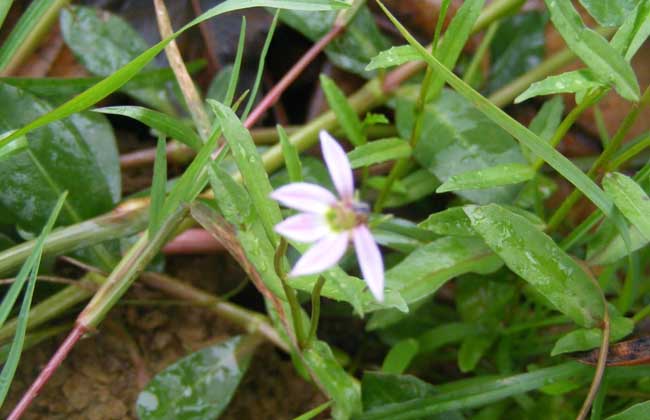
Lobelia chinensis is also known as guarencao, jijiesuo, ximicao and so on. It differs from Scutellaria barbata by only one character in its name, but their medicinal effects are very different. If you carelessly confuse the two, unimaginable consequences can result, so before using them it is well worth learning about the difference between Lobelia chinensis and Scutellaria barbata. Let us take a look below at what differences exist between Lobelia chinensis and Scutellaria barbata!
Family and genus differences between Lobelia chinensis and Scutellaria barbata
1. Lobelia chinensis: Lobelia chinensis is a perennial herbaceous plant in the plant kingdom, Angiosperms, Dicotyledons, Sympetalae, Campanulales, Campanulaceae, genus Lobelia.
2. Scutellaria barbata: Scutellaria barbata is a perennial herbaceous plant in the plant kingdom, Angiosperms, Dicotyledons, Asteridae, Lamiales, Lamiaceae, Scutellarioideae, genus Scutellaria, subgenus Scutellaria.
Morphological differences between Lobelia chinensis and Scutellaria barbata
1. Lobelia chinensis: The stems of Lobelia chinensis are slender and weak, creeping, rooting at the nodes, with upright branches. The leaves are alternate, sessile or nearly sessile, elliptic-lanceolate to linear. There is usually 1 flower, borne in the leaf axil of the upper part of the branch, the pedicel is slender, and the bracteoles are hairless. The calyx tube is obconical, and the corolla is pink or white. The capsule is obconical, the seeds are elliptic, and the flowering and fruiting period is from May to October.
2. Scutellaria barbata: The rhizome of Scutellaria barbata is short and thick, producing clustered fibrous roots. The stems are upright and four-angled. The leaves have short petioles or are nearly sessile, and the leaf blades are triangular-ovate or ovate-lanceolate. The flowers are solitary in the leaf axils of the upper part of the stem or branches, the calyx is about 2 mm long when flowering, and the corolla is purple-blue. The nutlets are brown, oblate, with small wart-like protrusions, and the flowering and fruiting period is from April to July.
Distribution differences between Lobelia chinensis and Scutellaria barbata
1. Lobelia chinensis: Lobelia chinensis prefers a damp environment, tolerates slight damp drought to a degree, is cold-resistant, and can overwinter naturally in the field. It grows in damp places such as field ridges, grasslands, ditch edges and stream banks, and is distributed in the middle and lower reaches of the Yangtze River in China and the provinces and regions south of it, as well as in other Asian countries east of India.
2. Scutellaria barbata: Scutellaria barbata grows at the edges of paddy fields, stream banks or moist grasslands, at an altitude below 2000 m, and is distributed in China in Hebei, Shandong, Shaanxi, Henan, Jiangsu, Zhejiang, Taiwan, China, Fujian, Jiangxi, Hubei, Hunan, Guangdong, Guangxi, Sichuan, Guizhou, Yunnan and other provinces and regions.
Differences in effects between Lobelia chinensis and Scutellaria barbata
1. Lobelia chinensis: Lobelia chinensis is pungent in taste, neutral in nature, and enters the heart, small intestine and lung meridians. It has the effects of clearing heat and detoxifying, and promoting diuresis and reducing swelling. It mainly treats carbuncles, boils and sores, snake and insect bites, tympanites and edema, damp-heat jaundice, eczema and damp sores and other conditions.
2. Scutellaria barbata: Scutellaria barbata is pungent and bitter in taste, cold in nature, and enters the lung, liver and kidney meridians. It has the effects of clearing heat and detoxifying, and resolving stasis and promoting diuresis. It mainly treats boils, swelling and toxic lesions, sore throat, traumatic injuries, edema, jaundice, snake and insect bites and other conditions.