What is the difference between poplar and willow? Learn to tell them apart quickly
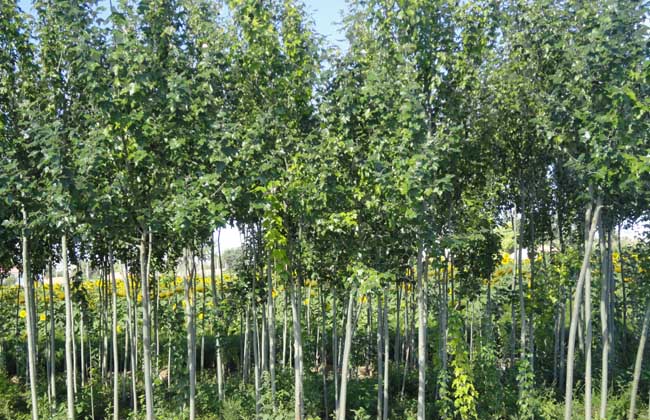
Poplar is the general term for deciduous trees of the genus Populus in the family Salicaceae, including Euphrates poplar, white poplar, cottonwood, and others. Willow is the general term for plants of the genus Salix, such as dry willow, glandular willow, and weeping willow. Willows adapt to a wide range of ecological environments; willows grow in mountains, plains, sand dunes, and polar regions alike. Let us take a look below at the differences between poplar and willow!
Differences in family and genus between poplar and willow
1. Poplar: Poplar is a deciduous tree of the plant kingdom, seed plants phylum, angiosperms subphylum, dicotyledon class, Dilleniidae subclass, order Malpighiales, family Salicaceae, genus Populus.
2. Willow: Willow is a deciduous shrub of the plant kingdom, seed plants phylum, angiosperms subphylum, dicotyledon class, Dilleniidae subclass, order Malpighiales, family Salicaceae, genus Salix.
Morphological differences between poplar and willow
1. Poplar: Poplar twigs have terminal buds and 2 or more bud scales. Leaves are simple and alternate, ovate or nearly round, turning yellow before falling. Catkins are unisexual, with male and female flowers on separate trees, lacking petals, with a ring-shaped disc and bracts. The bract tip is split, and stamens are numerous. Fruit is a capsule. Seeds are small and have a tuft of hairs.
2. Willow: Willow branches are cylindrical, with a nearly round pith center. There is no terminal bud, and lateral buds usually lie close against the branch, with a single bud scale. Leaves are alternate, rarely opposite, usually narrow and long, mostly lanceolate, with pinnate veins, serrate or entire margins. Catkins are upright or slanting, opening before the leaves, or at the same time as the leaves, rarely after the leaves. The capsule splits into 2 valves, and the seeds are small and mostly dark brown.
Differences in distribution between poplar and willow
1. Poplar: Poplar is the most widely distributed and most adaptable tree species in the world, mainly distributed in the temperate and cold-temperate forest zones of the Northern Hemisphere, from 22 to 70°N, and from low altitude up to 4800 m. In China, its distribution spans 25 to 53°N and 76 to 134°E, covering the Northeast, Northwest, North China, and Southwest regions.
2. Willow: Willow adapts to a wide range of ecological environments; willows grow in mountains, plains, sand dunes, and polar regions alike. They are mainly distributed in the temperate regions of the Northern Hemisphere. Dry willow is produced on the plains of North China, Northeast China, and Northwest China. Weeping willow is found throughout China, and has been introduced to many countries in Europe, Asia, and the Americas.
Differences in uses between poplar and willow
1. Poplar: Large-diameter poplar wood is mainly used to produce plywood, laminated veneer lumber, and furniture; small-diameter poplar wood is used to produce fiberboard, particleboard, paper, and matches. It can be widely used for ecological shelterbelts, the Three-North Shelter Forest Program, agricultural and forestry shelterbelts, and industrial timber forests. As road greening and landscape planting, it is also an excellent tree species, characterized by being tall and majestic, uniform and distinctive, quick to form a forest, able to prevent wind and sand, and able to absorb exhaust gas.
2. Willow: Willow has a graceful tree shape and leafs out and blooms early; in early spring the whole tree is tender green, and it is one of the main tree species in parks of the northern temperate zone. The bark can be used for utensils and as a papermaking raw material, the catkin fluff can be used to stuff chair cushions and pillows, the branches and fibrous roots can dispel wind and dampness, the fibers of willow branch bark can be used as textile and rope materials, the branches can be woven into hand baskets, carrying baskets, wicker boxes, and safety helmets, and the wood can be used for small farm tools, small utensils, and making charcoal.