What is the difference between a cobra and a king cobra? Learn to tell them apart quickly
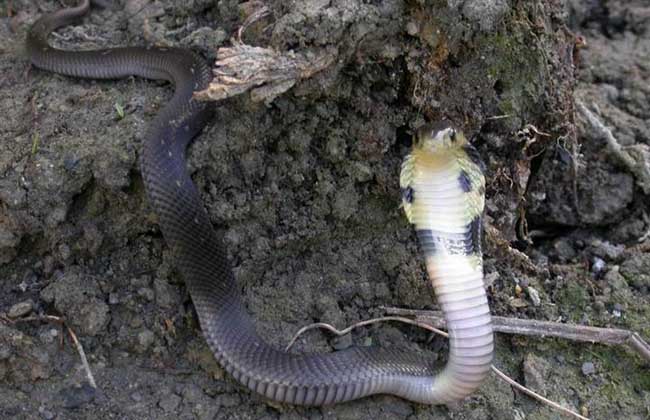
The cobra is also known as the rice-spoon snake, bat snake, neck-swelling snake, and so on. It is the collective name for animals of the genus Naja, a genus in the family Elapidae, and its members are mostly referred to collectively as cobras. Although the name "king cobra" contains the word "cobra", it is not classified as a cobra because of insufficient evolutionary relatedness. Let us take a look below at the differences between cobras and king cobras!
The difference in family and genus between cobras and king cobras
1. Cobra: The cobra is the collective name for highly venomous snakes of the animal kingdom, phylum Chordata, subphylum Vertebrata, class Reptilia, subclass Diapsida, order Squamata, suborder Serpentes, family Elapidae, genus Naja.
2. King cobra: The king cobra is a large highly venomous snake of the animal kingdom, phylum Chordata, subphylum Vertebrata, class Reptilia, subclass Diapsida, order Squamata, suborder Serpentes, family Elapidae, subfamily Elapinae, genus Ophiophagus.
The difference in appearance between cobras and king cobras
1. Cobra: The cobra can reach a body length of 1.2-2.5 m. Its upper jawbone is relatively short, with grooved fangs at the front, and there are often 1 to several small teeth behind the grooved fangs. It is a front-fanged venomous snake, and its venom is mainly neurotoxic. It is not fond of activity, and its head is oval; in appearance it is not easy to distinguish from non-venomous snakes. The top of the head has large symmetrical scales, with no cheek scales. The pupils are round, the tail is cylindrical, and the entire spine has hypapophyses.
2. King cobra: The king cobra is a large snake, with the largest recorded total length being 5580 millimeters. The dorsal surface of the body is dark brown, and the back of the neck has a yellow-white "∧"-shaped marking, with no spectacle-shaped marking. The back of the trunk and tail has narrow white crossbands edged in black. The lower jaw is earth-yellow, and the ventral surface of the body is grayish brown with black linear markings. The body weight is generally 6 kilograms, and the lifespan is around 20 years.
The difference in habits between cobras and king cobras
1. Cobra: Cobras often like to live in shrubland or bamboo forests in plains, hills, and mountainous areas. They are also commonly seen on hillside grave mounds, beside water at the foot of mountains, by streams and fish ponds, in fields, and near dwellings. They have a very broad diet, eating snakes, fish, and frogs as well as birds, eggs, and scorpions. They are diurnal snakes, mainly going out during the day to forage.
2. King cobra: The king cobra likes to live alone, coming out during the day to hunt and hiding at night in rock crevices or tree holes to rest. Its food is usually other snakes. Its body contains anti-venom serum, so when other venomous snakes bite the king cobra, it is usually unharmed, including suitably sized pythons and various venomous and non-venomous snakes such as cobras, banded kraits, many-banded kraits, and rat snakes. When food is insufficient, it will even eat other members of its own kind.
The difference in toxicity between cobras and king cobras
1. Cobra: Early symptoms of a cobra bite include drooping eyelids, double vision, difficulty swallowing, dizziness, facial paralysis, and vomiting, followed by gradually developing paralysis of the respiratory muscles. The usual treatment is the use of antivenom, and artificial assisted ventilation may be needed until the venom degrades and the patient can breathe on their own. If treatment is ineffective, the patient often dies 6-12 hours after the bite, mostly from suffocation due to respiratory paralysis.
2. King cobra: The king cobra moves agilely and can turn its head flexibly. After biting something, it often does not easily let go. Its venom contains about 100 milligrams of dry venom, while the average lethal dose is 12 milligrams. A bitten person will experience swelling, nausea, abdominal pain, and respiratory paralysis within minutes, along with symptoms such as speech impairment and coma. If the person does not receive timely medical treatment within half an hour after being bitten, death is certain.