What is the difference between pothos and spider plant? Learn to quickly tell the two apart
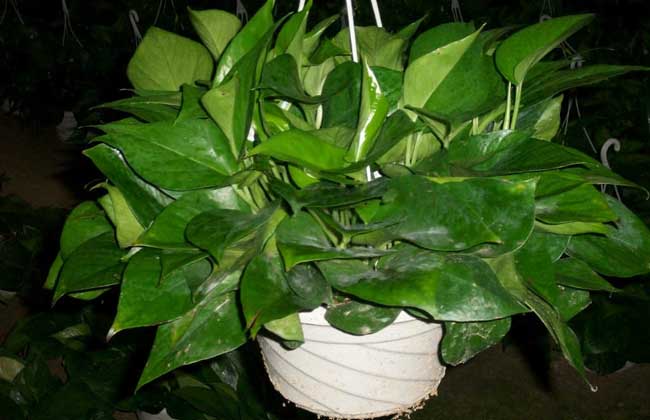
Pothos is also known as devil's ivy, golden pothos, golden vine, etc. It originates from the tropical rainforest areas of Indonesia and the Solomon Islands. Spider plant is also known as Gui orchid, grape orchid, fishing orchid, tree banana melon, Zhe he orchid, upside-down orchid, earth American ginseng, eight-leaf orchid, etc. It originates from southern Africa and is now widely cultivated around the world. Let's take a look below at what differences there are between pothos and spider plant!
The difference in family and genus between pothos and spider plant
1. Pothos: Pothos is a large evergreen climbing plant in the plant kingdom, Angiosperms, Monocotyledons, Arales, Araceae, Monstereae, Epipremnum.
2. Spider plant: Spider plant is a perennial evergreen herbaceous plant in the plant kingdom, Angiosperms, Monocotyledons, Liliales, Liliineae, Liliaceae, Anthericeae, Chlorophytum.
The morphological difference between pothos and spider plant
1. Pothos: On mature branches of pothos, the petioles are stout, 30-40 cm long, slightly enlarged at the base, the upper joint 2.5-3 cm long and slightly thickened, with a broad groove on the ventral side, leaf sheaths long, leaf blades thinly leathery, emerald green, usually (especially on the leaf surface) with many irregular pure yellow patches, entire, asymmetrical ovate or ovate-oblong, apex shortly acuminate, base deeply cordate, slightly stout, slightly raised on both sides.
2. Spider plant: The rhizome of spider plant is horizontal or oblique, with many fleshy roots. Leaves clustered, linear, slender, orchid-like, sometimes with green or yellow stripes in the middle. The flowering stem emerges from the leaf cluster and grows into a stolon that produces leaf clusters at the tip; flowers white, usually in clusters of 2-4, arranged in a loose raceme or panicle, and purple petals occasionally appear inside. The capsule is triangularly flattened-globose, about 5 mm long and about 8 mm wide, with 3-5 seeds per locule. Flowering period May, fruiting period August.
The difference in habits between pothos and spider plant
1. Pothos: Pothos is a shade-loving plant that likes hot and humid environments, avoids direct sunlight, prefers shade, and likes soil rich in humus, loose and fertile, and slightly acidic; its overwintering temperature should not be lower than 15°C. It survives when it meets water, and because of its tenacious vitality it is called the “flower of life”. Its trailing green branches and leaves are very easy to satisfy; when grown indoors, whether potted or with a few stems cut for hydroponics, it can grow well.
2. Spider plant: Spider plant likes warm and humid, semi-shaded environments, has strong adaptability, is relatively drought-tolerant, not very cold-tolerant, and is not choosy about soil. It grows better in well-drained, loose and fertile sandy soil. It is not strict about light and is generally suitable for growing under medium light conditions, and it also tolerates weak light. The optimum growing temperature is 15-25°C, and the overwintering temperature is 5°C.
The difference between pothos and spider plant
1. Pothos: Pothos can absorb benzene, trichloroethylene, formaldehyde, etc. from the air. A newly renovated home should be ventilated more, and then placing a few pots of pothos can basically meet the standard for moving in. Pothos also has a very strong air purification function and has the reputation of a green purifier. It can convert formaldehyde into substances such as sugar or amino acids during metabolism, and can also decompose benzene emitted by copiers and printers, and can also absorb it.
2. Spider plant: Spider plant branches are slender and drooping. In summer or when temperatures are high in other seasons, it produces small white flowers. The flowers are concentrated at the ends of the drooping branches, with yellow stamens, and the small young leaves inside are sometimes purple. It can be used for potted ornamental display. Spider plant is easy to grow and highly adaptable. It is one of the most traditional hanging indoor plants. It can carry out photosynthesis under weak light and can absorb more than 80% of harmful gases indoors, and its ability to absorb formaldehyde is extremely strong.