What is the difference between the Oriental ratsnake and the cobra? How to tell the two apart
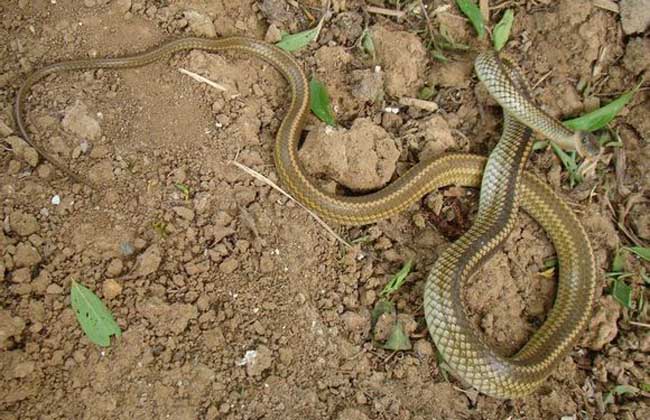
The Oriental ratsnake, commonly known as the black snake, black wind snake, etc., is a relatively large snake of the genus Ptyas in the family Colubridae. It is widely distributed in China and often lives in hilly areas. The cobra is the common name for animals of the genus Naja, a genus in the family Elapidae, whose members are mostly collectively called cobras. There are currently about 20 or more confirmed species. Let us take a look below at the difference between the Oriental ratsnake and the cobra!
The difference in family and genus between the Oriental ratsnake and the cobra
1. Oriental ratsnake: The Oriental ratsnake is a large snake in the animal kingdom, phylum Chordata, subphylum Vertebrata, class Reptilia, subclass Diapsida, order Serpentes, suborder Alethinophidia, family Colubridae, subfamily Colubrinae, genus Ptyas.
2. Cobra: The cobra is a large snake in the animal kingdom, phylum Chordata, subphylum Vertebrata, class Reptilia, subclass Diapsida, order Serpentes, suborder Alethinophidia, family Elapidae, genus Naja.
The difference in appearance between the Oriental ratsnake and the cobra
1. Oriental ratsnake: The Oriental ratsnake can reach a total length of more than 2.5 m. Its back is greenish brown or brownish black and brownish, with a yellow longitudinal stripe running down the center of the back, and two black longitudinal stripes on each side of the body that disappear toward the rear of the body. In subadults, the longitudinal stripes over the whole body are obvious. The head and neck are distinctly differentiated. The rostral scale is visible from the top of the head, and there are two slightly larger scales behind the parietal scales. The dorsal color ranges from greenish brown and brownish to dark brown.
2. Cobra: Most cobras are very large, reaching 1.2 to 2.5 m. Their most obvious feature is that the skin folds on their necks can expand outward to intimidate opponents. When provoked, they raise the front part of their bodies, the skin folds on both sides of the neck swell, and at this time the spectacle markings on the back become even more obvious, while they emit a “hissing” sound to frighten enemies. In fact, many snakes can expand their necks more or less, and the cobra is simply more typical.
The difference in toxicity between the Oriental ratsnake and the cobra
1. Oriental ratsnake: The Oriental ratsnake is a non-venomous snake. It inhabits mid- and low-elevation mountain areas below 1600 m, often near farmland and ditches, and is sometimes also found in villages. It moves quickly and reacts agilely, is gentle in nature, and usually does not bite people. Due to habitat destruction and large-scale human hunting, the number surviving in the wild has greatly decreased at present, and it should be protected.
2. Cobra: The cobra is highly venomous. Early symptoms include ptosis, diplopia, difficulty swallowing, dizziness, facial paralysis, and vomiting, followed by gradually appearing paralysis of the respiratory muscles. The general treatment is the use of antivenom, and artificial assisted ventilation may be needed until the venom degrades and the patient can breathe spontaneously. If treatment is ineffective, the patient often dies 6 to 12 hours after the bite, mostly from suffocation due to respiratory paralysis.
The difference in distribution between the Oriental ratsnake and the cobra
1. Oriental ratsnake: The Oriental ratsnake lives in mid- and low-elevation mountain areas, plains, hilly areas, or low mountain areas below 1600 m in eastern, central, southeastern, and southwestern China. It is distributed in Hebei, Henan, Shaanxi, Shandong, Gansu, Sichuan, Guizhou, Hubei, Anhui, Jiangsu, Zhejiang, Jiangxi, Hunan, Fujian, Taiwan, China, Guangdong, Guangxi, and other places. No reports have been seen from abroad.
2. Cobra: The cobra has an extremely wide distribution range. Apart from Europe and Madagascar, they can be found in most warm regions of the world. In China, they are mainly distributed in the south in Yunnan, Guizhou, Anhui, Zhejiang, Jiangxi, Hunan, Fujian, Taiwan, China, Guangdong, Guangxi, Hainan, and other places, and can occasionally be seen in the north as well, especially in large numbers in Yongzhou, Hunan.