What is the difference between cedar and Korean pine? Learn to easily tell the two pines apart
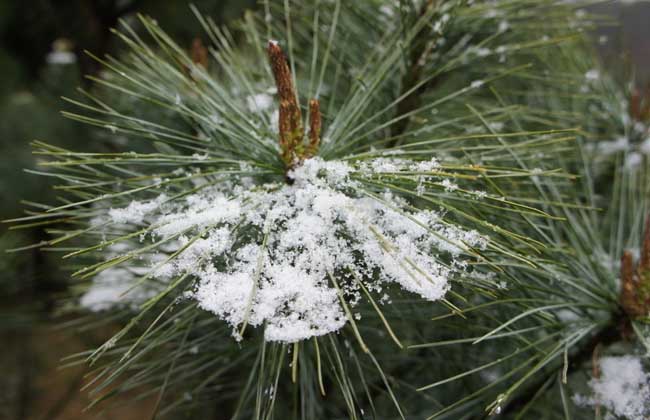
Cedar is also known as fragrant cypress, pagoda pine, foreign cypress, Himalayan cedar, etc. It is produced in western Asia, the western Himalayas, Africa, and the Mediterranean coast. Korean pine is also known as sea pine, fruit pine, Korean pine, red fruit pine, Chosen pine, etc. It is distributed in China, Japan, Korea, South Korea, Russia, and other places. Let's take a look below at the differences between cedar and Korean pine!
Differences between the trunks of cedar and Korean pine
1. Cedar: Cedar can reach about 30 m tall, with a diameter at breast height of up to 3 m. The bark is dark gray, split into irregular scaly flakes. The branches are spreading, slightly ascending or slightly drooping, the persistent bud scales at the base curve outward, and the branchlets often droop. First-year long shoots are pale grayish yellow, densely covered with short villi, slightly white powdery, and second- and third-year branches are gray, pale brownish gray, or dark gray.
2. Korean pine: The Korean pine tree can reach 30 m tall, with a diameter at breast height of 1 m. The bark of young trees is grayish brown, nearly smooth; the bark of large trees is grayish brown or gray, longitudinally split into irregular rectangular scaly blocks, and after the flakes fall off, the red-brown inner bark is exposed. The upper part of the trunk often forks, the branches are nearly spreading, and the crown is conical. First-year branches are densely covered with yellow-brown or red-brown soft hairs. Winter buds are pale red-brown, oblong-obovoid, pointed at the tip, slightly covered with resin, and the bud scales are rather loosely arranged.
Differences between the leaves of cedar and Korean pine
1. Cedar: The leaves of cedar spread radially on long shoots, while the leaves on short shoots are clustered. The leaves are needle-like, hard, pale green or dark green, 2.5-5 cm long and 1-1.5 mm wide, wider in the upper part, sharply pointed at the tip, gradually narrowing below, often triangular in cross-section, rarely with a conspicuous ridge. On the ventral side of the leaf there are 2-3 stomatal lines on each side, and on the dorsal side 4-6, and when young the stomatal lines have white powder.
2. Korean pine: Korean pine needles are 5 per bundle, 6-12 cm long, thick and hard, straight, dark green, with fine serrations on the edges, usually without stomatal lines on the dorsal side, and with 6-8 pale blue-gray stomatal lines on each side of the ventral surface. The cross-section is nearly triangular. The hypodermal cells are a single layer, but between the two resin canals on the dorsal side there is often a discontinuous second hypodermal layer distributed, 1-3 or up to 15 cells wide; there are 3 resin canals, medial, located at the three corners; the leaf sheath falls early.
Differences between the flowers of cedar and Korean pine
1. Cedar: The male cones of cedar are long-ovoid or elliptic-ovoid, 2-3 cm long and about 1 cm in diameter. The female cones are ovoid, about 8 mm long and about 5 mm in diameter.
2. Korean pine: The male cones of Korean pine are elliptic-cylindrical, red-yellow, 7-10 mm long, mostly densely clustered in spikes at the lower part of new branches. The female cones are green-brown, cylindrical-ovoid, upright, solitary or several gathered near the top of new branches, with a thick and long stalk.
Differences between the cones of cedar and Korean pine
1. Cedar: The cones of cedar are pale green before maturity, slightly white powdery, red-brown when mature, ovoid or broadly elliptic, 7-12 cm long and 5-9 cm in diameter, with a rounded blunt apex and a short stalk. The middle seed scales are fan-shaped obdeltoid, 2.5-4 cm long and 4-6 cm wide, broadly rounded above, with inwardly curved margins, wedge-shaped in the middle, ear-shaped below, claw-like at the base, and the scale back is densely covered with short villi. The bracts are short and small. The seeds are nearly triangular, and the seed wing is broad and large, longer than the seed, 2.2-3.7 cm long including the seed.
2. Korean pine: The cones of cedar are conical-ovoid, conical-long-ovoid, or ovate-oblong, 9-14 cm long, rarely longer, 6-8 cm in diameter, with a stalk 1-1.5 cm long. After maturity, the seed scales do not open, or open slightly to expose the seeds, but the seeds do not fall off. The seed scales are rhombic. The seeds are large, borne in the grooves on the lower ventral side of the seed scales, wingless or with slight ridges at the tip and on both sides of the upper part, dark purple-brown or brown, obovate-triangular, slightly flattened.