What is the difference between Danshen (Salvia miltiorrhiza) and red ginseng? This article helps you tell them apart
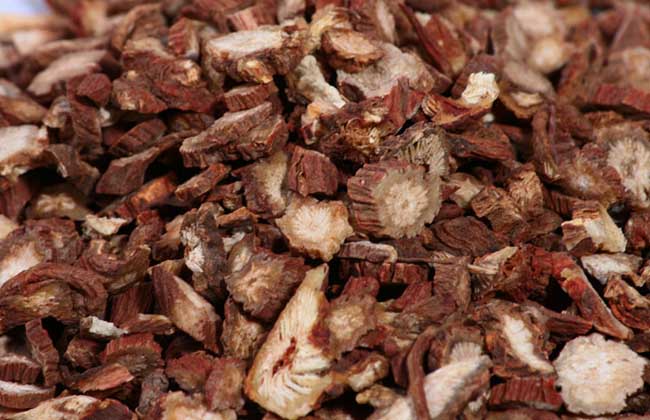
Danshen is also known as Chishen, Zidanshen, Honggen, and so on. Due to years of unchecked harvesting of wild Danshen, wild resources are now on the verge of extinction. Red ginseng is a processed product of ginseng, made through steps such as soaking, washing, sorting, steaming, air-drying and oven-drying, and it has the effects of greatly tonifying original qi, restoring the pulse and securing collapse, and tonifying qi to control blood. Let us take a look below at the difference between Danshen and red ginseng!
The difference in family and genus between Danshen and red ginseng
1. Danshen: Danshen is a perennial upright herbaceous plant in the plant kingdom, Angiosperms, Dicotyledoneae, Sympetalae, Tubiflorae, Lamiaceae, Salviae, Salvia, and the subgenus Sclarea.
2. Red ginseng: Red ginseng is a perennial herbaceous plant in the plant kingdom, Angiosperms, Tracheophytes, Magnoliopsida, Rosidae, Apiales, Araliaceae, Paniceae, and Panax.
The difference in appearance between Danshen and red ginseng
1. Danshen: The rhizome of Danshen is short and thick, sometimes with residual stem bases at the top. The roots are several, long cylindrical, slightly curved, some branched and with fibrous fine roots. The surface is brownish red or dark brownish red, rough, with longitudinal wrinkles. The outer bark of old roots is loose, mostly purplish brown, and often flakes off in scales. The texture is hard and brittle, the cross-section is loose, with cracks or slightly smooth and dense, the bark part is brownish red, the wood part is grayish yellow or purplish brown, and the vessel bundles are yellow-white, arranged radially.
2. Red ginseng: The main root of red ginseng is spindle-shaped or cylindrical, the surface is semi-transparent, reddish brown, occasionally with opaque dark yellow-brown patches, with longitudinal grooves, wrinkles and fine root scars, the upper part has intermittent indistinct ring patterns, and the lower part has 2 to 3 twisted and crossed branch roots, and bears curved fibrous roots or only traces of fibrous roots. The rhizome is 1 to 2 cm long, with several sunken stem scars (lu bowls) on it, and some bear 1 to 2 complete or broken adventitious roots. The texture is hard and brittle, and the cross-section is flat and horny.
The difference in origin between Danshen and red ginseng
1. Danshen: Danshen likes to grow in a mild climate, sufficient light and humid air environment, and grows better in fertile sandy loam, but it can grow in neutral, slightly acidic and slightly alkaline soils. It is produced in Hebei, Shanxi, Shaanxi, Shandong, Henan, Jiangsu, Zhejiang, Anhui, Jiangxi and Hunan, among other places, and is also distributed in Japan.
2. Red ginseng: Ginseng prefers a cool and humid climate, is cold-tolerant, likes slanting and diffused light, and avoids strong light and high temperatures. It has been listed as a nationally rare and endangered protected plant, and nature reserves such as Changbai Mountain have carried out protection. It has been widely cultivated in the three northeastern provinces, and has been introduced and planted in provinces and regions such as Hebei, Shanxi, Shaanxi, Hunan, Hubei, Guangxi, Sichuan and Yunnan.
The difference in effects between Danshen and red ginseng
1. Danshen: Danshen has the effects of activating blood and removing stasis, unblocking the meridians and relieving pain, clearing the heart and relieving restlessness, and cooling blood and dispersing abscesses. It is used for conditions such as chest impediment and heart pain, abdominal and hypochondriac pain, abdominal masses and accumulations, painful heat impediment, restlessness and insomnia, irregular menstruation, dysmenorrhea and amenorrhea, and sores and swellings with pain.
2. Red ginseng: Red ginseng is a processed product of ginseng. In addition to the effects of tonifying original qi, tonifying the spleen and lungs, and promoting fluid production and calming the mind, its medicinal nature is warmer, with the characteristics of strong fire, strong power and strong effects, and it is better at greatly tonifying original qi, restoring yang and rescuing from collapse, and tonifying qi to control blood. For anyone showing frequent fear of cold, cold hands and feet, dizziness and fatigue, weakness of the limbs, easy fatigue, shortness of breath and panting, frequent feeling of cold in the stomach, long-term diarrhea, insomnia and frequent dreams, impotence and frequent urination, and so on, red ginseng can be chosen for supplementation.