What is the difference between sugar apple and custard apple? Explained clearly in one article
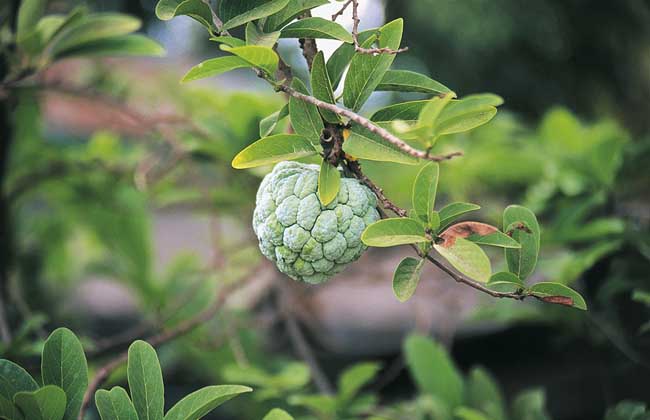
There is no difference between sugar apple and custard apple; custard apple is in fact the scientific name of the sugar apple. The fruit is similar in size to a pomegranate, and because its surface is covered with angular, finger-sized soft wart-like protrusions that resemble the head of a Buddha, it is also known as Buddha's head fruit, and sugar apple. It is a perennial semi-deciduous small tree of the genus Annona in the family Annonaceae. It is listed as one of the famous tropical fruits for its unique fragrance, and is widely grown as a cash crop. Its flesh is white and sweet.
The sugar apple tree is 3-5 m tall, with thin, grayish-white bark and many branches. The leaves are as thin as paper, arranged in two rows, elliptic-lanceolate or oblong. The flowers are solitary or in clusters of 2-4 at the tips of branches or opposite the leaves, about 2 cm long, greenish-yellow, and drooping. The fruit is an aggregate berry formed from many round or oval ripe carpels that are slightly joined and easily separated, round or heart-shaped conical, hairless, yellow-green, covered on the outside with a white powdery bloom. The flowering period is May to June, and the fruiting period is June to November.
The sugar apple is native to the tropical regions of the Americas. It is cultivated in Hainan, Fujian, Taiwan, China, Guangdong, Guangxi and Yunnan in China. It likes light and a warm, humid climate, and requires an annual average temperature above 22°C. It is not cold-tolerant; young trees suffer cold damage at 4°C, and 4-5 year old trees are also damaged by freezing at -2°C. The tree is drought-tolerant and dislikes waterlogging, and has strong adaptability to soil, but grows rapidly with large, high-quality fruit in well-drained sandy loam.
The sugar apple is extremely nutritious and very high in calories. It can beautify the face, replenish physical strength, purify the blood, strengthen bones, prevent scurvy, boost immunity and fight cancer. Since ancient times it has been regarded as a superior tonic with extremely high nutritional value. The fruit is mainly eaten fresh, but can also be made into juice, fruit syrup, jam, fruit wine, beverages, etc. Its roots can be used as a purgative, and its leaves can be used to disinfect wounds. The flesh, with sugar and milk added, is made into a sherbet-like dessert called shanpula, a refreshing and thirst-quenching food. For people with diabetes, regularly eating sugar apple has a clear supportive dietary effect in reducing symptoms. Its fiber content is relatively high, which can effectively promote intestinal peristalsis and expel accumulated stool from the intestines.
The sugar apple must be ripe and soft before eating. After buying it and bringing it home, if it is still hard, wrap it in newspaper, spray some water, and leave it for one or two days. Once it softens, cut it open with a knife, remove the skin and eat it; it is delicious, sweet and fragrant, with a very unique flavor. It can also be cut into pieces to make various iced drinks. The skin is not edible. If the skin turns black, do not worry, the flavor is even better. Because the sugar apple is sweet and warm in nature and astringent, and contains tannins, do not eat it together with dairy products or high-protein foods, so as to avoid forming substances that are hard to digest.