What is the difference between Buddhist pine and yew? A quick guide to telling them apart
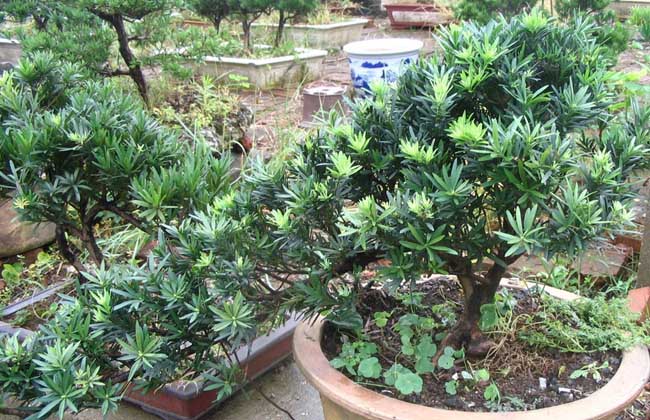
Buddhist pine is also known as luohanshan, tushan and so on; its fruit, root bark and receptacle have medicinal value, and its wood can be used for furniture, utensils, stationery and farm tools. Yew is also known as Chinese cypress, red bean tree, purple yew and so on; it is recognized worldwide as an endangered natural rare anti-cancer plant, an ancient relict tree species left over from the Quaternary glaciation. Let's take a look at the differences between Buddhist pine and yew below!
The family and genus differences between Buddhist pine and yew
1. Buddhist pine: Buddhist pine is an evergreen coniferous tree in the plant kingdom, Pinophyta, Taxopsida, Podocarpales, Podocarpaceae, Podocarpus.
2. Yew: Yew is a general term for about 11 species of evergreen trees in the plant kingdom, Pinophyta, Taxopsida, Taxales, Taxaceae, Taxus.
The morphological differences between Buddhist pine and yew
1. Buddhist pine: Buddhist pine grows up to 20 m tall, with a diameter at breast height of 60 cm, and a broad ovate crown. The bark is grayish brown to dark gray, shallowly longitudinally fissured, and flakes off in plates. Branches and leaves are dense; the leaves are linear-lanceolate, spirally alternate, 7-12 cm long and 7-10 mm wide, with the midrib distinctly raised on both sides, dark green on the surface and yellow-green on the back. The flowering period is April to May, and the seeds mature in August to September.
2. Yew: The branchlets of yew are irregularly alternate, with many or a few persistent bud scales at the base; the leaves are linear, spirally arranged, twisted at the base into two ranks, straight or sickle-shaped, decurrent, with the midvein raised above and two pale gray, gray-green or pale yellow stomatal bands below, and no resin canals in the leaves. It is dioecious, with cones solitary in the leaf axils. The seeds are nut-like, borne in a cup-shaped fleshy aril, with a distinct hilum; when mature, the fleshy aril is red, with a short stalk or almost no stalk.
The origin differences between Buddhist pine and yew
1. Buddhist pine: Buddhist pine is produced in Jiangsu, Zhejiang, Fujian, Anhui, Jiangxi, Hunan, Sichuan, Yunnan, Guizhou, Guangxi, Guangdong and other provinces and regions, cultivated in gardens as an ornamental tree, with very few wild trees, and it is also distributed in Japan. It prefers a warm and humid climate, has weak cold tolerance and strong shade tolerance, prefers well-drained moist sandy loam, has strong adaptability to soil, and can also survive on saline-alkali soil.
2. Yew: Yew is a tree species endemic to China, produced in southern Gansu, southern Shaanxi, Sichuan, northeastern and southeastern Yunnan, western and southeastern Guizhou, western Hubei, northeastern Hunan, northern Guangxi and southern Anhui (Huangshan), often growing in the upper part of high mountains above 1000-1200 m in altitude, and cultivated in Lushan, Jiangxi.
The uses differences between Buddhist pine and yew
1. Buddhist pine: The timber of Buddhist pine is fine and uniform, easy to process, and can be used for furniture, utensils, stationery and farm tools, while the root bark, leaves, seeds and receptacle can be used as medicine. Buddhist pine has an elegant and upright charm, with a vigorous and powerful proud momentum, and combined with meanings such as “longevity” and “keeping wealth and good fortune” in Chinese culture, it has extremely high ornamental value.
2. Yew: The roots, stems and leaves of yew can all be used as medicine; it can treat difficult urination and eliminate swelling and pain, has therapeutic effects on diabetes, irregular menstruation in women and increased blood volume, and can also be used for postpartum conditioning, with certain therapeutic effects on women's conditions. It also has very broad development prospects in landscaping and indoor bonsai.