What Is the Difference Between Morning Glory and Petunia? Learn to Tell the Two Flowers Apart with Ease
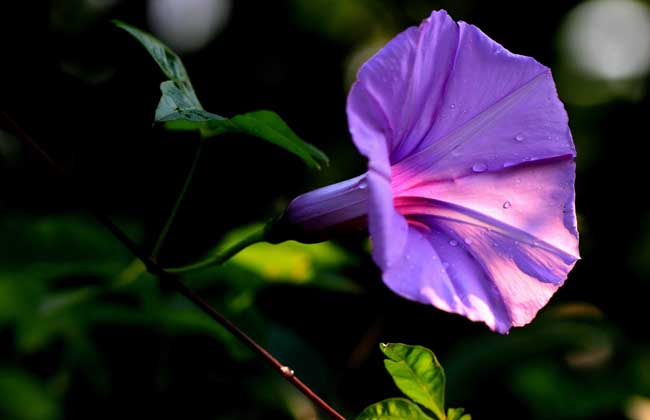
Morning glory is also known as qianniu, trumpet flower, jinjiaolazi, large morning glory, and qinniangzi, among other names, and is a common twining herbaceous flower of summer and autumn. Petunia's scientific name is Petunia hybrida, and it is also known as jianzihua, dwarf trumpet, and sweet potato flower, among other names; it is distributed in South America and is now widely popular in many countries. It looks somewhat similar to morning glory in appearance, so let us take a look below at the differences between morning glory and petunia!
Differences in Family and Genus Between Morning Glory and Petunia
1. Morning glory: Morning glory is an annual twining herbaceous flowering plant in the plant kingdom, phylum Angiospermae, class Dicotyledoneae, subclass Asteridae, order Solanales, family Convolvulaceae, subfamily Convolvuloideae, tribe Ipomoeeae, genus Ipomoea.
2. Petunia: Petunia is a perennial herbaceous plant in the plant kingdom, phylum Angiospermae, class Dicotyledoneae, subclass Sympetalae, order Tubiflorae, suborder Solanineae, family Solanaceae, tribe Cestreae, genus Petunia.
Differences in Appearance Between Morning Glory and Petunia
1. Morning glory: The stems of morning glory are covered with reversed short soft hairs mixed with reversed or spreading long stiff hairs; the leaves are broadly ovate or nearly round, the middle lobe is oblong or ovate, and the leaf surface is sparsely or densely covered with slightly stiff soft hairs. The flowers are axillary, solitary or usually 2 borne at the top of the peduncle, and the peduncles vary in length. The corolla is funnel-shaped, blue-purple or purplish-red, and the corolla tube is lighter in color. The capsule is nearly spherical, and the seeds are ovate-trigonous, about 6 mm long, blackish-brown or cream-yellow, covered with brown short down.
2. Petunia: Petunia plants are 15-80 cm tall, and there are also clustered and creeping types; the leaves are elliptical or ovate. It can bloom in the same year after sowing, and the flowering period lasts for several months. The corolla is trumpet-shaped, and the flower forms include single-petaled, double-petaled, wrinkled petal edges, or irregular serrated edges, among others. Flower colors include red, white, pink, purple, and various types with spots, reticulations, and stripes, among others. The seeds are extremely small, with a thousand-seed weight of about 0.1 grams.
Differences in Habits Between Morning Glory and Petunia
1. Morning glory: Morning glory is a flower with very strong vitality. It likes a mild climate, ample sunlight, and a humid and ventilated environment. Morning glory also has strong adaptability to soil, is relatively tolerant of drought and saline-alkali conditions, and is not afraid of high temperatures and intense summer heat. It is a deep-rooted plant, and when planted in the ground the soil should be deep.
2. Petunia: Petunia likes a warm environment with ample sunlight, is not tolerant of frost, and fears waterlogging. The suitable growth temperature is 13-18°C, and the winter temperature is 4-10°C. If it is below 4°C, plant growth stops. In summer it can withstand high temperatures above 35°C. It is best to use loose, fertile, and well-drained sandy loam. Petunia is a long-day plant, and the growth period requires ample sunlight. Under normal light conditions, it takes about 100 days from sowing to flowering.
Differences in Flower Color Between Morning Glory and Petunia
1. Morning glory: The flower colors of morning glory are bright and beautiful. Common flower colors include white, red, pink, blue, purple, and so on, and the color is related to genetic genes. At the same time, morning glory often changes color. Purple morning glory sometimes turns blue and sometimes turns red. The color change is caused by a gene that leads to a change in the pH of the cell sap vacuole.
2. Petunia: Petunia flowers are large and numerous, bloom profusely, have a long flowering period, and are rich in color. With a suitable climate or greenhouse cultivation, it can bloom in all four seasons. Flower colors include purple-red, bright red, peach red, pure white, flesh color, and many striped varieties (red background with white stripes, light blue background with red veins, peach red background with white spots and stripes, etc.), and it generally does not change color.