What is the difference between monk fruit and passion fruit? Mainly look at these points
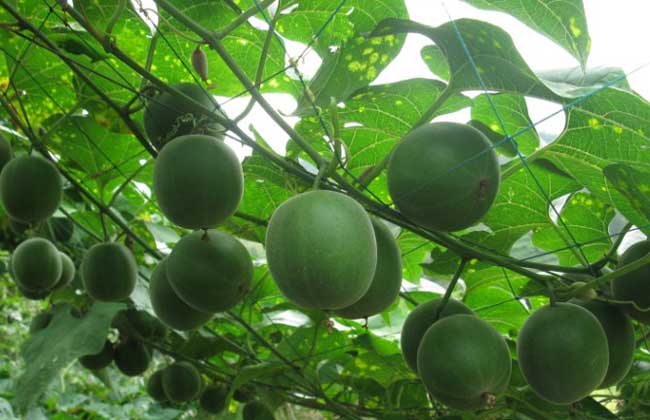
Monk fruit is also known as Lahanguo, Shenxianguo, etc. It is a precious local specialty of Guilin and one of the first batch of materials approved by the state for both medicinal and culinary use. Passion fruit is also known as Xifanlianguo, Reqingguo, Xifanguo, etc. It can be eaten raw or used as a vegetable or feed. The pulp is juicy, and when calcium bicarbonate and sugar are added, it can be made into an aromatic and delicious beverage. As a medicine, it has stimulating and strengthening effects. Let us take a look below at the differences between monk fruit and passion fruit!
Differences in family and genus between monk fruit and passion fruit
1. Monk fruit: Monk fruit is a perennial vine in the plant kingdom, Angiosperms, Dicotyledons, Dilleniidae, Violales, Cucurbitaceae, tribe Trichosantheae, genus Momordica.
2. Passion fruit: Passion fruit is a herbaceous vine in the plant kingdom, Angiosperms, Dicotyledons, Malpighiales, Passifloraceae, genus Passiflora.
Differences in appearance between monk fruit and passion fruit
1. Monk fruit: The roots of monk fruit are perennial, fleshy, spindle-shaped or nearly spherical; the stems and branches are slightly stout; the leaves are membranous, ovate-cordate, triangular-ovate, or broadly ovate-cordate; it is dioecious; the male inflorescence is racemose; the female flowers are solitary or 2-5 clustered at the tip of a 6-8 cm long common peduncle; the fruit is spherical or oblong; the pericarp is relatively thin and easily brittle after drying; the seeds are numerous and pale yellow; the flowering period is from May to July, and the fruiting period is from July to September.
2. Passion fruit: Passion fruit is a herbaceous vine, about 6 m long; the stem has fine stripes and is hairless; the leaves are papery, with a wedge-shaped or cordate base; the cyme is reduced to only 1 flower, opposite the tendril; the flower is fragrant; the berry is ovoid, 3-4 cm in diameter, hairless, and purple when ripe; the seeds are numerous, ovate, 5-6 mm long; the flowering period is June, and the fruiting period is November.
Differences in origin between monk fruit and passion fruit
1. Monk fruit: Monk fruit grows at an altitude of 300-1400 m in subtropical mountain forests, moist riverside areas, or shrub forests. It is distributed in Guangxi, Guangdong, Hunan, and other provinces in southern China. It is mainly produced in Longjiang Township, Yongfu County, Guilin City, Guangxi Zhuang Autonomous Region, and in towns such as Longsheng and Baishou. Ninety percent of China's monk fruit is produced in Yongfu County and Longsheng County.
2. Passion fruit: Passion fruit is native to the Greater and Lesser Antilles and sometimes grows wild in valley forests at an altitude of 180-1900 m. It is now widely cultivated in tropical and subtropical regions. In China, it is cultivated in Guangxi, Guangdong, Hainan, Fujian, Yunnan, Taiwan, China, and other places.
Differences in effects between monk fruit and passion fruit
1. Monk fruit: Monk fruit is sweet in taste and cool in nature, entering the lung and large intestine meridians. It has the effects of moistening the lungs and stopping cough, and promoting fluid production and quenching thirst. It is suitable for cough due to lung heat or lung dryness, whooping cough, and thirst due to summerheat damaging fluids, among others. In addition, it also has the effect of moistening the intestines and promoting bowel movements.
2. Passion fruit: The pericarp of passion fruit can be used as feed and to extract pectin. The roots, stems, and leaves can all be used as medicine. It has magical health effects such as reducing inflammation and relieving pain, invigorating blood and strengthening the body, nourishing yin and tonifying the kidneys, lowering lipids and blood pressure, refreshing the mind and sobering up from alcohol, eliminating fatigue, detoxifying and beautifying the skin, and enhancing immunity.