How dangerous is a whale explosion exactly?
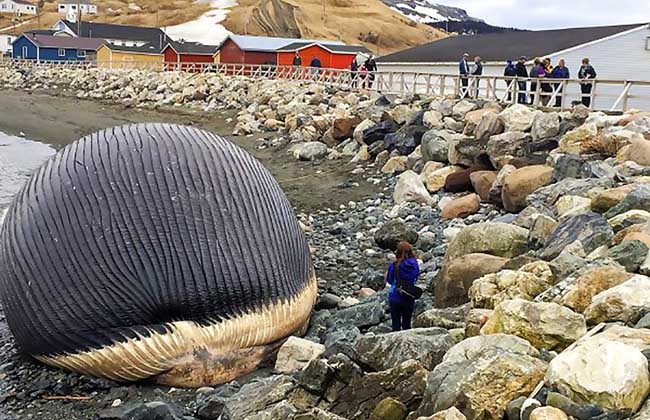
A whale explosion refers to the bursting of a dead whale's body caused by an excessive buildup of decomposition gases inside it. Because a whale eats a large amount of food while alive, digestion produces gases such as methane, hydrogen sulfide and ammonia. After death, the faster the internal tissues and organs decompose, the faster bacteria spread, and as the body's proteins break down, more gases are produced, increasing the pressure in the abdomen and intestines. If not handled properly, an explosion is highly likely.
The Tainan sperm whale explosion
On January 26, 2004, a slightly decomposed sperm whale 17 m long and weighing 50 tonnes exploded while being transported for research, scattering blood and internal organs everywhere and briefly drenching passers-by in a rain of blood. The sperm whale had died on a beach and was originally going to be sent to Tainan University for scientific research, but unexpectedly exploded on a street in Tainan during transport. Because the site was in a busy district of Tainan, Taiwan, China, a great many people were affected, and the incident once made the headlines in Taiwan, China. On January 24, 2004, this whale, a male sperm whale, died after stranding on the coast of Taixi Township, Yunlin County, Taiwan, China. The relevant authorities mobilized a flatbed truck, 3 cranes and more than 50 personnel, and it took 13 hours to load it onto the vehicle for transport by road.
The blue whale explosion hazard in Canada
In April 2014, the carcass of a blue whale washed ashore onto the rocky beach of a small coastal town on the island of Newfoundland, Canada. The mayor said that the carcass of this blue whale, about 25 m long, was filled with methane, that its head had swollen into a giant balloon and that it had already begun to stink and could explode at any moment. Canadian officials had previously asked the town to dispose of the blue whale carcass as soon as possible, but the local government said that because it lacked equipment for safe handling, it could not break down the carcass. When asked why the carcass was not simply pushed back into the sea, the mayor explained that because the carcass was in danger of exploding at any moment, pushing it back into the sea would endanger passing vessels, and leaving it on the rocky beach was truly a last resort. The town is located within Gros Morne National Park on the west coast of the island of Newfoundland and is itself a tourist attraction, with more and more tourists coming to see the blue whale carcass. The local government has tried its best to persuade tourists to stay away from the blue whale carcass and has put up a cordon, but it still cannot stop curious tourists.
The whale explosion hazard on the French seaside
On November 24, 2015, according to a Daily Mail report, a stranded whale appeared along the French seaside. After the whale's carcass rotted, its body filled with natural gas, its head swelled into a giant balloon because of the gas and it had already begun to stink, with a risk of explosion at any moment. Wildlife experts warned tourists to stay away from the coast, and the French authorities closed the seaside sightseeing route and evacuated the crowd. The French authorities began racing against time, trying to break down the carcass in the shortest possible time and, if necessary, possibly using explosives to blow it up.