What information is there about the narwhal? A comprehensive guide in one article
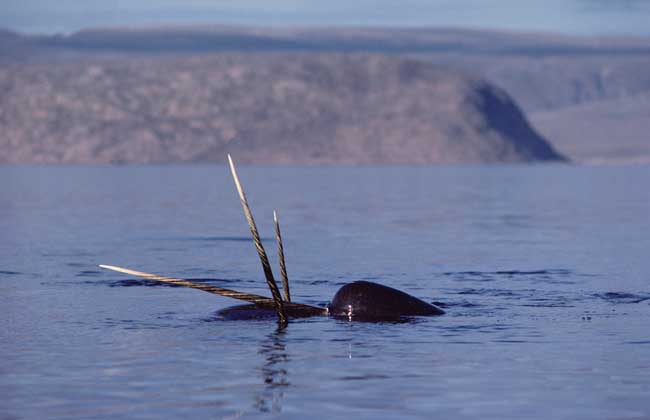
The narwhal is a type of whale, scientific name Monodon monoceros, also known as the narwhal whale, and its most striking feature is the long tusk extending from its head, which is a canine tooth protruding from the upper left jaw beyond the lip, reaching a length of 2-3 m, in a spiral shape, and named because it looks like a horn. Apart from being used in fights, the tooth is also a symbol of its status within the pod. Let us now take a look at what information there is about the narwhal!
Morphological characteristics of the narwhal
The narwhal's body length is generally 4 to 5 m (not including the tusk), with males slightly longer than females, and adult whales average 800-1,600 kg in weight. It has no dorsal fin, and the way its neck and vertebrae connect is more like that of other mammals, unlike dolphins and whales. Its belly is white, and its back has many dark brown or black spots. At birth its skin color is very dark, and as it ages the skin becomes increasingly white; by sexual maturity many white patches appear on the belly, and older narwhals are again almost white in body color, so they may be confused with the beluga.
Feeding habits of the narwhal
The narwhal is a deep diver and forages at various depths in the ocean. In winter it preys on benthic organisms, especially flatfish living beneath thick ice, and in summer its main food is Arctic cod, flatfish and some other fish. The narwhal's feeding activity is irregular, and the time it surfaces is extremely short. Dives usually last 7-20 minutes. When migrating it swims extremely fast and floats at or near the sea surface. When hunting it circles or moves slowly, and all members of a pod may surface or dive at the same time. It may rest at the surface for as long as 10 minutes, exposing part of its back or one pectoral fin, and when sea conditions are poor it tends to rest in deeper water.
Social habits of the narwhal
Narwhals usually form groups of 1-25 individuals, and there are also cases of several hundred or even several thousand traveling together. "Small groups" are composed of a mix of various animals, but they generally have the characteristic of being segregated by age and sex. Females and calves often form groups, while calves or adult males also frequently form separate units. Several hundred small groups may gather and travel together, and several thousand narwhals may spread over several sq km. During the autumn migration, sex segregation is most obvious in large groups. When males surface to breathe, the tusk can occasionally be seen, but it is generally below the surface. Groups of large males mostly stay in the open sea farther from shore than females or calves.
Reproductive habits of the narwhal
The narwhal is a seasonal breeder, with a gestation period of about 15.3 months. The mating season is in March-May, and calving occurs in July and August of the following year. The duration of lactation is unknown, and it is guessed to be comparable to the beluga's 20-month lactation period. The interval between births is usually 3 years, with one calf per birth (there are also some records of twins). The calf leaves the mother's uterus tail first and head last. A newborn narwhal's blubber layer is up to 25 mm thick, its body length is 1.5-1.7 m, and it weighs 80 kg. It can swim immediately after birth, but is still cared for by the female for a period. Both sexes usually reach sexual maturity at 4-7 years of age. At maturity, females are 4 m long and weigh 900 kg, while males are 4.7 m long and weigh 1,600 kg. The wild lifespan is about 50 years, and captive breeding has not yet been successful.
Population threats to the narwhal
The narwhal's natural enemies include killer whales, walruses, polar bears and sharks, yet none of these compare with humans. Inuit people have hunted narwhals for centuries for their valuable tusks and thick skin, and eating their skin raw is even a traditional delicacy for them, while the meat is used to feed dogs, and the blubber and fat can be used for burning and lighting. At present, Inuit people in Canada hunt narwhals with high-speed motorboats and powerful rifles, causing unnecessary harm, because at least half of the injured narwhals will sink or escape, but they still cannot escape death. Although the annual hunting quota is several hundred, the total number killed is often far higher than that.