What information is there about beluga whales? A comprehensive guide
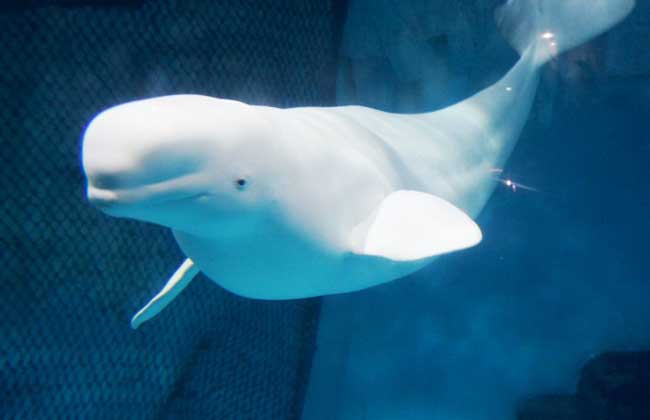
The beluga whale is a type of whale, also known as the beluga, sea canary, and so on. It is a marine mammal of the genus Delphinapterus in the family Monodontidae. It likes to live at or near the sea surface, has quite strong diving ability, and is well adapted to the Arctic drift ice environment. The vast majority of beluga whales in the world live in the waters north of Europe, the United States, Alaska and Canada. Let's take a look at what information there is about beluga whales below!
Morphological characteristics of the beluga whale
The beluga whale's forehead bulges outward prominently and is round and smooth, the snout is very short, the lip line is wide, and the body color is very pale, a unique white. Compared with other cetaceans, the only obvious difference is that in summer, when the skin takes on a pale yellow tone, it can molt and replace it. A mature beluga whale's entire body appears a unique white, the head is proportionally small with a melon on top, and behind the blowhole there are clearly defined folds. The body surface often has scars, and there may also be folds and layers of blubber. A dorsal ridge replaces the dorsal fin, located in the upper middle-to-rear position. The trailing edge of the tail fin may be dark brown, the central notch is obvious, and the tail flukes protrude more noticeably with age. The neck can move freely, allowing it to nod and turn its head. The pectoral fins are broad and scraper-shaped and move freely, the lip line is wide, and the male's pectoral fins curl upward, becoming more obvious with age.
The social habits of the beluga whale
The beluga whale is a social animal. Hundreds to thousands of beluga whales form groups. The way the pods are composed is still uncertain; age and sex seem to play a leading role in group formation. When a beluga pod enters the migration destination at an estuary, it appears very excited. Although it has already made a long-distance migration, it seems not tired at all. Besides continuously "communicating" with different voices, it also uses its broad tail flukes to play in the water, exposing half its body above the surface in a very beautiful posture.
The migratory habits of the beluga whale
Every year in July, tens of thousands of beluga whales set out from the Arctic region and begin their summer migration. There may be as few as a few or as many as tens of thousands, swimming grandly toward their destination, leisurely playing along the way while continuously performing. Migration destinations are mostly concentrated in places at higher latitudes, but some mischievous beluga whales seem to have a habit of wandering independently away from the group. Sometimes a beluga whale will head south alone, swimming several hundred kilometers, showing itself at the Heilongjiang River estuary, the Firth of Forth in Scotland, or the Rhine River, bringing people an unexpected surprise.
The feeding habits of the beluga whale
The beluga whale will enjoy various prey, including smelt, flounder, sculpin, salmon and cod, and also eats invertebrates such as crabs, shrimp, clams, worms, octopus, squid and other benthic marine organisms. Because they do not have many large sharp teeth for biting prey, they generally suck food into the mouth whole, so the prey cannot be too large, otherwise they may choke.
The natural enemies of the beluga whale
The known natural enemies are killer whales and polar bears. Polar bears attack beluga whales in the same way they attack seals, usually waiting around breathing holes where beluga whales are trapped by ice, striking them heavily with their powerful forepaws, and then dragging them onto the ice to eat. Killer whales arrive around August. Beluga whales can usually recognize their sounds. In addition, the killer whale's prominent flippers hinder its own flexible movement in the ice, so the way killer whales attack beluga whales is somewhat different.
The reproductive habits of the beluga whale
Male beluga whales mature in 7 to 9 years, and females in 4 to 7 years. The reproductive interval is 2 to 3 years, and females stop reproducing in their early twenties. The breeding season is generally from late February to early April, and the gestation period lasts 14 months, though delayed embryo implantation may also occur. The young are born in the summer from May to July, and newborn calves are entirely dark gray. When a female gives birth, a guard pod patrols around. After birth is completed, the main body of the pod withdraws, leaving only young nursing females. The nursery area is generally chosen in waters with a temperature of about 10°C and close to rivers, which is very important for the calves because they do not have as much cold-resistant blubber as adult whales. The calf is protected between two adult females and is dragged along by the female with the current as it swims. The beluga whale's nursing period is 1.5 to 2 years.