What information is there about orcas? A detailed look at orcas
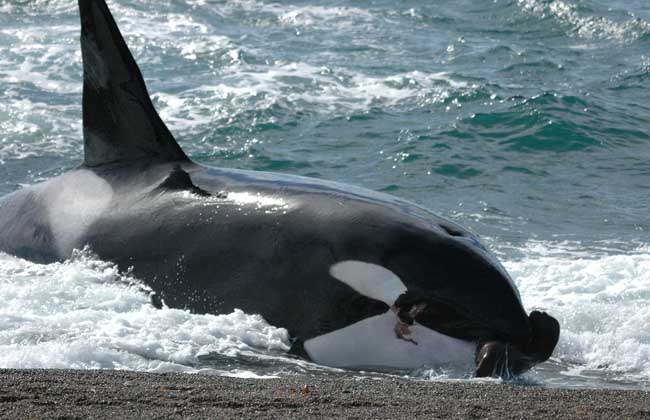
The orca is a type of whale, a large marine mammal in the family Delphinidae, genus Orcinus, also known as the killer whale and grampus. Its habitat is mainly polar and temperate seas, and it is widely distributed across the world's oceans, including the seas off northern Japan and Iceland. It appears to have no obvious restrictions regarding water temperature, depth and other factors, and it has a fairly high habitat density in high-latitude regions. Let's take a look below at what information there is about orcas!
Morphological characteristics of the orca
The largest recorded body length of an adult male orca is 9.75 m, with a weight of 9524 kg, making it the largest species in the family Delphinidae. The orca shows obvious sexual dimorphism in body size, flipper size and dorsal fin height. The maximum body length of females is 7.70 m, while that of males is 9 m. The dorsal fin of adult males is upright, reaching 1.0-1.8 m in height, while the dorsal fin of females is distinctly sickle-shaped and less than 0.7 m high. The head is slightly rounded, with an indistinct beak. The dorsal surface is black, with 1 light gray saddle patch behind the dorsal fin. The lower jaw and the ventral surface of the body from the front of the lower jaw to the urogenital region are white, with 1 white leaf-shaped patch extending upward from the urogenital region to the side of the body behind the dorsal fin. The ventral surface of the tail flukes is white or light gray and may have black edges. There is 1 white oval patch above and behind each eye. The saddle patch is not obvious when young and becomes more prominent after sexual maturity.
Feeding habits of the orca
The orca's food includes fish, other cetaceans, pinnipeds, sea otters, birds, reptiles and cephalopods. Of 362 orca stomachs collected in Antarctica, 217 contained fish, 75 contained remains of minke whales, 35 contained pinnipeds, and 35 contained cephalopods. With a highly developed brain and great physical strength, these highly intelligent animals can use these advantages to chase and kill many top predators in the ocean. The menu of some orca family members lists at least 9 kinds of shark delicacies, including the great white shark and the shortfin mako shark, which strike fear into many animals.
The orca's sound system
If the humpback whale is the “singer” among cetaceans and the beluga is the “canary” of the sea, then the orca is the “language master” among cetaceans. It can produce 62 different sounds, and these sounds have different meanings. For example, when hunting fish, it emits intermittent “chattering” sounds, like the sound of forcefully pulling the hinges of a rusty iron door or window. After fish are intimidated by this sound, their behavior becomes abnormal. Orcas can not only emit ultrasound to find fish schools through echolocation, but can also use ultrasound to judge the size of a fish school and the direction in which it is swimming. This ability is very important for carnivores living in the ocean, because the water below is very dark, making it difficult to clearly see distant prey in such an environment.
The orca's group-living habits
Orcas like to live in groups, ranging from small groups of 2-3 individuals to large groups of 40-50. Every day they always spend 2-3 hours quietly staying at the surface of the water. Because their lungs are filled with enough air, they can safely float on the sea surface with their huge dorsal fins exposed. Group members often keep their pectoral fins in contact, appearing affectionate and united. If a member of the group is injured or loses consciousness due to an accident, the other members will come to help, supporting and holding it up with their bodies or heads so that it can continue to float on the sea surface. Even when sleeping, they huddle together, in order to look after one another and maintain a certain degree of alertness. They travel together, feed together, use the population as a social organization, rest within a large family, and rely on one another to survive and grow up.
The orca's social lineage
The social form of the orca is matrilineal. The choice of mating partners is relatively complex, and it is not the case that male strength decides everything. For example, the matriarch of a whale group can sometimes live to 80 years old, and there are examples of mating in old age. The partners they choose to mate with are generally older males within the whale group. Scientists are not clear about the criteria by which female whales choose partners, and mating has rarely been observed on site. It is only known that there is a mother, but not where the father is. Within the whale group there is no father-son relationship or father-daughter relationship. The responsibility of males is to go out to find food and then lead the whale group in a collective hunt. The division of labor is clear, with no hierarchy of status, while mother-daughter and mother-son relationships are very stable and last a lifetime; they generally do not leave the group. The reason solitary whales appear is generally injury or getting lost. When a group becomes too large, it will “split”, producing a new group.
Reproductive habits of the orca
Orcas can mate throughout the year. Females give birth once every 3-5 years, with a gestation period of 1 year, 1 calf per litter, and a nursing period of about 1 year as well. During the first 1-2 years after birth, when hungry or calling the female, the calf can only make harsh sounds. Later, as it grows older, it gradually imitates the sounds of adults, improving and enriching its own calls. However, because orca language is complex and varied, it takes at least more than 5 years for a calf to fully master the “language” of adults. Females stop giving birth at about 40 years of age, after which the average reproductive period is about 10 years and can be extended to more than 30 years. The average lifespan is estimated at 80-90 years. Males reach sexual maturity at about 15 years of age, with an average lifespan of about 29 years and a maximum lifespan of about 50-60 years.