What Are the Facts About Sperm Whales? A Comprehensive Guide to Sperm Whales
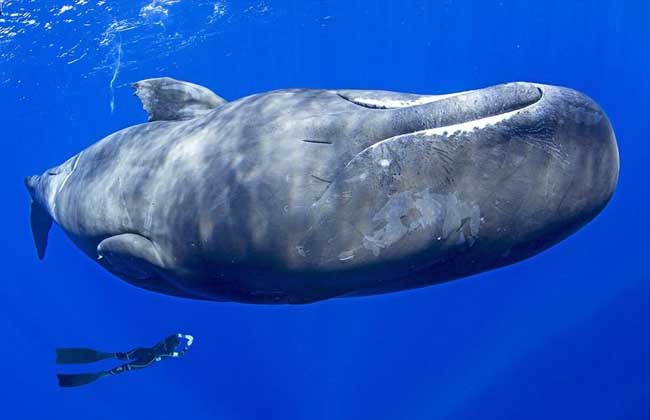
The sperm whale is a type of whale, also known as the giant sperm whale, cachalot, and so on. It is a marine mammal of the genus Physeter in the family Physeteridae. The dried product of its intestinal secretions is called “ambergris”, a precious traditional Chinese medicine used to treat cough and asthma with reversed qi, heart and abdominal pain, and other conditions. It is widely distributed in the ice-free seas of the world. Let us take a look below at what facts there are about the sperm whale!
Morphological Characteristics of the Sperm Whale
The sperm whale has a fish-like body and breathes with lungs. Its head is enormous, while its lower jaw is relatively small, with teeth only on the lower jaw. Its body length can reach 18 m, and its weight exceeds 50 tons. The head can account for 1/3 of the body. It has no dorsal fin and is extremely capable at diving, being the mammal that dives the deepest and stays submerged the longest. Its neck is short, and the head appears connected to the trunk. The cervical vertebrae are fused. The nostrils form a blowhole located at the tip of the snout. The forelimbs have become fins, with the forearm degenerated, the palm elongated, and the number of digits increased, though the digits and claws cannot be seen externally. The hind limbs are degenerated, and the tail is fish-like with a horizontal tail fin. It swims by waving its tail.
Habitat Environment of the Sperm Whale
The sperm whale is widely distributed in the ice-free seas of the world, mainly inhabiting waters between 70 degrees north and south latitude, with deep and highly productive waters being the most favored. There is a clear difference in the distribution of adult male and female whales. Females usually inhabit waters deeper than 1000 m and within 40 degrees latitude, but in the North Pacific they can reach about 50 degrees north latitude. Males follow their mothers in tropical waters when young, and after growing up they leave the group and gradually move toward higher latitudes. The larger and older the male, the more toward higher latitudes its distribution range shifts, even approaching the floating ice zones near the poles. Female sperm whales and groups of immature sperm whales usually remain within an area 1000 km wide for at least 10 years, while adult males move over a much broader range.
Social Habits of the Sperm Whale
Sperm whales like to live in groups and often form large groups of dozens or more, even two or three hundred, made up of a few males and large numbers of females and calves. Each year they make north-south migrations for reproduction and foraging. They swim very fast, reaching more than a dozen nautical miles per hour. Sperm whales also have excellent diving ability, diving as deep as 2200 m and staying underwater for as long as two hours. Because sperm whales dive for such long periods, there is not much chance of seeing them on the sea surface. Long-term stable female groups form the core unit of sperm whale society. Such small groups can reach 12 adult females, accompanied by their female and young male offspring. They generally swim at 5-3 nautical miles per hour, and can reach 7-12 nautical miles per hour when startled. Old males with body lengths of 12 to 17 m mostly roam the ocean alone, and associations lasting more than 1 day are rarely observed. An entire group of sperm whales sometimes strands on sandy beaches.
Feeding Habits of the Sperm Whale
Sperm whales mainly feed on large squid, octopus, and fish, while squid and octopus mainly eat shrimp, crabs, and other crustaceans and fish. They consume food equivalent to 3% to 3.5% of their body weight each day. Males also feed on squid, but the prey they prefer is usually larger in size, such as the colossal squid. A complete colossal squid 12 m long and weighing 200 kg was once found in the stomach of a sperm whale. Around the mouth and on the body of sperm whales there are sometimes scratch-like marks and round sucker marks, presumed to be wounds left by squid tentacles during struggles with such large prey. There are records of sucker marks reaching 11 cm in diameter.
Reproductive Habits of the Sperm Whale
The sperm whale reproduces slowly. Females do not mature until they are 9 years old, while males mature even later. Adult females become pregnant only once every 4-6 years, giving birth to one calf each time, with twins being extremely rare. The nursing period lasts as long as two years. Breeding grounds are generally in tropical and subtropical waters between 40 degrees north and south latitude. Although some mating behavior occurs from mid-winter to mid-summer, most occurs in spring. In the Northern Hemisphere the mating period may run from January all the way to July, with a peak from March to May. In the Southern Hemisphere the mating period of sperm whales is between August and December, concentrated in October. The gestation period is at least 1 year and may last as long as 18 months. Females nurse for at least 2 years, sometimes longer. Their lifespan is about 70 years, and at most can reach more than a hundred years.