What information is there about the blue whale? This article gives you a detailed introduction
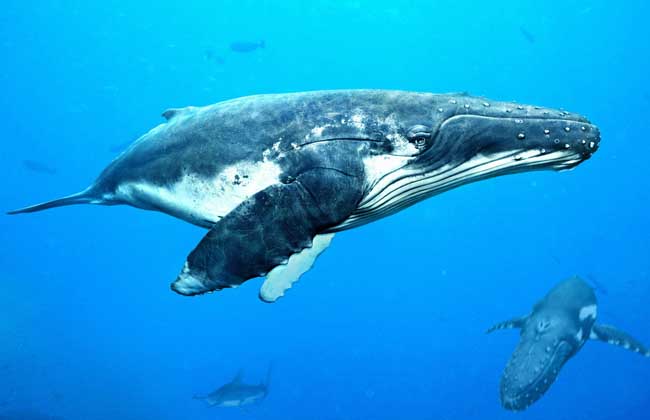
The blue whale is a type of whale, also known as the razorback whale. It is an extremely large marine mammal of the family Balaenopteridae, genus Balaenoptera. It is not only the largest species of whale, but also the largest living animal and the largest mammal to have ever existed. Some dinosaurs of the Mesozoic Era may have exceeded the blue whale in body length, but their weight still cannot compare with it. Let us take a look below at what information there is about the blue whale!
Morphological characteristics of the blue whale
The entire body surface of the blue whale is pale blue or mouse gray, with pale fine mottled markings on the back, white spots on the chest, more than 20 ventral grooves, and the abdomen is also covered with folds extending to the navel, with ochre-colored yellow patches. The female has mammary slits on both sides of the genital opening, within which are slender teats. The head is relatively small and flat, with 2 blowholes located on top of the head, a wide rostrum, and a large mouth. There are no teeth in the mouth. The upper jaw is wide and arches upward in a curve, bearing black baleen plates, as many as 300 to 400 on each side, 90 to 110 cm long and 50 to 60 cm wide. A large amount of wax accumulates in the earplug each year, and the age can be determined based on the thickness of the wax.
Feeding habits of the blue whale
The blue whale feeds on plankton, and krill is the main food of the blue whale. This type of plankton belongs to different species depending on the ocean region. In the North Atlantic, northern krill is the main food of the blue whale, while in the Antarctic, Antarctic krill is the main food of the blue whale. During foraging, the blue whale's dive time is generally 10 minutes; a 20-minute dive is not unusual, and the longest recorded dive time is 36 minutes. During feeding, it swallows a large swarm of krill at one time along with a large amount of seawater, then compresses the abdominal cavity and tongue to squeeze the seawater out through the baleen plates. After the seawater in the mouth is drained clean, it swallows the remaining krill that cannot pass through the baleen plates.
Respiration method of the blue whale
Although the blue whale lives in the ocean, it, like other mammals, breathes with lungs. Its lungs weigh more than 1000 kg and can hold more than 1000 liters of air. Such a large lung capacity greatly reduces the number of times it needs to breathe, and it only surfaces to breathe about once every 10 to 15 minutes. Whenever its head surfaces to breathe, it first expels waste gases such as carbon dioxide from its body. When this powerful, scorching air stream rushes out of the blowholes, it can spray to a height of about 10 m and also sweeps nearby seawater up out of the surface, causing a spectacular water column to appear on the blue sea surface. Seen from afar, it is just like a sea fountain, and at the same time it also makes a sound as loud as a train whistle. People call it “spouting”. People can determine its position based on the sound made when the blue whale spouts, and the height and shape of the spout.
Sound system of the killer whale
The blue whale is the loudest animal in the world, using a low-frequency, deafening sound when communicating with companions. This sound can sometimes exceed 180 decibels, louder than the sound you hear when a jet plane takes off while standing on the runway. A sensitive instrument once detected the sound of a blue whale from 80 km away. But humans may be unable to appreciate that the blue whale is the loudest animal, because the fundamental frequency of vocalizations in all blue whale populations is 10 to 40 Hz, while the lowest frequency humans can perceive is 20 Hz, and the sound duration is 10 to 30 seconds.
Reproductive habits of the blue whale
The blue whale breeds in winter. Females generally give birth once every 2 years, with a gestation period of 10 to 12 months, and only 1 calf per birth. The calf weighs about 2.5 tons and is about 7 m long. To prevent it from suffocating to death, the female must lift the calf out of the water to breathe its first breath of air, after which it can breathe on its own. The female's pair of teats are located on both sides of the genital opening. During nursing, she swims in the upper layer of the seawater, while the calf follows closely below and behind the female. Because the calf does not have movable lips and cannot hold the teats to suck milk by itself, the female relies on muscle contractions to spray the milk directly into the calf's mouth. This is also a very good adaptation to life in water. The age of sexual maturity for the blue whale is about 8 to 10 years, and its lifespan is generally over 50 years, with a maximum of 90 to 100 years.