What is the difference between yellow dragon jade and jadeite?
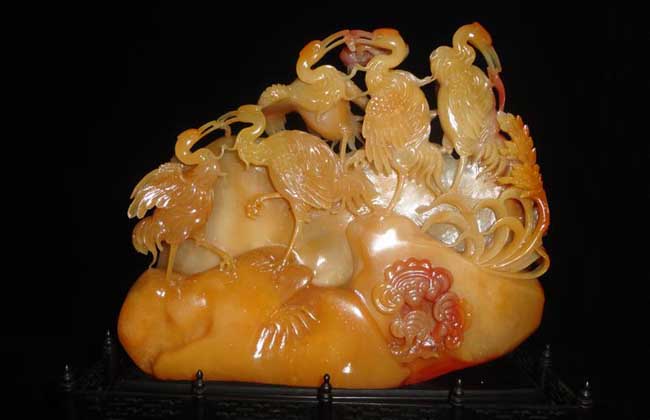
Yellow dragon jade and yellow jadeite are extremely similar, and many people often confuse the two. Even some careless testing departments once made the mistake of identifying yellow dragon jade as yellow jadeite when it first entered the market. Since the two cannot be well distinguished from each other in terms of color, texture and hardness, what exactly are the differences between yellow dragon jade and jadeite? Let us take a look together below!
The two differ in weight
The densities of yellow dragon jade and jadeite are different, and this can also serve as a basis for judging the two. Yellow dragon jade has a lower density than jadeite, ranging between 2.60 and 3.40, while the density of jadeite is 3.33. Therefore, for yellow dragon jade and jadeite of the same size, the lighter one is yellow dragon jade.
Refractive index differs
Refractive index is a physical constant, very important for organic compounds, and is related to the structure of the jade and the wavelength of light. Different types of jade have different refractive indices. The refractive index of yellow dragon jade is relatively small at 1.54, while the refractive index of jadeite is 1.66. People generally use an Abbe refractometer to measure their refractive indices.
Distribution characteristics of iron ore
Observing the distribution characteristics of limonite under a high-power magnifying glass, the limonite in yellow dragon jade is in a yellow-brown colloidal form, evenly dispersed within the chalcedony, while the limonite in yellow jadeite is also in a yellow-brown colloidal form, distributed in a net-like pattern filling the crystal gaps of jadeite.
Mineral grain size
Generally speaking, the main component of high-quality yellow dragon jade is chalcedony, so the mineral grain size of yellow dragon jade is usually no greater than 0.01 mm, and we cannot see its grains with the naked eye. However, the main component of yellow jadeite is jadeite, and its mineral grains are larger than those of yellow dragon jade, usually all above 0.01 mm. We can directly see its crystalline grains, and can also observe its jade nature (also known as fei nature, which is the optical property displayed by the cleavage planes of the grains). In plain terms, good-quality yellow dragon jade is very fine and delicate, so the optical characteristics on its polished surface do not possess jade nature and have no micro-waviness, whereas yellow jadeite does.
The two differ in sound quality
If you gently tap yellow dragon jade and jadeite with a metal rod, you will find that the sounds they emit are different. The sound emitted by jadeite is a melodious and crisp sound, while the sound of yellow dragon jade is noticeably muffled and heavy, not as pleasant to hear as jadeite. In addition, jadeite has very high toughness, and even if dropped it is not easy to break, whereas yellow dragon jade is different, because yellow dragon jade is very brittle and lacks toughness.