Where is yellow dragon jade produced? A detailed explanation of the main production areas
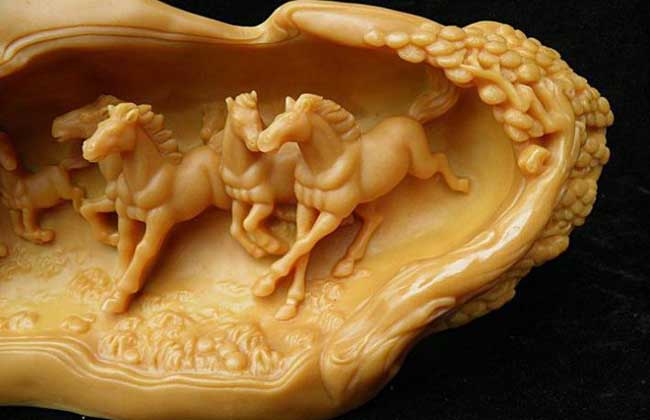
Yellow dragon jade was originally called yellow wax stone. In the eyes of the locals, it has a color like Tianhuang and the hardness of jadeite. It has good hardness, high transparency, and rich, vivid colors. Because it is produced in Longling and mainly yellow in color, it was ultimately named yellow dragon jade. At present, from an appreciation perspective, it can be divided into two types: primary yellow dragon jade and carved yellow dragon jade. Now let us take a look at where yellow dragon jade is produced!
Where is yellow dragon jade produced?
Yellow dragon jade is a new type of jade discovered in Longling, Yunnan in 2004. Excellent gem-grade yellow dragon jade is mainly produced in the Xiaoheishan Nature Reserve in Longling County, Baoshan City, Yunnan Province, and the surrounding Supa River basin. It is very close to the jadeite production area of Myanmar and belongs to the same Yunnan-Myanmar gemstone and jade metallogenic belt formed by the mutual compression of the Eurasian Plate and the Indian Ocean Plate. This place has a very high primary forest coverage rate, complex terrain, diverse climate, and very abundant rainfall. It is known as the rainy screen of western Yunnan and provides very unique, irreproducible natural conditions for the formation of excellent jade.
Distribution of yellow dragon jade production areas
1. Xiaoheishan: Xiaoheishan is the most important production area of yellow dragon jade, with huge output and the largest reserves. The area it covers can reach more than 40 sq km, of which high-quality yellow dragon jade minerals can account for 1/20, that is, about 2 sq km. The Xiaoheishan production area is located in the south-central part of Longling County, on mountain terrain above 2,700 m in altitude. The yellow dragon jade produced here comes in diverse varieties, and its raw materials also include several kinds, such as grass-skin material, cave-pit jade, and mountain water material, with more than about 7 ore belts.
2. Longjiang Township: The yellow dragon jade from the Longjiang Township production area is mainly large in size and is excellent material for large yellow dragon jade carving crafts. Large volume indicates that it suffered relatively less tearing during the formation process, which can also be proven by the fact that it has few cracks. In addition, the skin of the jade material produced here is yellow-brown, wavy, or fish-scale shaped, with rich red or yellow inside. The interior contains more impurities than that from Xiaoheishan, which affects its quality.
3. Zhen'an Township: The yellow dragon jade material from the Zhen'an Township production area generally has colors such as yellow, orange, red, and white, but they are not so pure and not vivid enough. The outer skin of the seed material is different, with patterns in colors such as bronze, green, and cyan, which is very ornamental. The main external color tone is red or yellow, while the interior is gray or dark.
Appreciation methods for yellow dragon jade
1. Color: The colors of yellow dragon jade are divided into light yellow, golden yellow, orange-red, tangerine red, pigeon-blood red, light red, golden orange-red, and so on. These tones are the most active, most prosperous, most noble, and most vital and infectious auspicious colors among warm tones. This is the first factor that makes yellow dragon jade highly favored and valuable.
2. Transparency: Yellow dragon jade is generally uniformly semi-transparent. When observed against light, the edges or thinner parts of the jade material show orange-yellow light transmission. When illuminated with a flashlight, the halo is relatively wide. When shone close to the edge, it can often be transparent to 3-6 cm. Finished products after processing have a pure and clear texture.
3. Moistness: Yellow dragon jade has a fine, dense texture, is pure and clear, and has no impurities, so the effect after polishing is excellent, delicate, soft, moist, clear, bright, and lively.
4. Hardness: The hardness of yellow dragon jade is 6.5-7. When there are many aluminum and iron silicate components, the hardness will decrease slightly. During processing, it is very "hard" on tools and takes somewhat more work than carving jadeite.