What is the difference between large yellow croaker and small yellow croaker?
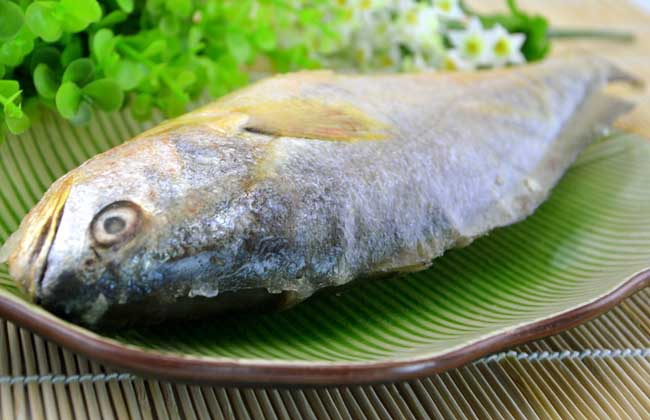
Many people assume that large yellow croaker and small yellow croaker are the same kind of fish, believing that the large ones are large yellow croaker and the small ones are small yellow croaker, and that large yellow croaker is simply the name given to small yellow croaker after it grows up, while small yellow croaker is the name for large yellow croaker before it has fully grown. Is that really so? Let us take a look below at the differences between small yellow croaker and large yellow croaker.
Differences in alternative names between large yellow croaker and small yellow croaker
1. Small yellow croaker: The scientific name of small yellow croaker is Larimichthys polyactis, and it is also known by alternative names such as xiaoxian, dayan, huase, xiaohuanggua, guyu, huanglinyu, xiaochunse, jinlong, houlinzai, xiaohuanghua and so on.
2. Large yellow croaker: The scientific name of large yellow croaker is Larimichthys crocea, and it is also known by alternative names such as huangyu, dawangyu, daxian, dahuanghuayu, honggua, jinlong, huangjinlong, guihuahuangyu, dazhong, hongkou, shishouyu, shitouyu, huangguayu and so on. It is one of the traditional “four great marine products” (large yellow croaker, small yellow croaker, hairtail and cuttlefish).
Differences in alternative names between large yellow croaker and small yellow croaker
1. Small yellow croaker: The body of the small yellow croaker is elongated and rounded, laterally compressed, and the caudal peduncle is 2 times as long as it is high. The head is large, the mouth is wide and slanted, and the upper and lower jaws are roughly equal. The lower jaw has no barbel, and there are 6 small pores on the chin. Both jaws bear fine teeth; the teeth on the outer side of the upper jaw and the inner side of the lower jaw are larger, but there are no canine teeth. The palatine bone and vomer have no teeth. The head and body are covered with ctenoid scales, and the scales are relatively large, with 5 to 6 scales on the lateral line. More than 2/3 of the membrane of the dorsal fin and anal fin rays are covered with small cycloid scales. The anal fin has fewer than 10 rays. The lateral duct of the swim bladder has 2 small branches that run parallel but are unequal, appearing as one long and one short tube.
2. Large yellow croaker: The body of the large yellow croaker is elongated and laterally compressed, with a body length of about 40 to 50 cm. The caudal peduncle is slender, about more than 3 times as long as it is high. The scales are relatively small, with 8-9 rows of scales between the origin of the dorsal fin and the lateral line. The head is relatively large and has well-developed mucous cavities. The lower jaw protrudes slightly. The body is yellowish brown, the ventral surface is golden yellow, the fins are yellow or grayish yellow, and the lips are orange-red. The swim bladder is relatively large, with a round front end. There are 2 white sagittal otoliths inside the skull, and 26 to 27 vertebrae.
Differences in distribution between large yellow croaker and small yellow croaker
1. Small yellow croaker: The small yellow croaker is widely distributed in the East China Sea, Yellow Sea and Bohai Sea of China, as well as the waters off the west coast of the Korean Peninsula. Its main production areas are the coastal waters of Jiangsu, Zhejiang, Fujian, Shandong and other provinces, as well as the sea area at depths of 40 to 80 m in the southern Yellow Sea and northern East China Sea that is strongly affected by Changjiang River runoff. It is a warm-temperate demersal fish.
2. Large yellow croaker: The large yellow croaker is distributed in the coastal waters of the Chinese mainland from south of the central Yellow Sea to east of the Qiongzhou Strait, as well as the west coast of Korea. It is also occasionally found west of the Leizhou Peninsula. The large yellow croaker in China's coastal waters can be divided into 3 populations: the southern Yellow Sea——East China Sea geographical population, the Taiwan Strait——eastern Guangdong geographical population, and the western Guangdong geographical population.
Differences in benefits between large yellow croaker and small yellow croaker
1. Small yellow croaker: The small yellow croaker is rich in protein, sugar, fat, calcium, phosphorus, iron, potassium, sodium, magnesium, selenium, vitamin A and many other nutrients required by the human body, and has high edible value. Moreover, whether in traditional Chinese medicine or modern medical research, it has been found that the small yellow croaker also has considerable medicinal value. For example, the swim bladder has the effects of moistening the lungs, strengthening the spleen and replenishing qi and blood; the gall bladder can clear heat and detoxify, calm the liver and lower blood lipids; the fish scales can be made into medicinal glue; the testes are used to extract protamine and arginine; and the ovaries can be used to extract lecithin.
2. Large yellow croaker: The large yellow croaker has relatively good flesh quality and is delicious. Squirrel-style yellow croaker is a banquet delicacy. Most is sold fresh, while the rest is salted into “guaxiang”; after the viscera are removed, it is salted, washed clean and sun-dried to make “huangyu xiang” or made into canned products. The swim bladder can be dried to make the precious food “fish maw”, and can also be used to make “yellow croaker glue”. The liver contains vitamin A and is a good raw material for making cod liver oil, and the otoliths can be used medicinally.