Do you know how long elephants generally live?
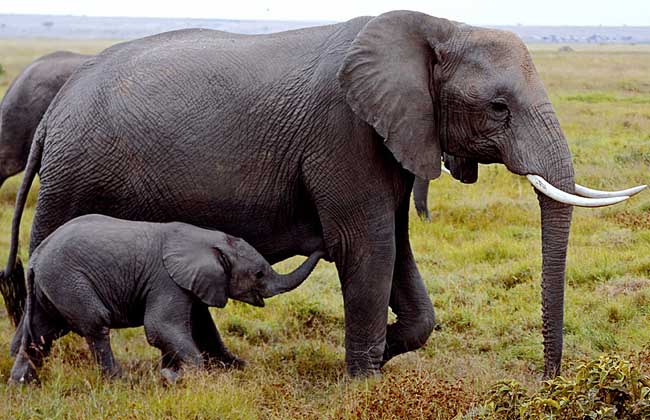
Elephants are mammals of the family Elephantidae in the order Proboscidea, and they are also the largest mammals on land. They prefer to live in jungles and grasslands, are committed vegetarians, and have relatively long lifespans. Pregnancy can last up to 22 months, and they give birth to one calf at a time. There are three extant species: the African bush elephant, the African forest elephant, and the Asian elephant. African elephants are larger in size, while Asian elephants are relatively smaller. Let us take a look below at how long elephants live!
How long do elephants live?
Elephants are the longest-lived of all mammals. African elephants live more than 60 years, breed at no fixed time of year, have a gestation period of about 22 months, give birth to 1 calf per pregnancy, and reach sexual maturity at 13 to 14 years of age. Asian elephants live 70 to 80 years, breed at no fixed time of year, have a gestation period of 20 to 22 months, give birth to 1 calf per pregnancy, and reach sexual maturity at 9 to 12 years of age. According to records, the long-lived elephants of the Galapagos Islands can live 180 to 200 years.
What do elephants eat?
Elephants feed on plants such as tender leaves, wild fruits, wild grasses, wild vegetables, and tender bamboo. They are pure vegetarians and are truly the strongmen and giants of the land animal world. With their long trunks and long tusks as weapons, they have no natural enemies in the wild except humans. They cannot see at night, so they are vulnerable to attacks by lion prides at night.
The social habits of elephants
1. Communication: Elephants can communicate using infrasound that humans cannot hear. Under undisturbed conditions, it can generally travel 11 kilometers. If air currents cause uneven transmission media, it can only travel 4 kilometers. If they still need to communicate under such conditions, the herd will stomp their feet together, producing a powerful “rumbling” sound, and this method can travel as far as 32 kilometers. So how do distant elephants hear it? They cannot very well press their ears to the ground to listen, can they? In fact, elephants use bone conduction. When the sound wave arrives, it travels along the soles of the feet through the bones to the inner ear, and the fat on an elephant's face can be used to amplify sound. Zoologists call this kind of fat acoustic fat, and many marine animals also have this kind of fat.
2. Empathy: Whether in Africa or Asia, elephants have long been considered empathetic animals. They will help elephant calves stuck in mud pits, use their trunks to pull other injured or dying elephants to safety, and can even gently touch one another with their trunks to comfort other individuals in pain. But witnessing elephants display consolation-like behavior is another matter, and now someone has precisely proven that elephants possess this ability. Scientists' research has already shown that when Asian elephants see other members of their kind in trouble, they themselves also feel very distressed, and at such times they extend a helping hand to comfort the other party——just as humans offer comfort when they see others suffering deeply.
3. Intelligence: Elephants have an extremely high level of self-awareness. When they encounter giant hornets, they use a unique low-frequency rumbling sound to notify companions that this winged animal is nearby. Acoustic analysis of the unique sounds made by elephants shows that elephants can use these sounds to warn other companions of the potential threat posed by giant hornets and remind them to take shelter quickly.