What information is there about elephants? A comprehensive introduction to the basic facts about elephants
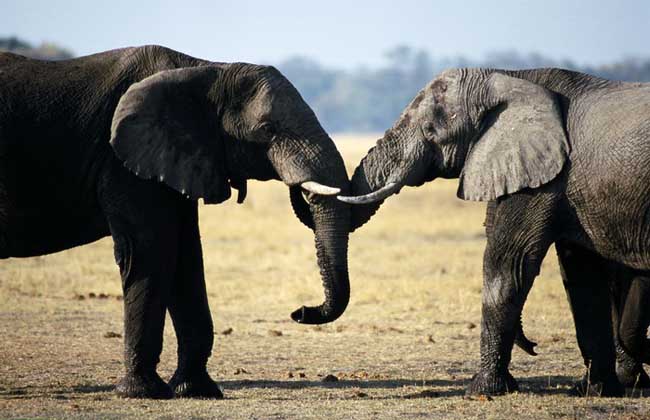
Elephants are mammals of the family Elephantidae in the order Proboscidea, and the largest mammals on land. They prefer to live in jungles and grasslands, are committed vegetarians, and have a long lifespan, up to a maximum of eighty years. Their pregnancy is also long, up to 22 months, and they give birth to one calf at a time. Due to historical climate and human factors, the number of species in this group has become fewer and fewer. Let's take a look below at what information there is about elephants!
Morphological characteristics of elephants
Elephants have a shoulder height of about more than 3 m and a body weight of 2 to 8 tons. They have large heads, ears as large as fans, and limbs as thick as cylinders that support their huge bodies; the knee joints cannot bend freely. The trunk is almost equal in length to the body, is cylindrical, and can extend and bend freely. The nostrils open at the tip, and the tip of the trunk has finger-like projections that can pick up small objects. The upper jaw has 1 pair of well-developed incisors that grow throughout life; the incisors of African elephants can reach 3.3 m in length, while the tusks of female Asian elephants are not exposed. The upper and lower jaws each have 6 cheek teeth on each side, which grow in sequence from front to back, have high crowns, and are complex in structure. Each foot has 5 toes, but the 1st and 5th toes are underdeveloped. The hair is sparse, and the body color is light grayish brown.
Distribution range of elephants
The order Proboscidea once had 6 families, of which 5 families are extinct, leaving only 1 family, Elephantidae, with a total of 2 genera and 3 species (the genus Elephas and the genus Loxodonta). The three species are the Asian elephant, the African bush elephant, and the African forest elephant. Historically, the Asian elephant was widely distributed south of the Yangtze River in China and in south-central Henan, South Asia, and Southeast Asia. Its current distribution range has shrunk, and it is mainly found in India, Thailand, Cambodia, Vietnam, and other countries. There is also a small wild population in the Xishuangbanna region of Yunnan Province, China. The African bush elephant is widely distributed across the entire African continent (except the Sahara Desert), while the African forest elephant lives in the forests of west-central Africa.
Reproductive characteristics of elephants
1. African bush elephant: The African bush elephant is the largest extant terrestrial mammal and is listed in the Convention on International Trade in Endangered Species of Wild Fauna and Flora. Its breeding season is not fixed, the gestation period is about 22 months, and it gives birth to 1 calf per pregnancy. It reaches sexual maturity at 13 to 14 years old and has a lifespan of more than 60 years.
2. Asian elephant: The Asian elephant is a first-class protected animal in China and is listed in the Convention on International Trade in Endangered Species of Wild Fauna and Flora. Its breeding season is not fixed, the gestation period is 20 to 22 months, and it gives birth to 1 calf per pregnancy. It reaches sexual maturity at 9 to 12 years old and has a lifespan of 70 to 80 years.
Living habits of elephants
1. Social habits: Elephants are social animals that live in family units led by a female elephant. The daily activity time, travel routes, foraging locations, and resting places are all directed by the female elephant, while adult male elephants only bear the responsibility of protecting the family's safety. Sometimes several elephant herds gather together to form a large group of hundreds of elephants.
2. Feeding habits: Elephants are the largest mammals on land and feed on plants such as tender leaves, wild fruits, wild grasses, wild vegetables, and tender bamboo. Although they are pure vegetarians, because of their tall and large bodies they are truly the strongmen and giants of the terrestrial animal world, and they have long trunks and long tusks as weapons. Therefore, in nature they have no natural enemies except humans. They cannot see at night, so they are easily attacked by groups of lions at night.
Extant species of elephants
1. African bush elephant: The African bush elephant lives in the vast tropical forests, jungles, and grassland areas of Africa, and it is the largest extant terrestrial mammal. It is social, must be led by a male elephant, is diurnal, and does not have a fixed home. It feeds on wild grasses, leaves, bark, tender branches, and so on. Its ears are large and pointed at the lower part. Both males and females have long, curved tusks. It has an extremely irascible temperament and will actively attack other animals.
2. African forest elephant: The African forest elephant has round ears and is relatively small, generally no more than 2.5 m tall, with a maximum height of only 2.8 m and a body weight of 3 tons. Genetic analysis has proven that it is not the same species as the African bush elephant and has clearly different genetic characteristics from the African bush elephant, and its external features are also very different. In the past, an even smaller pygmy elephant was also found in the African rainforest, and it is now considered to be an immature individual of the African forest elephant. The flesh under its feet has become larger, making it better adapted to water-scarce life. It is very good at conserving water and will search for water sources in the desert.
3. Asian elephant: The Asian elephant is distributed in southern Yunnan Province, China, and abroad it is found in South Asia and Southeast Asia. It lives in tropical forests, jungles, or grassland areas. It is social, has relatively poor eyesight (mainly because the elephant's eyelashes are relatively long, which affects vision), and has a keen sense of smell and hearing. When it is hot, it likes to bathe in water, and it forages at dawn and dusk. It feeds on wild grasses, leaves, bamboo leaves, wild fruits, and so on. Its shoulder height is 2.6 to 3.3 m, and its body weight is 5 to 7 tons.