What are the characteristics of elephants? A comprehensive analysis of appearance and habits
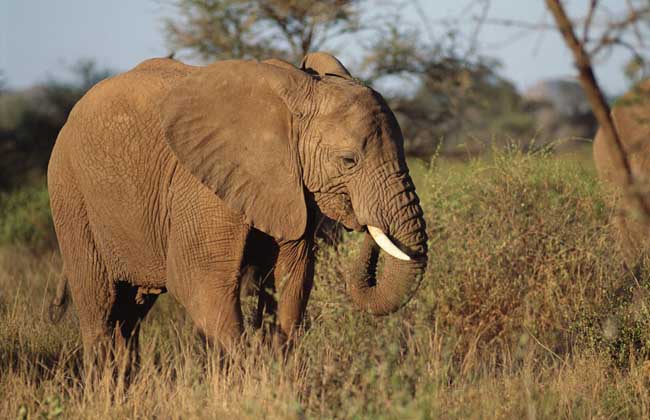
Elephants are the largest land-dwelling social mammals in the world today, usually active in family units, and sometimes several herds gather together to form groups of over a hundred elephants. The main characteristics of elephants include a long trunk, large ears, large tusks, thick legs, a round body, and a small tail. Let us take a look at these characteristics of elephants below!
Long trunk
The most conspicuous feature of an elephant is its huge trunk, which is also one of its most important organs. It is like a water pipe, long enough to hang down to the ground, cylindrical in shape, able to stretch and bend freely, usually curled up. The tip of the trunk is very sensitive and can open and close; the tip has finger-like protrusions that can pick up small objects. Both food and water are taken in through the curled trunk, and all of its strength lies in the trunk.
Large ears
Elephants have two large ears. For elephants, the greatest function of the ears is heat dissipation, even above hearing. Elephant ears are not only large but also thin, and are filled with blood vessels. As blood flows through them, heat is easily released. Especially when they flap, it becomes even easier to quickly lower the temperature of the blood in the ears, reducing blood temperature by 5°C. The cooled blood circulates through the body, helping lower the temperature of the whole body. Of course, elephant ears also have many other functions, such as flapping to drive away mosquitoes and insects, and even spreading wide in a show of force when danger is detected. Ordinarily they can hear every stir on the savanna, and they can also be used to swat flies.
Large tusks
The upper jaw of an elephant has 1 pair of well-developed incisors that grow throughout life. The incisors of African elephants can reach 3.3 m in length, while the tusks of female Asian elephants are not exposed. Tusks are a tool for male elephants to show off; the longer the tusks, the more they can attract females, and they also have a deterrent effect on other males. The trunk is easily injured, so elephants generally use their tusks to fight. At the same time, tusks are also a tool for obtaining food. Elephants use their solid tusks to push down trees, assist the trunk in pulling shrubs, and also use them to strip bark.
Thick legs
An elephant's four limbs are thick and cylindrical, supporting its huge body. The knee joints cannot bend freely, and there are no nails but rather hoof-like nails. When walking, it moves the left foot first, and when lying down it rests on its arms. This is the origin of what people commonly call "elephant legs," describing legs like an elephant's.
Round body
Elephants are the largest mammals on land. Asian elephants have a shoulder height of 2.0-3.7 m and a body weight of 2-7.5 tons. African elephants have a shoulder height of 3.0-4.0 m and a body weight of 3-8 tons. African forest elephants have an average shoulder height of no more than 2.6 m and a body weight of 2-4 tons.
Small tail
The last characteristic of elephants is their small tail relative to the body. The tail has hair, and the hair is relatively long, sparse, and a bit stiff. Its use is to extend the tail's “sphere of influence” and more effectively drive away harassing flies and horseflies.