Do giant pandas bite people? Understanding the aggression and danger of giant pandas
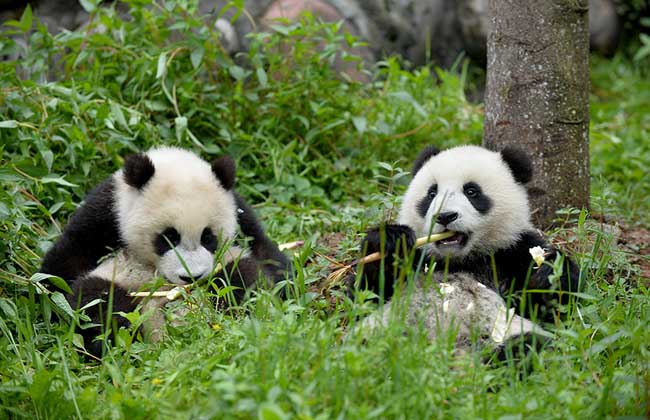
The giant panda is a mammal of the order Carnivora, family Ailuropodidae. Under normal circumstances it is always very gentle in temperament. On first seeing a person, it often covers its face with its front paws, or lowers its head, not showing its true face. It rarely actively attacks other animals or people, and when it happens to meet one in the wild, it always adopts an avoidance strategy. But do giant pandas really not bite people? Let us take a look below at whether giant pandas actually bite people or not!
Do giant pandas bite people?
Giant pandas do bite people. Although giant pandas are usually gentle in temperament, if they are startled, or feel pain, discomfort or unease, they will suddenly bite when there is no way to escape. This is basically a conditioned reflex behavior. Because giant pandas feed on bamboo, their teeth are sharp, and an intruder may be injured fairly seriously. A startled giant panda will be more alert for the next few days, but it will soon return to normal. This is especially true of mother pandas: their cubs are sacred and inviolable, and even a caring visit will enrage the mother, who will fly into a rage, bare her claws and lash out.
Do giant pandas eat meat?
Giant pandas do eat meat. The giant panda originally ate meat and also has the potential of a carnivore to eat meat, but it rarely preys on animals or animal carcasses. This is not because it does not like eating meat, but because it lacks the opportunity. In the giant panda's distribution range there are few large carnivores, so there are not many leftover carcasses for it to feed on. If it often went out to catch rodents and other small animals, the nutrition obtained would often not be enough to offset the energy consumed. Therefore, the giant panda can only occasionally eat a little meat, and most of the time it lives its life in a routine way, relying on bamboo, becoming an animal that follows the rules its whole life and lives on bamboo.
What food do giant pandas eat?
Giant pandas mainly eat bamboo. 99% of the giant panda's food is bamboo. There are more than 60 species in 12 genera of bamboo plants that can be eaten by giant pandas. In addition, wild giant pandas occasionally eat some animal carcasses or other plants. There are quite a few kinds of bamboo that giant pandas like to eat; Fargesia is just one of the more common kinds. These bamboos grow long-term under the canopy of subalpine dark coniferous forests, montane dark coniferous forests, montane mixed coniferous and broad-leaved forests, and montane evergreen broad-leaved forests, with a distribution altitude ranging from 700 to 3500 m. Giant pandas in different mountain ranges have different staple bamboos. The giant panda's diet varies with mountain range and season, feeding on different kinds of bamboo or different parts of the same bamboo in different seasons. In spring and summer it most loves eating different kinds of bamboo shoots, in autumn it mainly feeds on bamboo leaves, and in winter it mainly feeds on bamboo culms.
Incidents of giant pandas biting people
In 2000, a junior high school student from Xindu No. 4 Middle School in Xindu County, Chengdu, climbed over the wire fence enclosing the pandas at the Chengdu Research Base of Giant Panda Breeding, and was scratched and bitten by a panda, suffering lacerations of the skin and flesh over the whole body.
In February 2004, a university student in Beijing, taking advantage of the giant panda “Jini” being asleep, wanted to have “close contact” with it, jumped into the giant panda enclosure, and was bitten on the right sole and ankle by the resting “Jini”.
In September 2006, a male tourist, after drinking alcohol, wanted to shake hands with the giant panda “Gugu”, jumped into its enclosure, and the startled “Gugu” bit his right lower leg. The tourist bit “Gugu” back on the back, and was finally rescued by the staff.
In August 2007, a keeper at Lanzhou Zoo was bitten and mauled by a panda and received more than 100 stitches; it was suspected that the giant panda was affected by the change of environment and was not acclimatized.
In October 2007, a 12-year-old boy jumped into the Beijing giant panda enclosure, and the giant panda “Gugu” bit both of the boy's legs.
In March 2011, an incident occurred at the San Diego Zoo in the United States in which the giant panda “Baiyun” bit a keeper. The seriously injured keeper was rescued and sent to the hospital for emergency treatment, and was not in life-threatening danger.
In March 2012, villagers in Longchi Town, Dujiangyan City, Chengdu, found a wild giant panda. The villagers thought the giant panda was injured and wanted to go up and catch it before notifying the reserve staff. As a result, a villager was bitten by the startled giant panda. Fortunately, the injury was not serious.