What are the characteristics of the giant panda? A full guide in one article
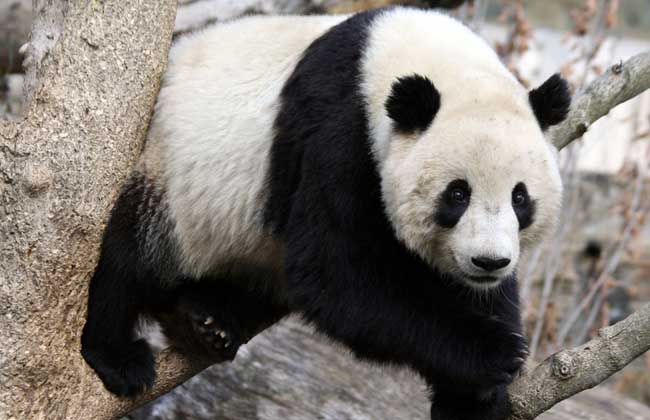
The giant panda is a mammal of the order Carnivora, family Ailuropodidae. Its body color is black and white, with round cheeks, large black eye patches, a chubby body, and a signature pigeon-toed way of walking. It is a flagship species for global biodiversity conservation. There are fewer than 1,600 wild giant pandas in the world, and it is a Class I nationally protected animal in China. Let us take a look below at what characteristics the giant panda has!
Morphological characteristics
The giant panda has a stout, bear-like build and a plump, well-fed appearance, with a round head and a short tail. The head and body length is 1,200 to 1,800 mm, and the tail length is 100 to 12 mm. Body weight is 80 to 120 kg, with the heaviest reaching 180 kg. Captive pandas are slightly heavier, and males are generally slightly larger than females. The fur on the head and body is distinctly black and white, but the black is not pure black and the white is not pure white; rather, the black has a brownish tinge and the white has a yellowish tinge. Individuals in the Qinling region tend to be larger, with coarse body hair and belly fur that is slightly brown in color. In the Minshan Mountains (especially in Qingchuan and Pingwu), individuals are smaller, and their body hair is finer than the former, with the brown color of the belly fur not obvious, but individuals in the Liangshan Mountains are not on the small side.
Feeding habits
The giant panda is an omnivore, but it originally ate meat and also has the potential of a carnivore to eat meat. However, it rarely preys on animals or animal carcasses. This is not because it dislikes eating meat, but because it lacks opportunities. In the giant panda's distribution area, there are few large carnivores, so there are not many leftover carcasses for it to eat. If it frequently catches small animals such as rodents itself, the nutrients obtained are often not enough to offset the energy consumed. Therefore, the giant panda can only eat a little meat occasionally, and most of the time it relies routinely on bamboo to sustain life, becoming an animal that follows the rules all its life and lives on bamboo.
Personality characteristics
The giant panda is usually very gentle by nature. When meeting people for the first time, it often covers its face with its front paws, or lowers its head, not showing its true appearance. It rarely actively attacks other animals or people, and when it happens to meet them in the wild, it always avoids them. But once it becomes a mother, her cub is sacred and inviolable. Even a caring visit will anger the mother into a rage, making her bare her teeth and claws and become physically aggressive. Sometimes they also like to do some grooming and other comfort-seeking activities. They can stretch their bodies out like a cat, with the front extended and the rear half raised, letting the body stretch flexibly, or after waking up, stretch the forelimbs straight and yawn. If they get wet or wade across a river, they can also shake the water off their bodies like a dog.
Behavioral characteristics
Apart from spending half of each day eating, the giant panda spends most of the remaining half sleeping and dreaming. In the wild, giant pandas sleep for 2 to 4 hours between every two meals. Lying flat on the back, lying on the side, lying prone, stretching out, or curling into a ball are all preferred sleeping positions. In zoos, keepers feed them at fixed times twice a day, so giant pandas use the rest of their time to rest. Even when sleeping, giant pandas look very cute. They are very flexible and can place their bulky bodies into all kinds of poses. Their favorite pose is with their legs propped on a tree and their hands covering their eyes.
Reproductive characteristics
A newborn giant panda is quite immature at birth, weighing only 0.1% of its mother's body weight. The newborn cub is very light, with an average birth weight of about 145 grams, roughly one thousandth of an adult giant panda's body weight. The lightest is 51 grams, and the heaviest is 225 grams. Caring for a cub is a very arduous task for a female giant panda, usually lasting 18 months, and sometimes even as long as two years, until her next cub is born. In the wild, if twins are born, the mother giant panda usually ignores or rejects the weaker one, which ensures that at least one survives. Under captive conditions, artificial rearing is carried out, and cub-swapping techniques are used to try to ensure that all giant panda cubs can survive.