What Exactly Is Ebony Wood? This Article Explains It Clearly
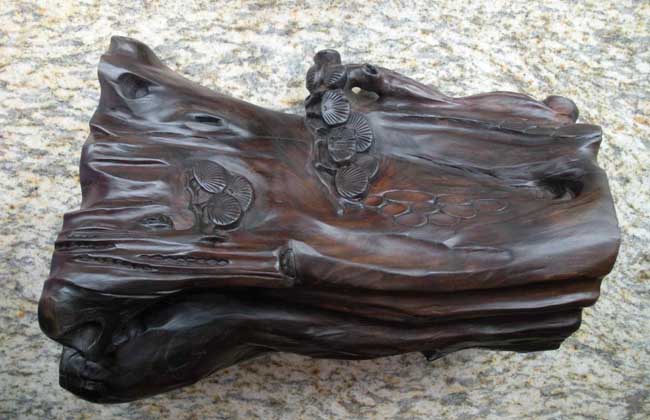
Ebony wood, also known as yinchenmu ("sunken wood"), combines the antique elegance of wood with the spiritual charm of stone. It is called the "Oriental sacred wood" and the "plant mummy." Earthquakes, floods and mudslides buried terrestrial plants and organisms entirely into ancient riverbeds and other low-lying areas. The trees buried in the silt, under oxygen-deficient and high-pressure conditions and through the action of bacteria and other microorganisms, underwent a carbonization process lasting thousands to tens of thousands of years to form ebony wood, hence it is also called carbonized wood. Through the ages, ebony wood has been used as a talisman against evil, made into handicrafts, Buddha statues, and amulet pendants.
The formation time of ebony wood mostly ranges from 4000 to 8000 years, which is not enough to become a plant fossil, nor does it belong to mineral resources. It is formed from trees such as nanmu (Phoebe zhennan), red toon (Toona ciliata) and maliu (Pterocarya stenoptera) that were buried in silt by natural disasters, and under oxygen-deficient and high-pressure conditions underwent a carbonization process lasting thousands to tens of thousands of years. Due to differences in tree species, the market value also differs; the golden-thread nanmu of the Phoebe genus is the most expensive, reaching 80,000 to 150,000 yuan per cubic meter, and the older the age and the better preserved, the higher the price.
Because ebony wood is generally completely black, people in Sichuan generally call it ebony (wumu) descriptively, and later this spread and became a common name for sunken wood. Types include maliu (Pterocarya stenoptera), qinggang (Cyclobalanopsis glauca), camphor (Cinnamomum camphora), nanmu (Phoebe zhennan), red toon (Toona ciliata), Chinese yew (Taxus chinensis), masang (Coriaria sinica), yellow willow, Phellodendron amurense, locust (Sophora japonica), sandalwood, etc. Generally only tree species with fragrance and bactericidal properties can form ebony wood. In the area of the Mianyuan River in Deyang City, a large ebony log 3 m in diameter was also found.
Ebony wood is essentially hard, mostly brown-black, black-red, golden yellow, or yellow-brown, with a smooth cut surface and fine grain; when polished properly it can achieve a mirror-like shine. Some ebony wood is already close to rosewood (zitan) in nature, never fading, never rotting, and never worm-eaten, making it an ideal material for making artworks and antique-style furniture. Archaeologists used Sanxing ebony wood to reconstruct the living environment of the time and unraveled the mystery of the large number of elephant tusks unearthed at Sanxingdui. It is precisely the spiritual nature of ebony wood that led teachers at the Palace Museum to determine that ebony wood also has a notable function of promoting blood circulation and prolonging life; the people of Shu regard it as a treasure for warding off evil and inviting blessings. Because ebony wood is a non-renewable resource and its exploitation is decreasing, some naturally shaped ebony wood artworks have extremely high collectible value.
Compared with ordinary wood, ebony wood appears rather peculiar: ordinary wood burns to white ash, while sunken wood burns to yellow ash. Its color deepens when exposed to water and returns to its original color after the water dries; coated with a little rapeseed oil, it becomes black and shiny without fading. Most sunken wood has a rotted heartwood when unearthed, leaving only the tree head and the middle layer of the trunk; the severely carbonized surface cannot be used as ordinary material, and generally its outer layer must be planed away, leaving the heartwood for use.
Modern ebony wood refers to one type under the national rosewood standard. In the timber market, what is generally called ebony wood refers to black African ebony; it is a category of tree species and belongs to one type under the national rosewood standard. By convention it is further divided into three types: ebony, green wood, and ebony-grained wood. Ebony is pure black and quite brittle; green wood is solid and sinks when placed in water. In Japan, ebony-type woods are collectively called black ebony (kokutan).