What does the Major Snow solar term mean? An interpretation of its meaning explained in one article
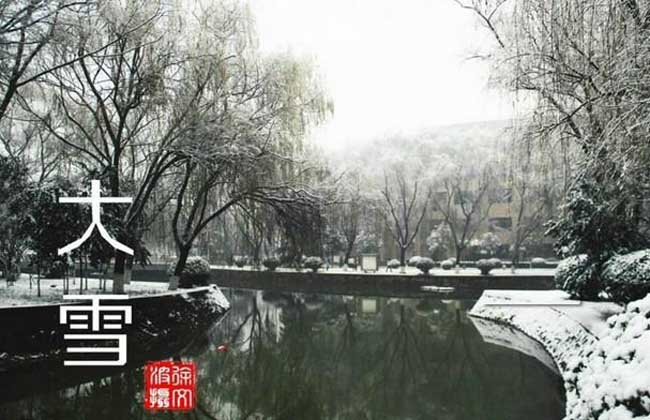
Major Snow is the 21st of the 24 solar terms in the lunar calendar, and also the third solar term of winter, marking the official start of midwinter. At this time, the sun reaches the celestial longitude of 255 degrees, meaning the weather is colder and snow is more likely than during Minor Snow; it does not mean the amount of snowfall is necessarily large. Let us take a look together below at what the Major Snow solar term means!
What does the Major Snow solar term mean?
Major Snow, as the name suggests, means a large amount of snow. The ancients said: "Da means abundant; at this point, snow becomes abundant." When this period arrives, snow tends to fall heavily and over a wide area. At this time, the lowest temperature in most parts of our country drops to 0°C or below, and in areas where cold and warm air masses clash at the front of strong cold air, heavy snow, or even blizzards, often occur. It can be seen that the Major Snow solar term indicates the starting time of heavy snowfall and the degree of snow amount during this period. Like Minor Snow, Rain Water, Grain Rain and other solar terms, it is a solar term that directly reflects precipitation.
The Major Snow solar term and agricultural production
The Major Snow period is divided into three pentads: in the first pentad, the brown-eared bulbul does not sing; in the second pentad, tigers begin to mate; in the third pentad, the liting sprouts. This means that because the weather is cold at this time, the brown-eared bulbul no longer calls. This is the period when yin energy is at its peak; when the peak is reached, decline begins, and yang energy has already begun to stir. Tigers begin courtship behavior. "Liting" is a type of orchid grass, which, sensing the stirring of yang energy, puts forth new buds.
It is often said that "a timely snow promises a good harvest." The severe winter snow covers the earth, keeping the temperature of the ground and around the crops from dropping too low due to cold waves, creating a good overwintering environment for winter crops. When the snow melts, it also increases the moisture content of the soil for the needs of crop growth in spring. The content of nitrogen compounds in snow water is 5 times that of ordinary rainwater, giving it a certain fertilizing effect. There is an agricultural proverb: "This year the wheat is covered with three layers of quilts; next year we will sleep on steamed buns."
Weather characteristics of the Major Snow solar term
1. Temperature drop: Some people have made statistics showing that the month with the most strong cold air in our country is November. The average temperature in most parts of the north in December is about -5 to -20°C. After strong cold air passes through the south, frost sometimes also appears. Strong cold air can often form relatively large-scale snowfall or localized blizzards.
2. Freezing rain: When strong cold air reaches the south, especially in Guizhou, Hunan, Hubei and other places, freezing rain is prone to occur. Freezing rain is snowflakes that fall from a cold layer high in the sky, sometimes melt into rain in the middle layer, and then, in the low-altitude cold layer, become supercooled water droplets whose temperature is below 0°C but which are still raindrops. The supercooled water droplets fall from the air, and when they reach the ground and touch any object on the ground, they immediately freeze, forming freezing rain.
3. Rime: According to statistics, generally from November each year to February of the following year, rime appears successively in the northwest, northeast and most of the Yangtze River basin, and is more commonly seen in mountainous areas with high humidity. Rime is a milky-white ice crystal deposit on objects formed by the direct deposition of water vapor in the air at low temperatures, or by the direct freezing of supercooled fog droplets.
4. Fog and haze: In December, in Jiangnan just as it enters winter, when the morning temperature is relatively low, or after rain and snow, when near-surface humidity is high, extensive fog areas may also appear. Fog and haze weather will also make an appearance in northern cities.
5. Ice floods: In winter, the Baotou section of the river in Inner Mongolia freezes and is sealed by ice, while the more southerly Lanzhou section of the river is not sealed by ice. The river water flows toward the already ice-sealed section. Because the ice layer and ice dam on the ice-sealed section block the river water coming from upstream, the water level is forced to rise, and disasters in which water overflows the riverbanks are likely to occur in the Baotou section. If the strong cold air comes late, ice-run disasters are likely to be triggered in December.