What does the Minor Snow solar term mean? Let us help you understand the meaning of Minor Snow
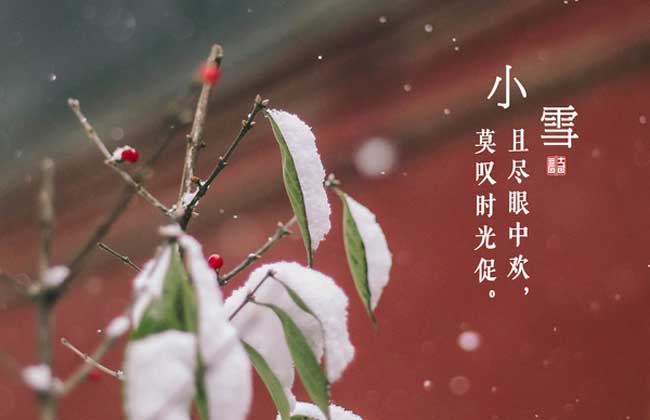
Minor Snow is the 20th of the 24 solar terms. Every year on November 22 or 23, when the sun reaches the celestial longitude of 240°, this solar term begins. In vast areas of China, northwest winds start to become a regular occurrence, temperatures drop and gradually fall below 0°C, but the land is not yet too cold. Although snow begins to fall, the amount is not great, hence the name Minor Snow. Now let us take a look at what the Minor Snow solar term means!
Climatic characteristics of the Minor Snow solar term
Temperatures during Minor Snow are lower than during the beginning of winter. When the Minor Snow solar term arrives, it means that snowfall will occur in North China. Cold air causes temperatures in most of northern China to gradually reach below 0°C. The average first snowfall period in the middle and lower reaches of the Yellow River is basically consistent with the Minor Snow solar term. Although snow begins to fall, the amount is generally small, and it freezes at night and melts during the day. If the cold air is strong and the warm, moist air flow is relatively active, heavy snow is also possible. The northern part of southern China begins to enter winter. "The lotus flowers are all gone, and there is no longer an umbrella-like leaf to hold up the rain; the chrysanthemums have withered, yet their branches still stand proudly in the frost." The scene of early winter is already present.
Agricultural activities of the Minor Snow solar term
1. Off-season sideline work: During Minor Snow, ice and snow seal the ground and the weather is cold. The old bad habit of idling away the winter must be broken, and farm work still cannot be neglected. Winter leisure time should be used to vigorously develop agricultural and sideline production, and according to local conditions carry out winter fertilizer accumulation, fertilizer making, willow weaving and straw weaving, opening up ways to become better off through multiple channels. In order to rapidly improve farmers' scientific and cultural quality, sufficient time should be arranged to do a good job in agricultural technology lectures and training, and to put the work of invigorating agriculture through science and technology into practice.
2. Fish ponds overwintering: During this period, preparation and management for fish ponds overwintering must also be done well. Managing overwintering fish fry ponds well is the key to improving the overwintering survival rate of fish. Preparation of overwintering feed for large livestock should be done in advance to ensure the survival of livestock through the winter.
3. Storing vegetables: In northern China after the Minor Snow solar term, fruit growers begin pruning fruit trees and wrapping the trunks with reed mats woven from straw to prevent the trees from freezing. Winter vegetables are mostly stored by traditional methods, either in cellars or buried in soil, for convenient consumption. As the saying goes, "At Minor Snow, dig up Chinese cabbage; at Major Snow, dig up spinach." When storing Chinese cabbage by deep trench soil burial, watering should be stopped about ten days before harvest, and freeze prevention should be done well to facilitate storage; harvest on sunny days as much as possible. After harvest, dry the roots of the Chinese cabbage facing the sun for 3 to 4 days, and store after the outer leaves become soft. The depth of the trench is based on the height of the Chinese cabbage. When storing, all the roots of the Chinese cabbage face downward, arranged side by side in the trench. When it is cold, cover with more Chinese cabbage leaves and corn stalks to prevent freezing. When storing half-mature Chinese cabbage, put some water in the trench, adding water and soil at the same time; the depth of water and soil should be suitable for burying the roots. When it is time to eat, it will have grown and matured.
What should be eaten during the Minor Snow solar term?
1. Cured meat: There is a folk custom of "curing in the winter wind and storing to ward off the winter." After Minor Snow, temperatures drop sharply and the weather becomes dry, making it a good time to process cured meat. After the Minor Snow solar term, some farming families begin to make sausages and cured meat, preserving excess meat by traditional methods to enjoy as food during the Spring Festival.
2. Eating ciba: In some places in southern China, there is also the custom of eating ciba in the tenth lunar month. Ciba is a food made by steaming glutinous rice and pounding it into a paste, and it is a popular delicacy in some areas of southern China. In ancient times, ciba was a traditional festival offering in southern China, and was first used by farmers as an offering to the ox god. There is a saying, "On the tenth month festival, ciba is cooked abundantly," which refers to sacrificial events.
3. Drying fish: During Minor Snow, fishermen along the coast of central and southern Taiwan, China begin to dry fish and store dry provisions. Schools of mullet come to the Taiwan Strait around Minor Snow, along with swordfish, sharks and others. A Taiwanese proverb says, "Tenth-month beans, so fat you cannot see the head," referring to the Budai area of Chiayi County, where "bean fish" can be caught in the tenth lunar month.
4. Eating paotang: Around Minor Snow, the Tujia people begin their annual folk activity of "killing the New Year pig and welcoming the New Year," adding a lively atmosphere to the cold winter. Eating "paotang" is a custom of the Tujia people. In the "killing the New Year pig and welcoming the New Year" folk activity, a delicacy carefully cooked from top-quality fresh pork still giving off steam is called "paotang."
Proverbs and folk songs of the Minor Snow solar term
1. Hebei: "When Minor Snow fills the sky with snow, the coming year will surely be a bumper year." This is the praise of farmer friends for snow during the Minor Snow solar term; the snow water at this time can resist drought and prevent cold.
2. Shandong: "At Minor Snow, harvest the green onions; if you do not harvest, they will be empty. Radishes and Chinese cabbage, store them in cellars. Winter irrigation for wheat, preserve soil moisture and prevent freezing. Plant trees and afforest, collect tree seeds. Transform waterlogged lowlands, manage water and ridges. Complete water conservancy facilities, repair canals and dig wells."
3. Henan: "At the Start of Winter and Minor Snow, hurry with winter plowing. Combine with replanting to increase the harvest. Deep plow the land to thicken the soil layer. Press sand and replace soil to freeze pests to death."
4. Jiangsu: "At the Start of Winter, sowing wheat is late; at Minor Snow, do fertilizer accumulation."
5. Shanghai, Zhejiang: "At the Start of Winter and Minor Snow, the north wind is cold; quickly finish harvesting cotton, grain and oil crops. Transplant rapeseed and continue sowing wheat; store enough feed without delay."
6. Fujian, Guangdong: During Minor Snow there are still crops in the fields, as proverbs attest. In Fujian there is a local saying, "At Minor Snow, plant green rice," where green rice refers to late rice. In Guangdong there is "At Minor Snow, the fields are full of red; at Major Snow, the fields are empty." The so-called red here does not refer to the color red, but to the abundance of farm work; at this time harvesting of late rice begins and wheat is sown.