What does Frost's Descent mean? A detailed explanation of the meaning of the Frost's Descent solar term
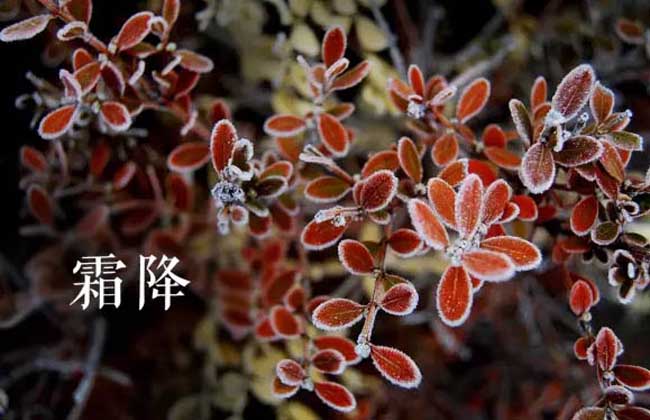
Frost's Descent is one of the 24 solar terms, falling around October 23 on the Gregorian calendar each year. The Frost's Descent solar term carries the meaning of weather turning colder and the first frost appearing. It is the last solar term of autumn and also signifies the beginning of winter. During Frost's Descent, health care and wellness are especially important. There is a folk proverb that goes “A whole year of nourishing is not as good as nourishing during Frost's Descent,” which shows just how much this solar term affects us. Let us now look at what Frost's Descent means!
Folk customs of Frost's Descent
In some places in China, people eat red persimmons during Frost's Descent. In the eyes of local people, this not only wards off the cold and keeps them warm, but also strengthens the bones and muscles, making it a very good food for Frost's Descent. The elderly in Quanzhou say about eating persimmons at Frost's Descent: eating small persimmons at Frost's Descent keeps your nose from running. In some places, the explanation for this custom is: on the day of Frost's Descent you must eat persimmons, otherwise your lips will crack all winter long. People living in rural areas, when this time comes, climb up tall persimmon trees one by one and pick a few bright, sweet persimmons to eat.
The origin of the Frost's Descent solar term
Every year around October 23 on the solar calendar, when the sun reaches the celestial longitude of 210 degrees, it is Frost's Descent among the 24 solar terms. Frost's Descent is the last solar term of autumn and the transitional solar term from autumn to winter. In late autumn, the ground releases a great deal of heat, and the temperature suddenly drops below 0 degrees. Water vapor in the air condenses directly on the ground or on plants to form fine ice needles, some of which become hexagonal frost flowers, white in color and loose in structure.
“Frost's Descent” indicates that the weather is gradually turning cold and dew is condensing into frost. In ancient China, Frost's Descent was divided into three pentads: the first pentad when jackals offer sacrifices of beasts, the second pentad when plants and trees turn yellow and fall, and the third pentad when hibernating insects all bow down. Jackals begin to capture prey, offering beasts to heaven in sacrifice to repay their origins, just as offerings are laid out to honor the autumn metal; the leaves on the earth wither and fall, and hibernating insects all remain motionless in their holes without eating, lowering their heads and entering a state of hibernation.
Frost's Descent and agricultural production
Most areas in the north have already finished the autumn harvest, and even cold-resistant scallions can no longer grow, because “if you don't pull scallions at Frost's Descent, the longer they grow the more hollow they become.” In the south, however, it is the busy “three autumns” season: single-season hybrid rice and late rice are just being harvested, early-crop wheat is being planted, early-crop rapeseed is being transplanted, cotton is being picked, cotton stalks are being pulled up, and the land is being plowed and prepared. “If all the stalks are pulled out clean, there will be fewer insects and diseases next year.” After the harvest, the stalks and stubble must be promptly collected from the fields, because many overwintering insect eggs and pathogens lurk there. In North China, Chinese cabbage is about to be harvested, and later-stage management should be strengthened. During Frost's Descent, most areas of China enter the dry season, and great attention must be paid to forest protection and fire prevention.
Frost's Descent is also a good time for sheep breeding in the Yellow-Huai River basin. An agricultural proverb says, “Mating at Frost's Descent, lambing at Qingming, just as the grass comes up.” Ewes generally come into heat in autumn and winter, and the duration of accepting mating from rams is generally about 30 hours. As with mating at White Dew in the south, when the lambs are born the weather is warm, the green grass is tender, the ewes are well nourished and have plenty of milk, and can nurse the lambs well.