What does White Dew, one of the 24 solar terms, mean?
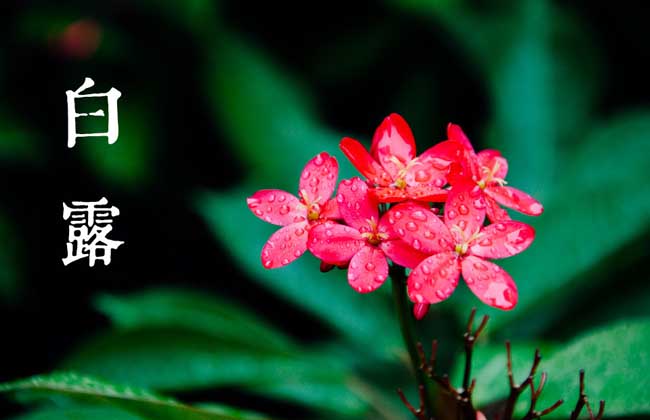
White Dew is the 15th solar term of the 24 solar terms in the lunar calendar. When the sun reaches the celestial longitude of 165 degrees, it is White Dew. As the weather gradually turns cool, many dewdrops are found on the ground and leaves in the early morning, because water vapor condenses on them at night, hence the name. The ancients matched the four seasons with the five elements; autumn belongs to metal, and the color of metal is white, so white was used to describe autumn dew. After entering “White Dew”, one feels a touch of coolness at night.
What does White Dew mean?
White Dew is the third solar term of autumn, marking the end of the early autumn period and the beginning of the mid-autumn period. Dew is the water droplets formed by water vapor condensing on the ground or on near-ground objects due to falling temperatures. Therefore, White Dew actually indicates that the weather has already turned cool. At this time, people clearly feel that the hot summer has passed and the cool autumn has arrived. The temperature difference between day and night can reach more than ten degrees. Yang energy reaches its peak at the summer solstice; when things reach an extreme, they reverse, and yin energy also begins to rise at this time. By White Dew, yin energy gradually intensifies, and the morning dew grows thicker day by day, condensing into a layer of white water droplets, so it is called White Dew.
White Dew and agricultural farming
During the White Dew period, cold air becomes increasingly active, and autumn low-temperature weather often occurs, affecting the heading and flowering of late rice, so low-temperature cold damage and pests and diseases must be prevented. When cold air invades, irrigation can be used to preserve warmth; irrigating more than two cun before low temperatures can raise the temperature by 1 to 2°C. When low temperatures come, on sunny days water can be drained by day and irrigated at night with shallow water, while on cloudy and rainy days thick water should be irrigated; in general weather, the field should be alternately dry and wet, with wetness as the main condition. During this solar term, the summer heat gradually fades, the autumn sky is high and clear, jade-like dew brings coolness, and fragrant osmanthus blooms, making it a golden tourism season. “White Dew” is right at the turning point between summer and autumn, and the day-to-day temperature changes greatly. “When White Dew comes, do not expose your body”; the elderly, the weak, and the sick should pay more attention to adding or removing clothes in time to prevent catching cold.
Weather changes during White Dew
After entering the White Dew solar term, the summer monsoon is gradually replaced by the winter monsoon; cold air shifts from defense to offense, and warm air gradually retreats. Cold air moves southward in batches, often bringing a certain range of temperature drops. People like to use the proverb “White Dew autumn wind night, cool night after cool night” to describe the situation in which temperatures fall faster.
In northern China, precipitation decreases markedly, the autumn sky is high and clear, and the weather is relatively dry. In the middle and lower reaches of the Yangtze River during this period, the first autumn rain often alleviates the earlier water shortage, but if cold air meets a typhoon, or if cold and warm air are evenly matched and neither side can easily advance or retreat, the resulting rainstorm or low-temperature continuous cloudy rain is unfavorable to the growth of autumn crops. Continuous cloudy rain also often occurs in eastern Southwest China, South China, and West China.
Along the southeast coast, especially the South China coast, there may also be heavy rainstorms caused by tropical weather systems (typhoons). In addition, in some areas at this time there may also be autumn drought, forest fire danger, early frost, and other weather. If the summer drought in the middle and lower reaches of the Yangtze River, and the summer drought in West China and South China, do not receive the moisture of autumn rain, continuous summer-autumn drought may form.
In some northern areas, such as Shaanxi, Shanxi, Gansu in the northwest, and North China, autumn precipitation is originally on the low side. If severe autumn drought occurs, it not only affects the harvest of autumn crops, but also delays the sowing and emergence of autumn-sown crops, affecting the next year's harvest. In addition, along with autumn drought, especially in mountainous forest areas, the air is dry and wind power increases, and forest fire danger begins to enter its autumn high-incidence period.