What does the Minor Heat solar term mean? Understanding the meaning of Minor Heat in one article
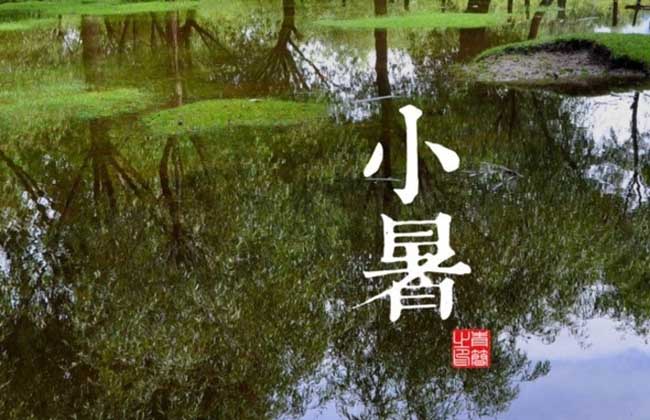
Minor Heat is the eleventh solar term of the twenty-four solar terms in the lunar calendar, and the fifth solar term of summer, marking the official beginning of late summer. The Minor Heat solar term begins when the sun reaches the celestial longitude of 105 degrees. Shu means hot, and Minor Heat means slightly hot, not yet very hot, meaning the weather is starting to get hot, but has not yet reached the hottest point. Most parts of the country basically fit this, and crops across the country have entered a stage of vigorous growth, requiring strengthened field management.
The weather characteristics of Minor Heat
In the southern region, the average temperature during Minor Heat is around 33°C. In mid-July, in the low-altitude river valley areas of southeastern South China, daily average temperatures above 30°C and daily maximum temperatures above 35°C may begin to appear. In the northern part of the northwestern plateau, frost and snow can still be seen at this time, equivalent to the early spring scene in South China.
Starting from Minor Heat, the plum rain in the Yangtze-Huai River basin ends one after another. In the vast areas north of the Huai River and Qinling line in the east, the southeast monsoon rainy season from the Pacific Ocean begins, with precipitation increasing significantly and rainfall being relatively concentrated. South China, Southwest China, and the Qinghai-Tibet Plateau are also in the southwest monsoon rainy season from the Indian Ocean and the South China Sea, while the middle and lower reaches of the Yangtze River are generally under the control of the subtropical high with high temperature and little rain. In some years, the northern cold air is still relatively strong around Minor Heat, and in the middle and lower reaches of the Yangtze River it is evenly matched with the southern warm air, producing frontal thunderstorms. Thunderstorms during Minor Heat are often weather information for a “reverse plum rain”, foretelling that the rain belt will continue in the middle and lower reaches of the Yangtze River for some time.
Around Minor Heat, most areas of southern China enter the season with the most thunderstorms. Thunderstorms are a severe weather phenomenon, often accompanied by strong winds and heavy rain, and sometimes hail, and can easily cause disasters. In eastern South China, after Minor Heat, because it is often controlled by the subtropical high, there are many consecutive sunny and high-temperature days, beginning the summer drought period. Most areas of southern China have this climate characteristic of drought in the east and flooding in the west.
Folk legends of Minor Heat
“June 6th” is said to be the day when the Dragon Palace airs the dragon robe. Because this day is roughly on the eve of Minor Heat, the day with the highest temperature, the longest sunshine duration, and the strongest solar radiation of the year, every household often coincidentally chooses this day for “airing the hidden things”, that is, hanging clothes stored in boxes and cabinets outside to be exposed to the sun, in order to remove dampness, remove moisture, and prevent mildew and moths.
Folk saying goes that on “June 6th” the hundred-cord bracelet is thrown onto the roof. “It is said that the Cowherd Star and the Weaver Girl Star in the sky are separated on the two banks by the Milky Way, and only on the day of ”the seventh day of the seventh month” each year can they meet. But between them lies the Milky Way, and there is no ferry, so what can be done? Therefore on the day of June 6th, children all over the world mostly throw the “hundred-cord bracelet” worn on their wrists during the Dragon Boat Festival onto the roof for magpies to carry away, so as to build a bridge as beautiful as a rainbow over the Milky Way, so that the Cowherd and the Weaver Girl can meet.
It is said that this day is the day when “Little White Dragon” returns home. Because “Little White Dragon” violated heavenly rules, he was imprisoned by his father, the Dragon King, on a faraway small island and lost his freedom of movement. Only on the day of June 6th did the Dragon King graciously permit him to return home to visit his mother. Because “Little White Dragon” was eager to visit his mother, he traveled day and night along the way, bringing startling thunder and lightning, violent winds, and torrential rain.
On dog days, the ancients said: Fu means “hiding and lying low to avoid the intense heat”. Sacrifices on dog days were already recorded as far back as the pre-Qin period. Ancient books say that the sacrifices on dog days were to “Emperor Yan and the deity Zhurong”. Emperor Yan is said to be the sun god, and Zhurong is the fire god, the great-grandson of Emperor Yan. Legend says Emperor Yan ordered the sun to emit enough light and heat to nurture the five grains and make them grow, and from then on humans no longer worried about food and clothing. People thanked him for his merits and commemorated him during the hottest time. Thus came the legend of “dog day sacrifices”.
Folk customs of Minor Heat
The sixth day of the sixth lunar month is the “Tian Kuang Festival”. According to historical records, this festival began in the fourth year of the Yuanfu era of Emperor Zhezong of the Song Dynasty. “Kuang” means “bestow”, that is, a festival granted by heaven. This is why the emperors of the Song Dynasty bestowed “ice fried dough” and “roasted flour” to their officials during the dog days, hence it was called the Tian Kuang Festival.
In the first fu, radishes; in the second fu, vegetables; in the third fu, buckwheat can still be planted. In the first fu, dumplings; in the second fu, noodles; in the third fu, pancakes with eggs.
Eating dumplings during the first fu is a traditional custom. During the dog days people have poor appetite and often become thinner than usual, commonly called bitter summer, and dumplings in traditional custom are exactly the food that stimulates the appetite and satisfies cravings. In some places in Shandong, people eat raw cucumber and boiled eggs to treat bitter summer. On the morning of entering the fu, they eat eggs and no other food.
People in Xuzhou eat mutton when entering the fu, called eating fu mutton. This custom can be traced back to the period of Yao and Shun. There is a folk saying that one bowl of soup with Pengcheng fu mutton saves the need for a miracle doctor to prescribe medicine. The love of Xuzhou people for eating fu mutton is best captured by the local folk rhyme: on June 6th, welcome the girl; new wheat cakes and mutton soup. The custom of eating noodles on dog days had already begun at least by the Three Kingdoms period. Wei Shi Chun Qiu: on dog days eat soup cakes, take a cloth to wipe sweat, and the complexion is bright and clear. The soup cakes here are hot soup noodles. Jingchu Suishi Ji: on the dog days of the sixth month eat soup cakes, named to ward off evil. The fifth month is an evil month, and the sixth month, being on its edge, should also ward off evil.
During the dog days one can also eat cold noodles and roasted flour. The so-called roasted flour is made by dry-frying flour in a pot until cooked, then mixing it with water and sugar to eat. This way of eating already existed in the Han Dynasty and became more common in the Tang and Song dynasties, but at that time the wheat grains were first roasted and then ground into flour to eat. Su Gong, a medical expert of the Tang Dynasty, said that roasted flour can relieve restlessness and heat and stop diarrhea.
In addition, the Linyi area of Shandong has the custom of improving the diet of cattle. On dog days, wheat kernel soup is boiled for the cattle to drink. It is said that after drinking it, the cattle become strong, can work, and do not sweat. Folk rhyme: spring cattle whip, licking cattle man (bull), wheat kernel soup, licking cattle meal, the licking cattle drink it and do not sweat, and when it reaches the sixth month, do it again.
Minor Heat is the seedling period for the second rice crop in Taiwan and the time when the first rice crop ripens. It is also the peak production period for loofah, bitter melon, cucumber, and winter melon. The sea areas around Taiwan belong to warm-water sea areas and are also the gathering period for warm-water fish schools. In the open sea north of Keelung there are catches such as small squid and red sea bream, and in the Tamsui sea area black sea bream can be caught.
The so-called eating mangoes during Minor Heat represents that this season is the peak ripening and production period for mangoes. The lotus fields of Baihe Township in Tainan County abound with lotus seed pods and lotus seeds. Baihe Township, long known as the home of lotuses, holds a lotus festival every year.