What Does Mangzhong Mean? A Detailed Explanation of the Meaning of the Mangzhong Solar Term
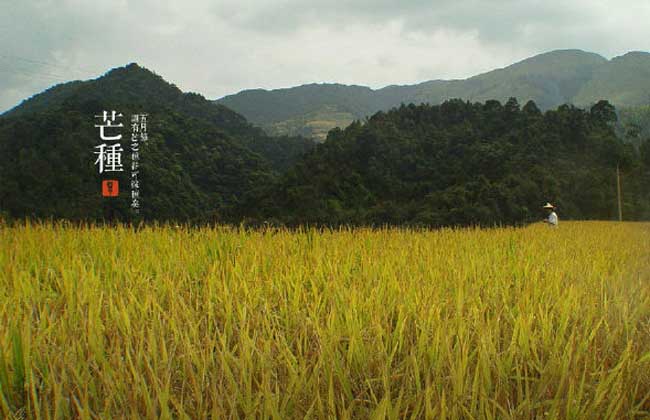
Mangzhong is the 9th of the 24 solar terms in the lunar calendar and the third solar term of summer, marking the official beginning of midsummer. Literally, it means "awned wheat should be harvested quickly, awned rice can be planted." At this time, the middle and lower reaches of the Yangtze River in China enter the rainy plum rain season. Let's take a look below at what Mangzhong means!
What does Mangzhong mean?
The "mang" (awn) in Mangzhong refers to the harvest of awned plants such as wheat, and the "zhong" (seed) in Mangzhong refers to the season for sowing grain and millet crops. The two characters "mangzhong" are homophones for "busy planting," indicating that all crops are in "busy planting." Therefore, "Mangzhong" is also called "mang zhong" (busy planting) or "mang zhe zhong" (busy with planting), which is the sowing and broadcasting of farmers. The arrival of "Mangzhong" heralds the start of farmers' busy field life.
Mangzhong: "Busy" Planting in Various Regions
Mangzhong is a very busy solar term. In Shaanxi, Gansu and Ningxia it is said, "Mangzhong is busy, busy planting; at Summer Solstice the grain is with child." In Guangdong it is "Sow at Mangzhong, transplant at Great Heat (shi means transplanting plants)." In Jiangxi it is "Three days before Mangzhong the seedlings cannot be set; three days after Mangzhong the seedlings will not come out." In Guizhou it is "If you do not plant at Mangzhong, planting later is useless." In Fujian it is "Around Mangzhong, good to plant indica rice; after Mangzhong, good to plant glutinous rice." In Jiangsu it is "Transplant at Mangzhong and it is a treasure; transplant at Summer Solstice and it is a stalk of grass." In Shanxi it is "Mangzhong, mangzhong, plant everything." "At Mangzhong, hurry to plant millet and grain." In Sichuan and Shaanxi it is "Before Mangzhong, busy planting fields; after Mangzhong, busy planting beans." From the above farming activities it can be seen that by the Mangzhong solar term, all of China from south to north is busy planting, and the busy farming season has already reached its peak.
The Folk Culture of Mangzhong
1. Sending off the Flower God: On the Flower Festival on the 2nd day of the second lunar month, the Flower God is welcomed. By Mangzhong, it is nearly the fifth month, and the hundred flowers begin to wither and fall. Folk customs often hold ceremonies on the day of Mangzhong to sacrifice to the Flower God, offer a farewell feast to send the Flower God back to their place, and at the same time express gratitude to the Flower God and hope to meet again next year. This custom no longer exists today.
2. Anmiao: The Anmiao custom at Mangzhong is an agricultural custom activity in southern Anhui that began in the early Ming dynasty. Every Mangzhong season, after the rice has been planted, Anmiao sacrifice activities are held in various places to pray for a good harvest in autumn. Every household uses new wheat flour to steam buns, shaping the dough into the forms of the five grains and six domestic animals, melons, fruits and vegetables, then dyes them with vegetable juice, and uses them as sacrificial offerings, praying for an abundant harvest of all grains and the safety of the villagers.
3. Mud Slinging Fight: Among the Dong young men and women in the southeastern part of Guizhou, a Mud Slinging Fight Festival is held around Mangzhong every year. On that day, newlywed couples are accompanied by close young men and women, transplant rice seedlings together, and while transplanting they play and throw mud at each other. At the end of the activity, the results are checked, and the person with the most mud on their body is the most popular person.
4. Boiling Plums: In the south, May and June each year are the season when plums ripen. During the Three Kingdoms period there was the allusion of "warming green plums over wine to discuss heroes." Green plums contain a variety of natural high-quality organic acids and rich minerals, and have unique nutritional and health functions such as purifying the blood, regulating the intestines, lowering blood lipids, eliminating fatigue, beautifying the skin, regulating acid-base balance, and enhancing human immunity. However, fresh plums mostly taste sour and astringent and are difficult to eat directly; they must be processed before they can be eaten, and this processing is boiling plums.