What Does the Xiaoman Solar Term Mean? Understanding the Meaning of Xiaoman in One Article
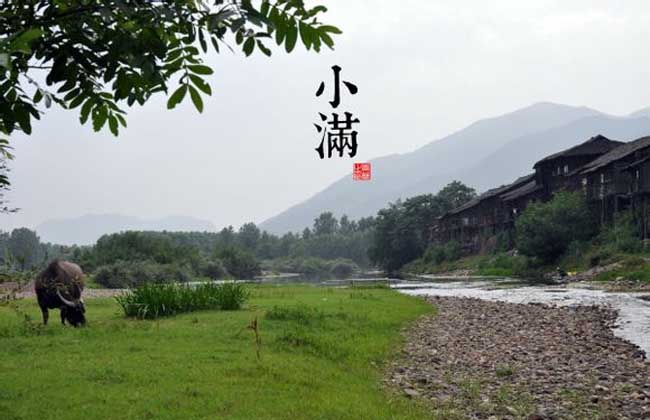
Xiaoman is one of the 24 solar terms and the second solar term of summer. Its meaning is that the grains of summer-ripening crops begin to fill out plumply, but have not yet matured - it is only "small fullness," not yet "great fullness." Every year between May 20 and 22, when the sun reaches the celestial longitude of 60 degrees, it is Xiaoman. Let us take a look below at what the Xiaoman solar term means!
The Origin of the Xiaoman Solar Term
According to the "Collection of Explanations of the Seventy-Two Pentads of the Monthly Ordinances": "In mid-fourth month, Xiaoman means that things have reached this point of small fullness." At this time, the grains of wheat and other summer-ripening crops in the northern regions of the country have begun to fill out, but are not yet mature, roughly equivalent to the late milk-ripening stage, hence it is called Xiaoman. Agricultural proverbs in the southern regions give Xiaoman a new meaning: "If Xiaoman is not full, the field ridges dry and break," and "If Xiaoman is not full, Mangzhong pays no heed." Here "fullness" is used to describe the abundance or scarcity of rain, indicating that if the fields cannot store enough water at Xiaoman, it may cause the field ridges to crack from dryness, and even at Mangzhong it may be impossible to transplant rice.
The Climatic Characteristics of Xiaoman
1. Southern regions: "Xiaoman full, great fullness full, rivers full" reflects the climatic characteristics of abundant and heavy rainfall in this region. Generally speaking, if at this time cold air from the north can penetrate deep into the more southern regions of our country, and the warm, humid air currents from the south are also strong, then it is very easy to cause rainstorms or extraordinary rainstorms in the South China area. Therefore, the later period of the Xiaoman solar term is often an intense period for flood control in these regions.
2. Middle and lower reaches of the Yangtze River: "If it does not rain at Xiaoman, the yellow plum rains will be rather scant," and "If there is no rain at Xiaoman, there will be no water at Mangzhong." For the middle and lower reaches of the Yangtze River, if rainfall during this period is rather low, it may be that the subtropical high pressure over the Pacific Ocean is weaker in strength and positioned farther south, meaning that when the yellow plum rain season arrives, precipitation may be rather low. Therefore, there is a folk proverb that says, "If it does not rain at Xiaoman, the yellow plum rains will be rather scant," and "If there is no rain at Xiaoman, there will be no water at Mangzhong."
3. Middle and lower reaches of the Yellow River: "If Xiaoman is not full, the wheat faces a risk." During the Xiaoman solar term, the saying "If Xiaoman is not full, the wheat faces a risk" still circulates in the middle and lower reaches of the Yellow River and other areas. This "risk" refers to the fact that wheat has just entered the milk-ripening stage at this time and is very susceptible to damage from dry hot winds, which leads to insufficient grain filling, shriveled grains, and reduced yield. There are many methods to defend against dry hot winds, such as building protective forest belts and spraying chemical agents, all of which are very effective measures.
4. Jiangnan region: "At Xiaoman the three carts move, so busy there is no time for anything else." The three carts here refer to the water cart, the oil cart, and the silk cart. At this time, the crops in the fields need abundant moisture, so farmers busy themselves treading the water cart to lift water. The harvested rapeseed also awaits the farmers to hull and pound it into fragrant rapeseed oil. The farm work in the fields naturally cannot be delayed. But the silkworms at home also need careful tending. Around Xiaoman, the silkworms begin to spin cocoons, and silkworm-raising households are busy working the silk reel to reel silk. The "Qingjia Lu" records: "When Xiaoman first arrives, the silkworm women boil the cocoons, prepare the reels and reel silk, working day and night." It can be seen that in ancient times, during the Xiaoman solar term, new silk was about to come onto the market, and the silk market was about to flourish. Silkworm farmers and silk merchants were all full of expectation, waiting for the day of harvest to arrive quickly.
In addition, during the Xiaoman solar term, the rivers and lakes in the Jiangnan region are often full. If they are not full, it must be a year of drought and little rain. There are many proverbs in this regard. For example, Anhui, Jiangxi, and Hubei provinces have the saying "If Xiaoman is not full, there is no water to wash dishes," Guangxi, Sichuan, Guizhou and other regions have the agricultural proverb "If Xiaoman is not full, the field ridges dry and break," and Sichuan Province also has the saying "If it does not rain at Xiaoman, the plow and harrow hang high." The word "full" here does not refer to plump crop grains, but rather means abundant rain.
Agricultural Work During the Xiaoman Solar Term
1. Wheat-producing areas: At this time, it is advisable to promptly carry out pest control in wheat fields and prevent damage from dry hot winds and sudden thunderstorms, strong winds, and hail. In the south, it is advisable to promptly carry out topdressing and weeding of rice, and seize sunny days to harvest, thresh, and dry summer-ripening crops. During this period, attention must be paid to watering the "wheat-yellowing water" well, and to promptly carrying out pest control in wheat fields to enhance the growth vigor of the wheat. At the same time, effective windproof measures should also be taken to prevent damage from dry hot winds and sudden thunderstorms and strong winds.
2. Rice-producing areas: Because "at Lixia and Xiaoman it is exactly time to transplant seedlings," and "seedlings rush to Xiaoman, grain rushes to autumn," Xiaoman is precisely the season suitable for rice transplanting. Whether the summer drought in South China is severe or not is directly related to the amount of rice transplanting area, and the timing of transplanting is closely related to the level of rice yield per unit area. Central and western South China often experience winter dryness and spring drought, and heavy rains arrive relatively late. In some years, heavy rains do not arrive until June, and at the latest may even be delayed until July. In addition, in ordinary years, rainfall during the Xiaoman solar term is not plentiful, averaging only about 40 mm. Natural rainfall cannot satisfy the water demand for transplanting rice seedlings, making summer drought in central South China, where water sources are lacking, even more severe.
3. Vegetable farming
①Continue to strengthen the cultivation management of greenhouse crops, pay attention to ventilation and air exchange, especially after rain clears, remove the film promptly, and reduce the temperature and humidity inside the greenhouse. At the same time, pay attention to strengthening disease and pest control.
②Do a good job in the cultivation management of open-field vegetables and melons and fruits, carry out timely topdressing, intertillage and weeding, and disease and pest prevention and control.
4. Fruit tree farming
①Citrus: Continue to do a good job in flower and fruit preservation and disease and pest control, with the focus on scab disease, resin disease (black spot disease), and pests and diseases such as red spider mites, scale insects (arrowhead scale), and leaf roller moths. Pay attention to drainage to prevent waterlogging damage and soil erosion.
②Bayberry: Continue to focus on management centered on fruit preservation and pest control. Thin fruits at the appropriate time to overcome alternate bearing. The standard for fruit thinning is generally: out of every 6 fruiting branches, keep 3 fruiting branches and thin out 3, and for the 3 remaining fruiting branches, keep 2 fruits per branch. For disease and pest control, refer to the previous solar term.
5. Livestock farming
①If production requires it, specialized rabbit-raising households can still breed one more litter around Xiaoman, which can ensure that the young rabbits pass the summer safely. It is necessary to maintain a dry environment in the rabbit hutch, and first of all, do a good job in cleaning and hygiene in the rabbit hutch.
②Strengthen the planting of summer forage grass (Mexican corn, forage sorghum).
③Continue to strengthen the work of eliminating mosquitoes and flies, and deworming agents should be added to the feed.
④Continue to prevent the occurrence of Japanese encephalitis, parvovirus disease, and allergic dermatitis.