How do succulent leaf cuttings sprout? Bury the growth point in the soil and new roots grow faster
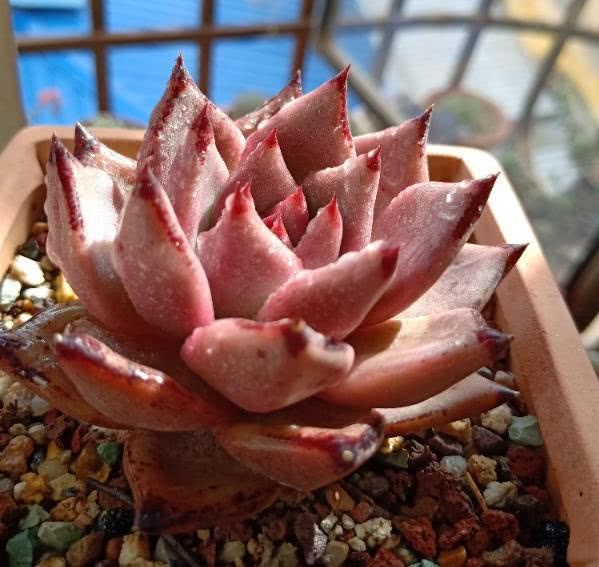
Succulent leaf cutting propagation: for succulent varieties that can grow shoots from leaves, leaves of varieties with very small leaves, such as Sedum hispanicum and Sedum anglicum, generally cannot be propagated by leaf cuttings but by stem cuttings. For varieties with relatively thin leaves like Aeonium arboreum 'Zwartkop', the success rate of leaf cuttings is very low. So usually, the leaf characteristics suitable for leaf cuttings are mainly thick leaves and large leaves. To pull off a leaf, pinch it with your hand and then twist it in a circle, and the leaf will naturally come off intact. Many beginners mistakenly think that leaf cutting means inserting the base of the leaf vertically into the soil. This idea is completely wrong. True leaf cutting means laying the leaf flat on the soil, with the upturned part of the leaf facing up, imitating as much as possible the situation of leaves falling in the wild.
Succulent leaf cuttings are actually quite casual, with not that many rules and requirements. Apart from differences in seedling emergence rates caused by variety differences themselves, most failed leaf cuttings end in one of three things: drying up, turning to mush, or black rot. On the contrary, those leaf cutting seedlings that are neglected actually have a decent survival rate. The soil we commonly use for leaf cuttings and sowing is mostly a fine granular mix of vermiculite, peat, coconut coir, perlite, etc. This makes many flower lovers assume that the care methods for leaf cuttings and sowing are similar. This is a rather big misconception.
The middle leaves are relatively plumper and fuller than the leaves in the lowest ring. These leaves are equivalent to the middle age of humans, the most mature leaves. With sufficient nutrients and thick leaves, they can withstand the long test of time and nutrient consumption of leaf cuttings, and generally sprout the fastest and best. Before breaking off leaves, it is best to withhold water from the succulent for a few days. When the leaves are dehydrated to a certain extent, that is the best time to break them off. As shown in the picture above, it is best if the leaf visibly deforms with a gentle pinch. If the leaf used has curled up, the growth point of such a leaf is not easy to contact the soil medium, and if it grows roots but cannot enter the soil, it will consume the leaf's nutrients greatly.
Succulent leaf cuttings only sprout but do not grow roots? For leaf cuttings that only grow roots without growing leaves, or only grow leaves without growing roots, it is easy to cause a multi-headed phenomenon. In addition, growing roots first and then sprouting seedlings also tends to produce a single head. Generally speaking, as long as the leaf piece is not dry, it will sprout, so rest assured. You might as well gently bury it with soil, water it a little appropriately, and in a bright, indirectly lit, ventilated environment keep the soil slightly moist, and the leaf will grow out before long. For the situation of only growing leaves without growing roots, some flower lovers say you can sprinkle some rooting powder, and then the roots will grow within a few days. Regardless of whether the leaf has grown roots, first bury the growth point into the soil, but do not bury it too deep, 2 to 3 mm from the soil surface is enough.
Should succulent leaf cuttings be given sun? The thinner the leaves of the variety, such as Sedeveria 'Pink Granite', the more it needs to avoid strong light; the thicker the leaves of the variety, such as Pachyphytum 'Momobijin', the lower its requirement for light intensity. By the same principle, the longer a variety takes to sprout, the more it must avoid harsh sun exposure, such as varieties like Graptoveria 'Titubans'. Regarding succulent leaf cuttings, the external growing environment is very important and determines the time for seedling emergence and root growth, so everyone should not be impatient and can wait a while to see how things go. For daily care, it is best to give some soft sunlight in the morning. If the sun is scorching, it is best to add some sun protection measures. For example, I place the little ones together with the big succulents, letting them cool off beside the large succulents.
Mixed planting of young succulent plants can have unexpected effects. The small succulents will grow plumper and larger than usual, and their growth rate is also relatively faster; perhaps they compete with each other. If the leaf of a leaf cutting turns black, it is recommended to carefully loosen the soil with a toothpick, lift the whole thing up to look, and if against the light the leaf is black or the back has very ugly, wrinkled folds, it is a sign of turning to mush. During the transition period, the soil should be as loose as possible to facilitate root growth; vermiculite is recommended. There are more mosquitoes and insects in summer. I now use vermiculite for rooting and rainbow stone as top dressing, so the soil below is soft and suitable for root growth, while the soil surface is relatively dry, making it hard for insects and such to lay eggs.
This is a gathering place for succulent lovers, sharing succulent care tips. Welcome to follow and exchange ideas.