Green plum blossoms fall like swirling snow, and the fallen petals, brushed from the car, soon cover it again.
Have you encountered a scene like this lately: in the morning, as you get ready for work and walk to your car (parked outdoors), you find the roof and the front and rear windshields covered with tiny, milky-white petals, and at the same time, the air carries a sweet, slightly stuffy fragrance.
This is Elaeocarpus. In this season, every Elaeocarpus tree is uniformly covered in a massive profusion of tiny flowers, filling the air with fragrance and keeping bees and flies busy.
Elaeocarpus is one of the main street trees in Chongqing and can be seen everywhere. To be precise, the one used for urban landscaping is a species in the genus Elaeocarpus of the family Elaeocarpaceae, with the scientific name Elaeocarpus glabripetalus, named because the outside of the petals is hairless. Such a common tree has such a tongue-twisting name that even now I am still not quite used to it. Unless otherwise specified, the Elaeocarpus discussed below refers to this species.
One of the main street trees in Chongqing
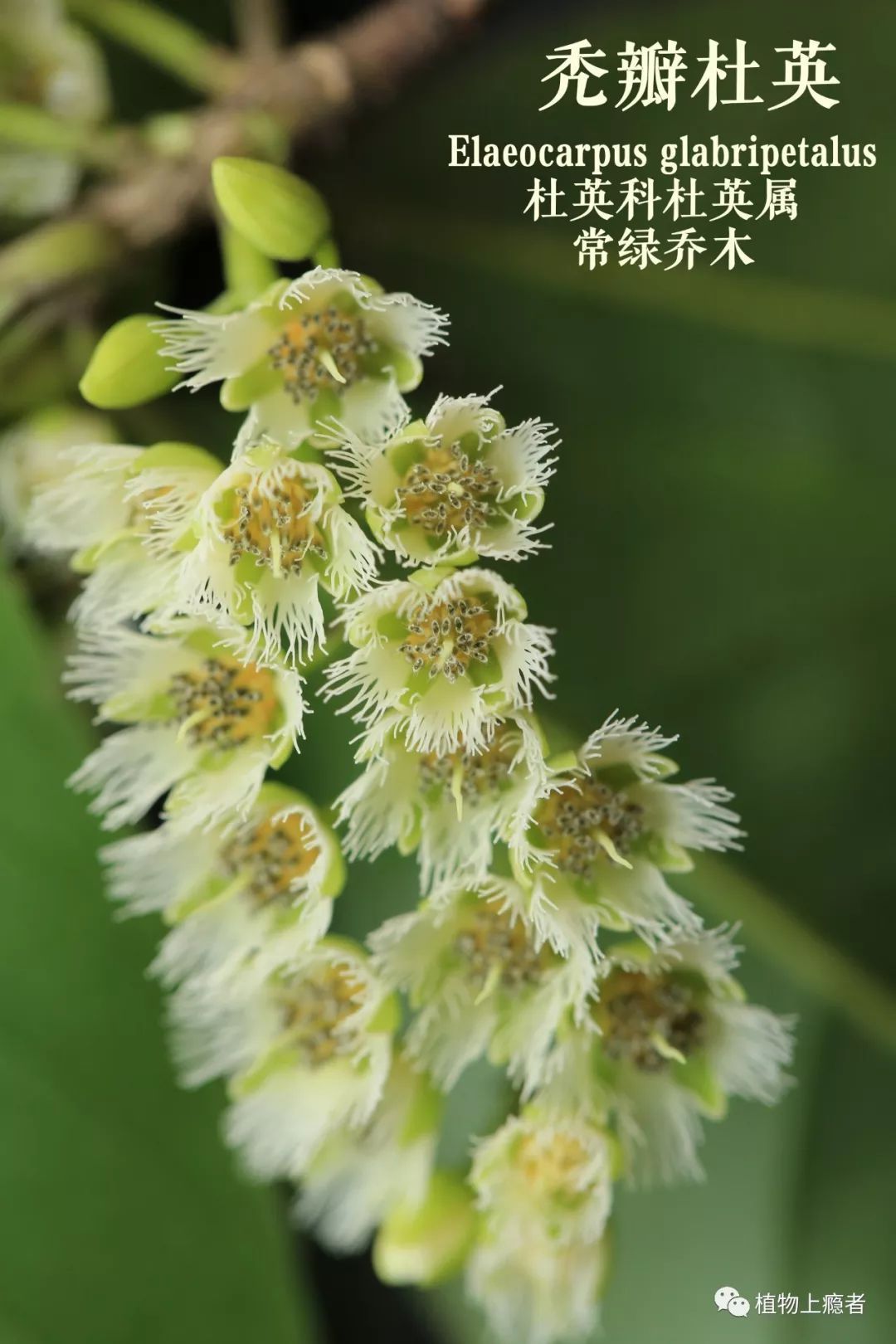
It is currently in bloom, and the first striking impression of Elaeocarpus is that it has an enormous number of flowers. The racemes are positioned in a particularly unusual way: neither terminal nor axillary, but growing out from bare branches, like little brushes. Each pale green little flower resembles a green plum blossom, except that the structure of Elaeocarpus is far more complex and intricate than that of plum blossoms.
Raceme
5 petals, the upper half torn into fringed strips
Petals hairless, hence the name glabripetalus
Each small Elaeocarpus flower has 5 milky-white petals and 5 green sepals, alternating with one another. Most distinctive is that the upper half of the petals is torn into fringed, slender strips, adding a touch of luxury to the otherwise plain little flowers.
The small Elaeocarpus flowers usually hang downward when in full bloom, but if you linger under the tree for a moment, you will see many bees and flies pouncing on the little flowers in the posture of hanging fuchsias. Not surprisingly, just like the Cayratia japonica written about last time, Elaeocarpus also has an orange-red floral disc, disc-shaped and very similar in form to a plum blossom. The stamens are densely inserted on the floral disc, like seedlings sown in a fertile rice paddy.
Bees and flies enjoying a feast
The floral disc is orange-red, and the tip of the anther has a tuft of hairs
The flowers you see are only the winners that made it through the auditions. The number of Elaeocarpus flower buds far exceeds the number that bloom, and a considerable portion of them drop before ever opening. They hang on the branches for a long time. During May and June, watching these buds sprout like millet grains and then grow into small green pendants is also a pleasant sight.
The buds are also very attractive
In autumn, the fruit of Elaeocarpus ripens. Have you ever noticed? The fruit is oval, quite similar to the "guizi" borne by osmanthus trees, and also like an olive (Note 1). I measured it, and the length of each fruit does not exceed 2 cm. Only then could I confirm that it is Elaeocarpus glabripetalus. To confirm its identity, I waited almost half a year.
Fruit oblong, no more than 2 cm long
Since I got to know Elaeocarpus, I have always liked this tree. It is an evergreen arbor, accompanying us through all four seasons, seen everywhere whether looking down or looking up, and it feels especially familiar.
Among a bunch of evergreen street trees, Elaeocarpus glabripetalus has an exclusive identifying mark: on every branch, there are always one or two red leaves. It is said that this is because some new leaves, under the influence of low-temperature frost, have their chlorophyll converted into anthocyanins. These red leaves often fall alone, landing on the road surface or hedges, and for some reason, I always enjoy collecting them.
Photographed on April 2, 2018
In the city, Elaeocarpus glabripetalus has also experienced the ups and downs from great popularity to being largely neglected. More than ten years ago, it became an internet-famous tree and was widely used in municipal landscaping in various cities. However, people overlooked that its habits do not suit exposure to scorching sun. Many Elaeocarpus glabripetalus used as street trees had their bark split from sunburn by the second or third year, grew poorly, or even died. The saying that "Elaeocarpus is delicate and precious" spread far and wide, and the price of seedlings plummeted.
Now, with accumulated experience, more and more landscape professionals are beginning to understand the habits of Elaeocarpus glabripetalus, knowing that planting and maintenance should avoid the western sun, or that planting it on the east side of buildings as a street tree is also very good. See, understanding is true love.
Photographed on November 3, 2017
Bonus
"Is what I photographed Elaeocarpus glabripetalus?"
Friends often send photos asking this question, and I always answer: "Very similar, possibly, haha."
Because according to the materials, in regions such as Southwest China, South China, and East China, the species most used for urban landscaping is currently Elaeocarpus glabripetalus. So even guessing blindly, the probability of being correct is very high.
But the genus Elaeocarpus has 360 species, and China has about 40. What if you are lucky enough to photograph a very similar Elaeocarpus sylvestris or Elaeocarpus chinensis? Southern cities have also begun using these species for landscaping.
In addition to the features mentioned above, here are 2 more details, and you can judge for yourself. Not difficult, right?
1. Observe the leaf shape. The leaves of Elaeocarpus glabripetalus are obovate-lanceolate or oblanceolate, with shallow obtuse serrations along the margin, and very short petioles. There are no black glandular dots on the back of the leaf, and about 8 pairs of lateral veins.
2. Look at the young branches. They have obtuse ridges and are hairless.
Note 1:
The scientific name of Elaeocarpus glabripetalus looks complex, but broken down it becomes simple, showing two features of this species: the genus name Elaeocarpus is composed of the Greek roots elaion, meaning olive, plus karpus, meaning fruit, so it means "fruit shaped like an olive." The species epithet glabripetalus is composed of glabri, meaning hairless, plus petalus, meaning petal, meaning petals are hairless.
The article and plant photos (unless otherwise credited) are all original by the author
If you like it, please share. Thank you for your support.
Plant Addict
WeChat ID: plantfiend
Discover the unique beauty of every plant