How Smart Is an Octopus Really? Uncovering the Intelligence Level of Octopuses
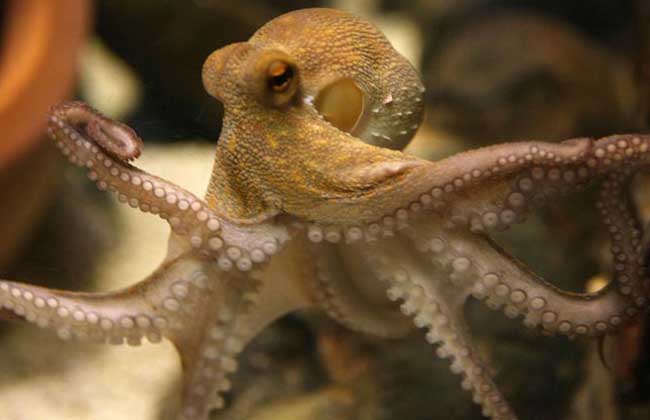
The octopus is also known as the eight-armed octopus, stone dweller, dead cow, and so on. It does not belong to the fish family; it is the collective name for animals of the genus Octopus in the family Octopodidae. It is considered the most intelligent of the invertebrates and one of the creatures that have ever appeared on Earth that differ most from humans. It is widely distributed in tropical and temperate seas around the world. Let us take a look below at just how smart an octopus really is.
Are Octopuses Highly Intelligent?
Octopuses are highly intelligent. An octopus has 500 million neurons in its brain, and its body also has some very sensitive chemical and tactile receptors. This unique neural structure gives it a thinking ability beyond that of ordinary animals. Through gene decoding, scientists have found that the octopus possesses a set of genes similar to those of humans, which enables it to build neural networks. This explains why octopuses have learning ability. Like humans, octopuses also have a fairly large brain, a closed circulatory system, and a pair of eyes equipped with an iris, a retina, and a lens.
Manifestations of the Octopus's High Intelligence
Jim Cosgrove, an expert who has studied octopuses for many years, pointed out that octopuses possess "conceptual thinking" and can solve complex problems on their own. It is precisely this ability that gives them the skill of walking on two legs. In order to avoid being killed by "predators," octopuses not only use the mimetic camouflage and the self-amputation of a "arm" to save themselves, which we are familiar with; American scientists also discovered "highly intelligent" octopuses in the Indian Ocean that use two legs to "walk" to escape.
Christine Huffard of the University of California, Berkeley, and her research team filmed an octopus called Margined Octopus in the tropical waters of Indonesia. It is about the size of an apple. When facing danger or encountering a diver, this octopus curls and folds six of its eight "arms" upward to make itself look like a coconut shell, while the remaining two "arms" stand on the seafloor and stealthily move backward, like a little moving coconut, escaping by walking backward with straddling steps. Its posture is quite comical.
There is also a walnut-sized octopus, the Aculeatus Octopus, that also walks on two legs, but its other six legs stretch outward to mimic the appearance of seaweed. The research team found that walking on two arms is much faster than using all eight arms. The former's top speed is about 0.14 meters per second.
Octopus Intelligence Test Experiments
Scientists once conducted an intelligence test on an octopus named McPhee, with the aim of finding out whether octopuses can form stable conditioned reflexes. McPhee was busy building a new home. It picked together many pieces of broken glass and stones that people threw to it and built a defensive wall. The construction work was carried out at night, and by morning a transparent house had been built. Behind the crystal wall piled up from thousands of reflective glass fragments, McPhee sat perched high. From all indications, it was quite satisfied with its masterpiece.
That said, the octopus did not know that glass is transparent. They choose materials by touch; anything hard will do. This is instinct, not wisdom prompting the octopus to drag the broken glass into its den. Obviously, a dwelling built of glass to block the eyes of the curious is not much better at covering the body than the "emperor's new clothes."
After letting McPhee go hungry for a few days, the next experiment began. A glass cylinder containing a crab was taken and placed into the crystal palace where the octopus lived. Its greedy eyes were fixed on the prey without looking away for a moment. One after another, its arms reached out from behind the sharply protruding glass wall, "then suddenly drew back and with a plop bumped against the glass cylinder. Although it was only a short distance away, the glass separated them, so it could not achieve its goal.
McPhee squirmed, vainly trying to catch the crab that made its mouth water and was right before its eyes. Out of irritation, its skin color kept changing. It could not judge that it only needed to climb 30 cm up along the glass cylinder to smoothly enter through the upper opening and reach the crab's hiding place. However, McPhee's greedy gaze could not leave the prey, and according to the rule that a straight line is the shortest distance between two points, it stubbornly kept attacking the crab.
The futile attacks continued for a long time. By chance, one arm reached the edge of the glass cylinder, and the tip of the arm entered the cylinder. At once McPhee changed tactics, turned its arm into the glass cylinder, and unswervingly stretched it toward the crab, while its whole body climbed upward along with it. At the instant the arm touched the crab, it suddenly shrank back again, and immediately afterward McPhee shot into the cylinder like a rocket and seized the crab. It seems the tip of the arm sensed the taste of the crab, so that the blind led the sighted.
Of course, by this time McPhee already knew completely how to get the crab through the glass. One time was enough for the octopus to form a conditioned reflex in the brain center. Unfortunately, it could not learn from the lesson and overcome the unnecessary detour. Instead, it could only repeat the entire process of the first time accurately and without error: first rushing at the glass cylinder in an attempt to seize the crab through the glass, and only then following its arm in through the upper opening.
Under the same conditions, the octopus's intelligence is much higher than that of the squid. When scientists experimented on a squid, they placed a small shrimp in a glass jar without a lid, but the squid kept bumping its head against the glass jar for 30 hours and never thought of adopting even a little indirect strategy. A few days later, after McPhee had achieved results that its ten-armed relatives could hardly understand, with excellent performance, people carried out a more complex experiment and covered the cylinder containing the crab with a piece of glass. However, the arm, which already had some understanding of the route, overcame this obstacle without much difficulty.
After several unsuccessful attempts, the arm finally found the small gap between the bottle and the glass lid, lifted the lid open, and the octopus then squeezed in as well. After stopping for 7 days, people repeated the original experiment, and McPhee still retained the correct method it had learned a week earlier. But the squid forgot entirely, after 18 hours, the method of foraging through glass. Clearly, among the members of the cephalopod mollusk family, intelligence is not the same for all; nature endowed the octopus with the strongest ability.